Latest
The day's market news, with the argument attached
New notes every trading day on earnings, policy and market structure. Each one opens with the conclusion, then the evidence, then the companies it hits.
2026-08-28
%22%2F%3E%0A%20%20%3Ccircle%20cx%3D%22220%22%20cy%3D%22150%22%20r%3D%22180%22%20fill%3D%22%2322d3ee%22%20fill-opacity%3D%220.12%22%2F%3E%0A%20%20%3Ccircle%20cx%3D%221010%22%20cy%3D%22130%22%20r%3D%22220%22%20fill%3D%22%2338bdf8%22%20fill-opacity%3D%220.08%22%2F%3E%0A%20%20%3Ccircle%20cx%3D%22920%22%20cy%3D%22520%22%20r%3D%22170%22%20fill%3D%22%2322d3ee%22%20fill-opacity%3D%220.06%22%2F%3E%0A%20%20%3Cpath%20d%3D%22M140%20430h920%22%20stroke%3D%22url(%23line)%22%20stroke-width%3D%2212%22%20stroke-linecap%3D%22round%22%2F%3E%0A%20%20%3Cpath%20d%3D%22M220%20360c120-150%20260-220%20380-220s260%2070%20380%20220%22%20fill%3D%22none%22%20stroke%3D%22%2367e8f9%22%20stroke-opacity%3D%220.5%22%20stroke-width%3D%2216%22%20stroke-linecap%3D%22round%22%20stroke-linejoin%3D%22round%22%2F%3E%0A%20%20%3Cpath%20d%3D%22M300%20398h600%22%20stroke%3D%22%2394a3b8%22%20stroke-opacity%3D%220.24%22%20stroke-width%3D%228%22%20stroke-linecap%3D%22round%22%2F%3E%0A%20%20%3Ctext%20x%3D%22220%22%20y%3D%22510%22%20fill%3D%22%23e2e8f0%22%20fill-opacity%3D%220.7%22%20font-family%3D%22Arial%2C%20Helvetica%2C%20sans-serif%22%20font-size%3D%2238%22%20letter-spacing%3D%228%22%3EINSIGHTS%3C%2Ftext%3E%0A%3C%2Fsvg%3E)

OCC moves to make bank enforcement timing and penalties more predictable—raising the “compliance cost” signal for regional banks
On Aug. 27, 2026, the Office of the Comptroller of the Currency (OCC) announced revised policies and procedures aimed at improving transparency and consistency in bank enforcement and supervisory standards. The key investor takeaway is that—if the new framework tightens how “violations” and “unsafe or unsound” determinations translate into supervisory actions—regional banks should face a more consistent compliance-cost distribution and less uncertainty around M&A approval timelines.

Pasqal’s Nasdaq debut turns “quantum second wave” into a cash-and-capex test
Pasqal’s Nasdaq go-public deal with Bleichroeder values the neutral-atom pure-play at a roughly $2.0B pre-money with ~$500M gross proceeds to the company, giving the market a concrete pricing benchmark for deep-tech hardware beyond the AI complex. Using IonQ’s reported cash burn and revenue scale as a yardstick, the question for investors is less “who wins quantum,” and more whether Pasqal can turn a cash runway into commercialization that outgrows burn before the public-market IPO window tightens further.

PayPal’s buyout collapse vs. Stripe’s “platform value”: the deal math implies the market was already discounting PayPal’s standalone turnaround
The reported $53B Stripe–Advent bid reportedly unraveled abruptly, triggering a sharp ~12% one-day drop in PayPal. The bigger lesson isn’t just deal-break risk; it’s what the bid premium versus the post-collapse valuation implies about how much “independent” earnings recovery the market will pay for—without a buyer underwriting the turnaround.

PhRMA’s Medicare-negotiation bid just failed—IRA drug price cuts shift from legal risk to a permanent revenue-mix problem
On Aug. 27, 2026, the U.S. Court of Appeals for the Fifth Circuit upheld the Medicare Drug Price Negotiation Program after PhRMA’s legal challenge was rebuffed. That outcome turns IRA-negotiated Part D pricing into a durability factor investors must underwrite: revenue now depends on how much of each company’s U.S. demand sits inside the negotiated “maximum fair price” lane (and how aggressively launches and contract structures adapt).

Qantas's premium momentum is the “best case” Delta and United are trying to price in—if fuel and fares don’t reprice first
Qantas reported FY26 profitability pressure while still pointing to premium strength and rolled out another layer of business-class product refresh on Aug 27, 2026. The investor takeaway for US airlines is not that premium demand is immune to cost shocks, but that the premium-cabin demand signal can partially offset fuel and rate risk—if carriers keep monetizing higher-yield long-haul seats faster than costs reset.
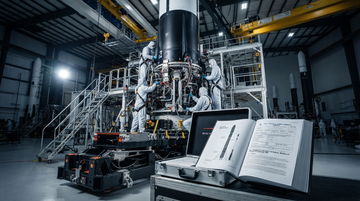
Rocket Lab's COO sold into the space rally—and the bigger tell is why it likely wasn’t a “no” on Neutron
Rocket Lab’s COO, Frank Klein, sold 45,692 shares for about $3.18M on Aug. 26, 2026, according to his Form 4. While insider selling can be a red flag at valuation extremes, Rocket Lab’s own filings show Neutron’s targeted first launch remains in Q4 2026—suggesting the trade fits a tax/plan-driven pattern more than a fundamental vote of no confidence.
SEC’s Aug. 27 fake-adviser sweep shows the “registration-backdoor” is the real compliance bill—legal, platform and custody workflows get more expensive fast
On Aug. 27, 2026, the SEC charged 38 entities with making material misrepresentations in SEC Forms ADV to feign legitimacy as U.S. advisers and lure retail investors. The read-through for investors: the enforcement mechanism targets the RIA registration/compliance layer—raising the expected cost of onboarding, monitoring, and “custody-ready” diligence across legitimate advisers, retail platforms, and the finfluencer/AI-adviser scam supply chain.

Socure’s $156M strategic growth round bets that “defensive AI” will win the KYC arms race—right as AI fraud accelerates
Socure’s Aug. 27, 2026 $156M strategic growth investment—paired with an acquisition of agentic fraud operations platform Fravity—explicitly funds a shift from legacy identity checks to AI-driven, feedback-loop fraud investigations. The company is also reporting strong operating traction, including $364M total ARR in Q2 2026, suggesting spend is being pulled forward by rising alert and fraud workload rather than only by compliance budgets.
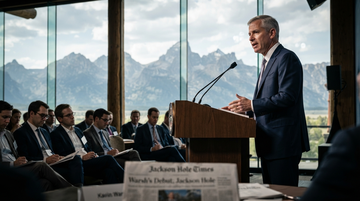
Warsh’s Jackson Hole keynote meets a 4.69% long end—does the new Fed chair validate hawkish term pricing, or hand Sept cuts a path?
Kevin Warsh delivers his first Jackson Hole keynote on Aug. 28, 2026—just 19 days ahead of the Sept. 16 FOMC meeting. With the Treasury executing a larger long-dated buyback framework starting Sept. 9 and policy still set to keep the interest rate paid on reserves at 3.65%, the speech’s signaling matters more than its words: it can either reinforce hawkish long-end term premia or loosen the market’s September-cut pricing impulse.
2026-08-27

Grid-to-GPU’s new bottleneck isn’t transformers—it’s who can schedule switchgear, UPS and interconnection fast enough to hit data-center deadlines
AI capex is colliding with power-delivery realities that don’t clear on silicon lead times. The result: switchgear-to-UPS-to-interconnection becomes the scheduling choke point where long backlogs, constrained commissioning windows and utility bottlenecks convert into multi-quarter project deferrals and pricing power for a narrow set of electrical-equipment suppliers.
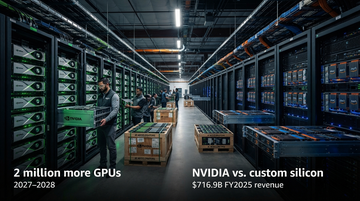
Amazon turns 2M more NVIDIA GPUs into a supply-chain signal—while AWS Trainium argues the “Nvidia-only” story is incomplete
Amazon’s expanded AWS partnership adds 2 million more NVIDIA GPUs for delivery in 2027–2028, the clearest hyperscaler “yes” to the AI capex cycle that aligns with NVIDIA’s recently reiterated ~70% FY2028 revenue-growth framing. But the same expansion exists alongside AWS’s continued scaling of Trainium, meaning the order book can strengthen Nvidia demand while still reshaping how much incremental compute ends up being “Nvidia GPUs vs. custom silicon.”

Anthropic’s $45B Nscale compute lock-up shifts AI capex risk onto infrastructure tenants—whether Nvidia demand becomes visible or not
Reports say Anthropic has agreed to spend about $45B to rent AI computing power from Nscale for a planned West Virginia AI campus. If that deal is sized around hundreds of megawatts of AI-ready capacity, it effectively converts “where do we build?” into “who funds and guarantees utilization?”—with NVIDIA capturing the install-base certainty while cloud platforms and servers face the downstream utilization risk.

AstraZeneca and Amgen's Tezspire win in EoE tests whether the ‘late-stage discount’ finally flips on a GI bellwether
AstraZeneca and Amgen say Tezspire (tezepelumab) delivered positive Phase 3 results in eosinophilic oesophagitis (EoE), meeting co-primary endpoints at Week 24 in the CROSSING trial and sustaining improvements through Week 52. The investor question is not just efficacy—it’s whether a confirmed late-stage readout in a Dupixent-adjacent GI indication meaningfully reduces the pipeline execution risk that has recently pressured AstraZeneca’s growth narrative.
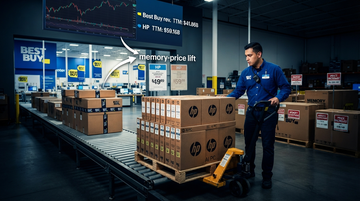
Best Buy “computing strength” looks real, but memory-price lift can fool the retail tape
Best Buy’s earnings showed strength tied to “computing,” yet the same period’s broader hardware pricing pressure implies a big share of the sales lift could be margin-neutral price passthrough rather than true AI-PC unit acceleration. Meanwhile, HP isn’t confirming an AI-PC demand inflection with its shipment mix, raising the odds that consumers are upgrading into higher memory costs—not because AI PCs are pulling-forward usage.

TD, RBC and CIBC’s same-morning Q3 results turn Canadian majors into a North American credit “vitals check” — TD’s US retail PCL is the signal
With TD, RBC and CIBC reporting fiscal Q3 on the same morning, the trio delivered a near-simultaneous read on credit health across Canadian and U.S. consumer/mortgage exposure. TD’s U.S. Banking credit losses and implied annualized PCL rate act as the swing input for how investors should price near-term U.S. consumer and mortgage risk as Canadian demand cools.
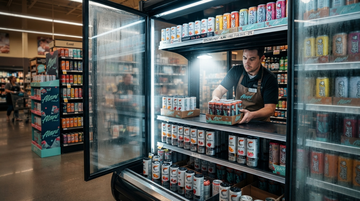
Celsius proves “better-for-you” can still steal energy-drink growth—yet its base brand is shrinking, and margins are taking the hit
Celsius posted Q2 results showing the category’s “fizz” is losing ground inside the same energy shelf: its portfolio drove outsized dollar share and a large share of zero-sugar growth, even as the core CELSIUS brand revenue fell. The key investor question is whether growth is durable or just a mix shift—Q2’s margin compression and brand decline suggest it’s not a clean continuation, and that compounding depends on execution plus switching the retailer capital question from “cold vault access” to “repeat rate.”

China’s industrial profit growth hits a 7-month low—proof that deflation is squeezing export margins, not just output
China’s July industrial-profit growth cooled to the weakest pace in months, reinforcing a market that’s already questioning demand and pricing power. The signal matters for global cyclicals because margin pressure in China typically turns from “cheap supply” into “less export price support,” which can quickly reprice copper and steel-related demand expectations—while boosting the probability of Beijing stimulus as September approaches.
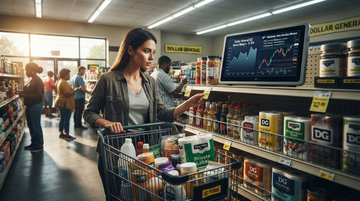
Dollar General’s Q2 FY2026 shows “trade-down” with margin help—but the Fed window is judging low-income strain in real time
Dollar General’s Q2 FY2026 print delivered stronger-than-prior-year traffic and a sharp gross-margin lift, turning consumer stress into earnings resilience. The trade-down story looks real in demand (traffic and ticket), but investors should watch whether the cost and inventory levers that boosted margins can stay intact as the September rate decision approaches.
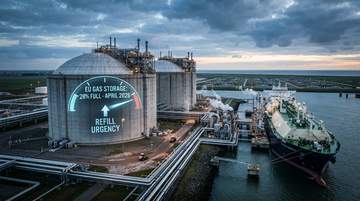
Europe’s depleted storage turns US LNG into the swing supplier for winter—and it can reprice the whole LNG value chain
Europe starts the 2026–27 winter with low underground gas in storage, forcing higher LNG refill urgency and making TTF price risk more likely to translate into a wider Atlantic price signal. If that winter tail risk materializes, US LNG exporters can capture a larger share of the swing margin as cargoes route where the arb (TTF vs. Henry Hub-linked supply costs) is widest.
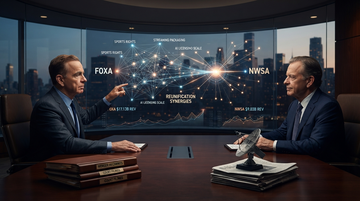
Court filings show Murdoch floated reuniting Fox and News Corp—now the sports-rights and AI-licensing scale question hits FOXA and NWSA
Unsealed court materials cited by Reuters say Rupert Murdoch contemplated reversing the 2013 split and re-merging Fox Corporation and News Corp, with Lachlan Murdoch’s side arguing such talks should remain redacted because a deal could still happen. If the market moves from “succession drama” to “deal mechanics,” the biggest investable swing will be how FOXA and NWSA value the combined leverage in sports rights, streaming packaging, and premium-news/financial-data licensing.
What to expect
Evidence-first notes with a visible point of view.
This section collects sharp takes on earnings, shareholder meetings, and market structure. Each new piece should make the thesis, the facts, and the implications obvious within the first few screens.
Expect direct analysis, not generic commentary.
Expect the data to be explicit and the argument to be easy to follow.
Plutux is not an investment adviser. Market data and AI-generated analysis are for information and education only, not investment advice. Disclaimer