Latest
The day's market news, with the argument attached
New notes every trading day on earnings, policy and market structure. Each one opens with the conclusion, then the evidence, then the companies it hits.
2026-09-07
%22%2F%3E%0A%20%20%3Ccircle%20cx%3D%22220%22%20cy%3D%22150%22%20r%3D%22180%22%20fill%3D%22%2322d3ee%22%20fill-opacity%3D%220.12%22%2F%3E%0A%20%20%3Ccircle%20cx%3D%221010%22%20cy%3D%22130%22%20r%3D%22220%22%20fill%3D%22%2338bdf8%22%20fill-opacity%3D%220.08%22%2F%3E%0A%20%20%3Ccircle%20cx%3D%22920%22%20cy%3D%22520%22%20r%3D%22170%22%20fill%3D%22%2322d3ee%22%20fill-opacity%3D%220.06%22%2F%3E%0A%20%20%3Cpath%20d%3D%22M140%20430h920%22%20stroke%3D%22url(%23line)%22%20stroke-width%3D%2212%22%20stroke-linecap%3D%22round%22%2F%3E%0A%20%20%3Cpath%20d%3D%22M220%20360c120-150%20260-220%20380-220s260%2070%20380%20220%22%20fill%3D%22none%22%20stroke%3D%22%2367e8f9%22%20stroke-opacity%3D%220.5%22%20stroke-width%3D%2216%22%20stroke-linecap%3D%22round%22%20stroke-linejoin%3D%22round%22%2F%3E%0A%20%20%3Cpath%20d%3D%22M300%20398h600%22%20stroke%3D%22%2394a3b8%22%20stroke-opacity%3D%220.24%22%20stroke-width%3D%228%22%20stroke-linecap%3D%22round%22%2F%3E%0A%20%20%3Ctext%20x%3D%22220%22%20y%3D%22510%22%20fill%3D%22%23e2e8f0%22%20fill-opacity%3D%220.7%22%20font-family%3D%22Arial%2C%20Helvetica%2C%20sans-serif%22%20font-size%3D%2238%22%20letter-spacing%3D%228%22%3EINSIGHTS%3C%2Ftext%3E%0A%3C%2Fsvg%3E)
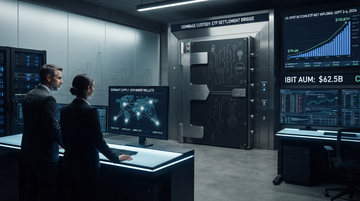
Seven Satoshi-Era Wallets Moved $28M of Bitcoin Last Weekend — and the 2026 ETF Rally Didn't Flinch
On September 6, 2026, seven dormant miner wallets from March 2010 each transferred a single 50 BTC coinbase reward — 350 BTC worth about $28 million at roughly $80,000 per coin — into fresh, unlabeled addresses, bypassing every major exchange. Over the same trading week US spot Bitcoin ETFs absorbed roughly $905 million in net inflows, with BlackRock's IBIT capturing 62% of the September 3 haul alone. The contrast is the answer to the original question: the2010 supply never met the 2026 demand, because Coinbase custody — sitting on more than $20 billion of ETF-held BTC for the majority of US spot Bitcoin ETF sponsors — sits between them.

Citi’s China Brokerage License Re-Entry Is a “Fee Wallet” Event—But the Stock May Still Be Underpricing the Friction Risk
Reuters reports Citigroup. expects approval for a wholly-owned mainland China brokerage business as soon as September 2026, enabling onshore A-share brokerage, underwriting, research, and principal trading. The move directly upgrades Citi’s China fee pipeline, but the same re-entry faces policy and execution frictions that can delay monetization, which helps explain why the market may not fully re-rate Citigroup yet.
Italy's \"Voluntary\" Bank and Energy Ask Hides a €1.5–2B Extraction — and US ADR Investors Should Care
Italy's deputy prime minister Antonio Tajani asked banks and energy firms on Sept. 4 to \"bring forward\" tax payments for the 2027 budget, framing it as a negotiated, voluntary extension of two prior sector accords. Underneath the label sits a third round of cash from a banking system that has already paid €1.2B more tax in H1 2026 versus H1 2025, an energy sector that funded the August fuel-excise extension on the same model, and a coalition split where Deputy PM Salvini is publicly pushing a harder 5%-of-profits levy. The trade for US-based holders of UniCredit and Intesa Sanpaolo ADRs is not whether Italy hits the sector again — it already has — but whether Rome's template migrates to Spain or France and turns a managed extraction into a peripheral-Europe spread event.
162K Jobs and a Trade Ultimatum: The September Fed Meeting Is Now a $1 Trillion Debt Showdown
The August payrolls surprise pushed Fed pricing toward a September hike at the same moment President Trump demanded cuts and floated halting trade with deficit countries. With $1 trillion in annual federal interest costs, the September 16 FOMC meeting is no longer a monetary-policy decision — it is a test of whether the central bank can remain independent of a White House treating interest rates as debt-service management.
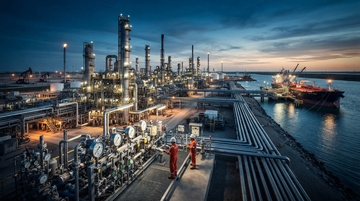
OPEC's October Hold Looks Like Discipline. It's the 2027 Quota War — and Refiners Just Won Q4
OPEC+'s September 6 decision to keep October output unchanged was framed as a supply pause, but it actually signals the start of the 2027 quota fight that will redraw every member's production baseline around audited maximum sustainable capacity. With US diesel cracks at a record $102/bbl, distillate inventories at the lowest August level since 1951, and 5 mbpd of global refinery throughput still offline from the Iran war, refiners and US shale are the cleanest beneficiaries — and any service company whose order book still depends on OPEC+ volume growth is now structurally exposed.

Private Credit Marks Fell $2.3 Billion in H1—Software Is Where the Losses Are Concentrating
U.S. business-development-company portfolios were worth $92.88 billion at June 30, 2026, versus $95.19 billion at reported cost, a wider gap than at year-end. The immediate problem is not a system-wide default wave but a valuation and liquidity feedback loop: software borrowers are weakening, while investors in Blackstone Private Credit Fund are requesting redemptions faster than the fund can honor them.

Singapore VLSFO up 76% while Brent lags: the bunker-fuel squeeze hiding inside the Iran war
Marine fuel oil is rising faster than crude because Gulf and US refiners — Marathon Petroleum, Valero, Phillips 66 — are rerouting crude into diesel and jet fuel where margins more than doubled. Singapore VLSFO has climbed 76% since the Iran war began versus 40% for Brent, and Energy Aspects projects a 218,000 bpd Q3 fuel-oil deficit. Tanker operators Frontline, DHT Holdings and International Seaways are printing record VLCC earnings, but the cost lands on container carriers already absorbing €340 million per day in extra bunker fuel. The market is still trading the crude headline; the squeeze is in the residual barrel that powers the fleet.
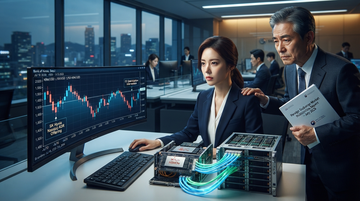
The Reported $20B SK Hynix FX Trade Turns AI Memory Into Korea’s Won Shock Absorber
Reuters reported that South Korea’s foreign-exchange authorities bought about $20 billion of dollars sold by SK Hynix after its July Nasdaq offering, while official government disclosures confirm that the ADR inflow helped move the won from the 1,550 range toward the upper 1,400s. The important distinction is that the public record supports a state absorption trade, not a confirmed legal order forcing repatriation. AI-memory profits made the flow large enough to matter for currency policy, but the intervention also makes SK Hynix’s dollar-conversion choices more policy-sensitive.

Tesla self-certified the Cybercab into AQ26002 — Zoox already wrote the playbook Tesla didn't use
On Sept. 3, 2026, Tesla launched the Cybercab in Austin and told NHTSA the no-controls robotaxi was compliant with every applicable FMVSS. NHTSA opened Audit Query AQ26002 the same day, probing the exact legal shortcut Tesla used to sidestep the 2,500-vehicle annual cap. Five weeks earlier, Amazon-owned Zoox got the first NHTSA Part 555 commercial exemption for a purpose-built robotaxi, with eight FMVSS exemptions covering exactly the controls Cybercab lacks. Every Cybercab on the road now carries a regulatory tail risk that Samsung Electronics, Samsung Electro-Mechanics, LG Innotek and TSMC are pricing into their 2027 Cybercab volume — and Tesla's bet that self-certification would scale faster than a petition now determines how many Cybercabs NHTSA ever lets hit the road.
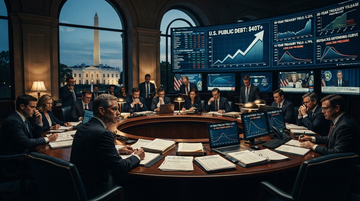
The Bond Market Just Became the Fiscal Disciplinarian — Why 'All-Hands-on-Deck' Is the Treasury's New Baseline
With U.S. debt crossing $40 trillion, the average interest rate on that debt more than doubling since 2021, and Treasury Secretary Bessent doubling long-end buybacks to defend the curve, the bond market is now enforcing fiscal restraint Congress will not. The trajectory — not the next auction — is the story, and it leaves mortgage REITs, long-duration fund managers, and rate-sensitive bank books bearing the bulk of the cost.
2026-09-06

Workers Are Funding Their Own AI Retraining — Three Rails Are Catching the Dollar Corporate L&D Won't Spend
Workers self-funded roughly $1.5B of AI skills via Coursera and Udemy in 2025 while 56% of employees got no training from their employer, per ManpowerGroup's January 2026 Global Talent Barometer. JPMorgan has cut 30–40% of headcount in some teams and is running ~1,000 AI use cases inside a $19.8B technology budget, while Cognizant reports 7.1% adjusted operating income per associate from AI-assisted coding — proof that corporate L&D dollars are being redirected from training to severance and compute. Three rails are absorbing the worker-paid reskilling dollar: the new for-profit megamerger (Coursera+Udemy), hyperscaler free tiers (Alphabet, Microsoft, Amazon, IBM), and public-sector workforce boards now backed by California's free AI micro-credential pilot and H.R. 7576's proposed 30% tax credit.
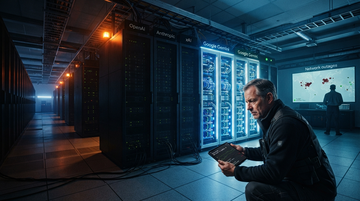
When ChatGPT, Claude, and Grok All Went Dark for 93 Minutes, the Single-Cloud AI Thesis Broke
On September 3, 2026, three of the four frontier AI providers — OpenAI, Anthropic, and xAI — suffered overlapping downtime for 93 minutes. Google Gemini stayed up. The episode didn't expose a shared external failure: each provider cited a different internal cause. What it exposed is that \"cloud AI\" is now a single-point-of-failure problem at the inference layer, and that resilience has become a buying criterion — which is why Alphabet's vertical stack and Oracle's OCI (+93% YoY) are suddenly more relevant than another Azure region.

Apple's 9-9 launch is the first test of Ternus's hardware playbook — and Morgan Stanley is pricing in a $14B foldable payoff
When Apple unveils the iPhone 18 Pro and its first foldable on September 9, it will mark new CEO John Ternus's debut on the world's biggest consumer-tech stage. Morgan Stanley's Erik Woodring calls it Apple's most consequential iPhone launch since the iPhone X, putting ~$14B of December-quarter revenue on the line for the foldable alone, plus a $200+ like-for-like price hike across the Pro lineup. The thesis hinges on Ternus's hardware credibility restoring pricing power just as NAND and DRAM costs are biting — a bet whose payoff flows directly into the supply chain from TSMC to Foxconn.

Bessent's $40 oil call breaks the airline–refiner trade in two
Treasury Secretary Scott Bessent's Friday projection of $40–$50 crude once the Iran war ends turns the post-Iran trade into a mirror image: airlines that bled through a $4/gal fuel quarter get a 2027 margin tailwind, while refiners like Marathon Petroleum, Valero Energy and Phillips 66 — whose Q2 2026 refining margins doubled — face the unwind of the record crack spread that drove their 80%+ year-to-date run.
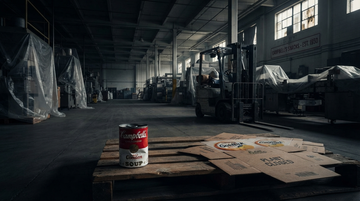
Campbell's 36% Dividend Cut Is the Second Packaged-Food Reset in Two Months — Three More Names Look Exposed
Campbell's joined Conagra on September 3 as the second major packaged-food company to reset its dividend in seven weeks, pairing a 36% payout cut with a 13% salaried layoff and two snack-plant closures on the same day FY27 guidance pointed to another 17–24% drop in adjusted EPS. The reset is no longer a single-name stress test — it is an industry-wide compression of branded volumes against record-high private-label share, and J.M. Smucker, Hormel and General Mills each carry a piece of the same exposure, with Kraft Heinz the only major still declaring victory.
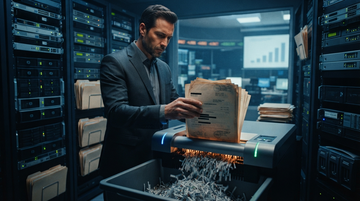
Fidelity's $5,000-per-customer cap is mostly illusion — $3.75M for 373,000 stolen images, settled the same month Reg S-P went live
A federal judge approved Fidelity Investments' $2.5 million class-action settlement on July 9, 2026 — on top of a $1.25 million Massachusetts Securities Division consent order — to resolve an August 2024 breach that exposed roughly 77,000 customer records (and the routing numbers of an additional 86,000 joint holders). The $5,000 per-claimant headline understates how little the cash pool actually buys: at full draw, the fund could fully compensate only 500 of the 163,000 eligible accounts, leaving roughly $100 pro rata for everyone else. The real cost landed in the Massachusetts docket: 23.7 million API calls, ~373,000 unique document images accessed, and an independent cybersecurity consultant with five years of record retention. For investors in custody and record-keeping peers — Charles Schwab, Bank of New York Mellon, State Street, LPL Financial — the settlement closes two weeks after the SEC's amended Regulation S-P small-firm compliance deadline, the rule designed precisely for breaches like this one.
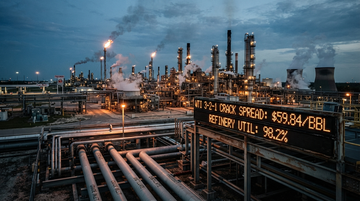
The Pump Hit $4.14 on Labor Day — and Trump Can't Make It Drop Before November
AAA logged a $4.14 national average over Labor Day weekend, beating the 2012 holiday record of $3.82 by 32 cents. With U.S. refineries running at 98% of capacity, distillate inventories 14% below the five-year average, and ExxonMobil and Chevron capturing record Energy Products earnings, the squeeze is structural: independent refiners like Marathon Petroleum, Valero and Phillips 66 are pocketing WTI 3-2-1 crack spreads near $60/bbl — and a White House appeal is not a price-cut mechanism.
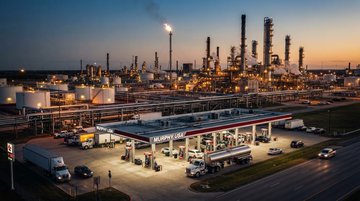
Refiners Doubled Margins, Stocks Surged — Murphy USA's 35.1-Cent Pump Beat Says the Retail Layer Got Its Cut Too
Murphy USA posted record Q2 2026 net income of $209.1M on a 35.1-cents-per-gallon retail fuel margin and 40.6 cpg total fuel contribution — the pump-level counterpart to the refiner windfall the tape has been celebrating. Unlike refiners whose margins roughly doubled-to-tripled in $91 crude, retail fuel's20% margin gain is a steadier, less cyclical trade, and management responded with a 28% dividend hike. Here's who else across the supply chain is collecting a piece, and what the next two quarters could bring into Labor Day 2027.
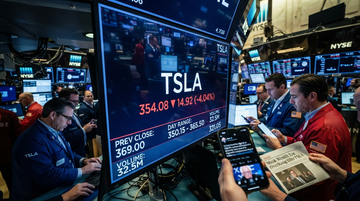
Tesla's $50 Billion 'Musk Discount': Why TSLA Is Now the Cleanest Political-Risk Bet on the Market
After Sen. Bernie Sanders publicly named Elon Musk an oligarch on X on Sep. 4, 2026, Tesla closed at $354 — about 12% below the $402 Wall Street consensus target and 29% below its December 2025 high. The gap is the cleanest read yet on the wealth-tax overhang: a 5% federal levy on Musk's roughly $165 billion Tesla stake would force recurring share supply, while California's Prop 40 wealth-tax vote on Nov. 3, 2026 turns the policy risk into a dateable catalyst. Investors who want exposure to 'MAGA-adjacent populism without paying the populist's stock multiple' now have a single, clean trade.
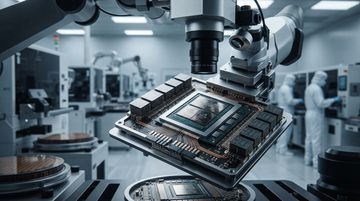
Nvidia Closed Green on the Day the Jobs Beat Sank Everything Else — the AI Capex Trade Has Stopped Waiting for the Fed
On Friday Sept 4, 2026, NVIDIA closed at $230.36 — within $5.38 of its $235.74 record — while the S&P 500 (-0.38%), Nasdaq (-0.29%) and Dow (-0.51%) all fell after a hawkish August jobs beat (+162k vs. 56k consensus) pushed the 2-year Treasury yield 5bps higher to 4.38%. The split is the cleanest read yet that AI infrastructure capex has become its own cycle: hyperscalers are committing more than $600B in 2026 alone, SK Hynix-Nvidia have a $500B+ initiative on the books, and Micron's 2026 HBM is fully sold out. The bottleneck is supply, not demand — and it sits above the foundry, in TSMC CoWoS packaging and HBM memory, not at the GPU itself.
What to expect
Evidence-first notes with a visible point of view.
This section collects sharp takes on earnings, shareholder meetings, and market structure. Each new piece should make the thesis, the facts, and the implications obvious within the first few screens.
Expect direct analysis, not generic commentary.
Expect the data to be explicit and the argument to be easy to follow.
Plutux is not an investment adviser. Market data and AI-generated analysis are for information and education only, not investment advice. Disclaimer