%22%2F%3E%0A%20%20%3Ccircle%20cx%3D%22220%22%20cy%3D%22150%22%20r%3D%22180%22%20fill%3D%22%2322d3ee%22%20fill-opacity%3D%220.12%22%2F%3E%0A%20%20%3Ccircle%20cx%3D%221010%22%20cy%3D%22130%22%20r%3D%22220%22%20fill%3D%22%2338bdf8%22%20fill-opacity%3D%220.08%22%2F%3E%0A%20%20%3Ccircle%20cx%3D%22920%22%20cy%3D%22520%22%20r%3D%22170%22%20fill%3D%22%2322d3ee%22%20fill-opacity%3D%220.06%22%2F%3E%0A%20%20%3Cpath%20d%3D%22M140%20430h920%22%20stroke%3D%22url(%23line)%22%20stroke-width%3D%2212%22%20stroke-linecap%3D%22round%22%2F%3E%0A%20%20%3Cpath%20d%3D%22M220%20360c120-150%20260-220%20380-220s260%2070%20380%20220%22%20fill%3D%22none%22%20stroke%3D%22%2367e8f9%22%20stroke-opacity%3D%220.5%22%20stroke-width%3D%2216%22%20stroke-linecap%3D%22round%22%20stroke-linejoin%3D%22round%22%2F%3E%0A%20%20%3Cpath%20d%3D%22M300%20398h600%22%20stroke%3D%22%2394a3b8%22%20stroke-opacity%3D%220.24%22%20stroke-width%3D%228%22%20stroke-linecap%3D%22round%22%2F%3E%0A%20%20%3Ctext%20x%3D%22220%22%20y%3D%22510%22%20fill%3D%22%23e2e8f0%22%20fill-opacity%3D%220.7%22%20font-family%3D%22Arial%2C%20Helvetica%2C%20sans-serif%22%20font-size%3D%2238%22%20letter-spacing%3D%228%22%3EINSIGHTS%3C%2Ftext%3E%0A%3C%2Fsvg%3E)
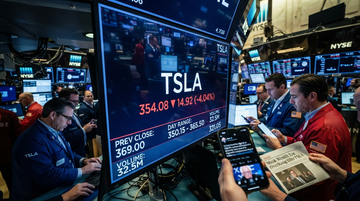
The thesis in one sentence: Tesla's roughly $50 billion gap to sell-side targets (closed Sep. 4 at $354.08 against a $401.74 average price target on MarketBeat) is no longer a robotaxi/Cybercab story — it's a wealth-tax story. Sen. Bernie Sanders' Sep. 4, 2026 X post calling Elon Musk's $100 million America PAC spending 'oligarchy' is the first time in this cycle a sitting senator has named Musk by name in the same breath as a federal wealth-tax bill Musk would personally fund. That converts a slogan into a line item on Tesla's discount-rate model.
Sanders Just Made Musk the Line Item
On Sep. 4, 2026, Sanders posted on X: 'This is what oligarchy is: Elon Musk, the richest man alive, plans to spend at least $100 million to help elect Republicans. We must end this corrupt campaign finance system.' The post, confirmed by the senator's official X feed, lands 18 days after the Aug. 17 Forbes re-crossing of $900 billion in Musk's net worth and 11 days after Musk authorized his America PAC to spend $100 million to $120 million on Republican turnout in eight states.
- Federal wealth-tax bill (Sanders-Khanna, S. introduced Mar. 2, 2026): 5% annual tax on 938 U.S. billionaires; Musk's tab = $42B/year per the bill's own back-of-envelope, ~$8B from his ~12% Tesla stake.
- California Proposition 40 (Nov. 3, 2026 ballot): one-time 5% tax on net worth of California billionaires as of Jan. 1, 2026; Polymarket-implied pass probability = 28%.
- California Proposition 42 (Nov. 3, 2026 ballot): counter-measure that would make future state wealth taxes harder to pass — the two are on the same ballot, an unusual hedge directly at Tesla's home-state exposure.
- Musk's net worth composition (Forbes, Mar. 11, 2026): ~$336B in SpaceX (now public since June 2026 IPO at ~$1.77T) vs. ~$130B in Tesla — Musk's wealth is mostly NOT in Tesla, but the forced-sale mechanism on either asset drags Tesla's float.
- Nov. 6, 2025: Tesla shareholders approved Musk's $1 trillion pay package by 75% — a binding obligation for Tesla to dilute itself into a market cap of $8.5 trillion, which directly inflates the wealth-tax base.
The Discount Is Real, Quantifiable, and Already Priced
TSLA close (Sep 4, 2026)
$354.08
Down 5.92% on the day; -29% from Dec 22, 2025 52-week high of $498.83
Trailing P/E (TTM)
321x
Macrotrends shows 393.42 as of Sep 5, 2026; ~39% above 6-year average of 282.77
Forward P/E
153–186x
Range across GuruFocus (152.95), StockAnalysis (186.01), Tesla overview (156.25), Sep 5, 2026
Market cap
$1.398T
Per Macrotrends, Sep 5, 2026; Tesla ranks 11th-most-valuable company globally
Price-to-sales
13.5x
Per Tesla company overview, TTM through Jun 30, 2026
Vs. Wall Street consensus
-12%
$354.08 vs. $401.74 MarketBeat consensus (range $25.28 to $600)
Two things stand out. First, Tesla is trading at a forward P/E of ~156 against a mega-cap tech median closer to 30 — that is not 'expensive relative to peers', it is 'expensive on an assumption of exceptional growth that the wealth-tax overhang actively threatens'. Second, the stock is now trading $45 below its 200-day moving average of $399.56; only four months into 2026 the stock fell below that level and has not reclaimed it.
TSLA vs. the political-risk milestones of 2026
Price action and key policy events; values in USD per share
Unit: USD/share
52-wk high (Dec 22, 2025)
498.8
Q1 2026 close (Mar 31)
295
Q2 2026 peak (Jul 1)
420
200-day MA (current)
399.6
50-day MA (current)
358
Sep 4, 2026 close
354.1
52-wk low
297.4
The simplest way to size the political-risk haircut: if Tesla traded at its consensus target of $401.74 (MarketBeat, Sep 4, 2026), the implied equity value is roughly $1.59 trillion, or about $190 billion above today's market cap. That $190 billion is the upper bound on what bulls believe is being held back by Cybercab/AI narrative risk; the $50 billion gap to consensus is the lower bound on what is already discounted for Musk-specific political risk.
Fundamentals Confirm the Discount Is Not a Buying Opportunity — Yet
Tesla's underlying business did not deteriorate fast enough in Q2 2026 to justify a $190 billion swing on its own. Revenue was $28.24 billion, up 26% year-over-year on 480,126 deliveries (also +25%), marking the strongest Q2 in company history and pushing trailing-twelve-month revenue over $100 billion for the first time (per Tesla's Q2 2026 Update, Jul. 22, 2026). The problem is below the top line: operating income collapsed to $398 million from $1.41 billion a year earlier, the operating margin compressed to 1.4% from 7.2%, and non-GAAP EPS of $0.33 missed the $0.53 consensus by ~38%.
| Quarter | Revenue ($B) | Op income ($M) | Op margin | Auto gross margin (ex-credits) | Deliveries (000s) |
|---|---|---|---|---|---|
| Q2 2025 | 22.50 | 923 | 4.1% | ~18.0% | 384 |
| Q3 2025 | 28.10 | 1,624 | 5.8% | ~17.6% | 497 |
| Q4 2025 | 24.90 | 1,409 | 5.7% | ~17.0% | 418 |
| Q1 2026 | 22.39 | 941 | 4.2% | 19.2% | 358 |
| Q2 2026 | 28.24 | 398 | 1.4% | 16.3% | 480 |
Full-year 2025 deliveries fell 8.6% to 1.64 million units from 1.79 million in 2024 — the second consecutive annual decline, the worst year in company history by absolute volume lost. Brand Finance measured Tesla's brand value down 36% in 2025 (third consecutive year of declines), and Reuters reported brand-loyalty metrics collapsed after Musk aligned with the Trump administration in 2025. The structural damage is not a 2026 risk; it is the 2025–2026 backdrop that the wealth-tax bill is now converting from intangible narrative into a recurring forced-sale liability.
The Supply-Chain Cross-Check: Who Gains If Musk Stays
If the wealth-tax premium persists, Tesla's volume trajectory matters less than its discounted-multiple trajectory. For the upstream battery cell supply chain, that is two different stories: cell makers tied to Tesla's accelerating ramp benefit; cell makers exposed to Tesla's pricing concessions suffer.
- LG Energy Solution sells Tesla cells under a multi-year supply contract that extends through 2030, including 4680-format production at its Ochang plant; a political-risk haircut on Tesla's share price does not change order volume directly but compresses Tesla's pricing leverage in cell renegotiations.
- Panasonic operates the Nevada Gigafactory joint with Tesla and disclosed a Q1 FY2027 (calendar Q2 2026) lithium-ion revenue figure worth watching; per Investing.com Sep 4, 2026, Panasonic closed at ¥4,163, down 16% from its 52-week high.
- CATL is the structural alternative — even if Tesla grows into a $8.5 trillion market cap on the Musk pay schedule, Chinese LFP cell supply keeps gross margins on U.S.-built packs capped, and that contest is decided in Washington and Sacramento, not Austin.
- BYD is the closest direct beneficiary if Musk-driven political risk reshapes consumer preference: BYD's H-share closed at HK$86.15 on Sep 4, 2026, having hit a 52-week low of HK$71.40 on Jun 30, 2026, but its battery-plus-vehicle vertical integration is the exact business model Tesla is being forced to imitate.
- NIO is the marginal premium-EV play, closing Sep 4 at HK$29.50 and a 52-week low; NIO's swap-to-battery model depends on Chinese policy, not U.S. policy, so a U.S. wealth tax is a relative tailwind for HK-listed premium-EV peers.
- U.S. premium-EV challengers — Rivian (RIVN, Sep 4 close $15.74, market cap ~$22.8B) and Lucid (LCID, Sep 5 intraday $4.67) — both trade at fractions of Tesla's multiple precisely because they lack the political-risk optionality; the wealth-tax premium thus lives almost entirely in Tesla and is the reason no two are priced comparably.
- Detroit legacy OEMs with the deepest U.S. retail footprints — Ford and GM — have already restructured EV programs around the assumption that political risk is episodic, not structural; the wealth-tax-overhang scenario reverses that assumption.
Two Horizons: Same Stock, Different Stories
Short-term (days–quarters). The binary catalysts are now dateable. The Nov. 3, 2026 California election decides whether the one-time 5% tax on Musk's Tesla stake is triggered; Polymarket is pricing a 28% probability of Prop 40 passing. The Tesla Q3 2026 earnings report (consensus date Oct. 21, 2026 per StockAnalysis, or Oct. 28 per Plus500) is the next operating-margin print after the Q2 collapse. Watch for two things in the print: (1) auto gross margin excluding regulatory credits, which needs to recover above 17% to validate a multiple re-rating; (2) Musk's tone on the call, which historically has driven 5–10% intraday moves on political references.
Long-term (1–3 years). The structural transmission is a feedback loop: wealth tax → forced selling of Tesla by Musk → higher float turnover → lower multiple → smaller stock → smaller market cap → lower denominator in the wealth-tax base, but also lower base for the Musk pay-package milestones that drive future dilution. Two milestones matter most: (a) passage of the federal Sanders-Khanna bill in any form, which would crystallize the recurring $42B/year Musk liability and force the first Tesla-for-SpaceX rebalance; (b) Tesla's 2027 shareholder re-vote on whether the Musk pay-package milestones (a market-cap path to $8.5 trillion) remain achievable under a wealth-tax regime. If Musk's Tesla stake becomes structurally less valuable as wealth-tax collateral, the dilution math changes.
What the Bears and Bulls Both Get Wrong
Bear case (political-risk-as-multiple-compression, 12-month price target $120–$200): Under the Sanders-Khanna 5% annual bill, Musk's annual wealth-tax bill on Tesla shares alone is roughly $8B; to avoid selling into a depressed market, Musk would need Tesla to issue against the tax bill, which dilutes existing holders and worsens the multiple. J.P. Morgan's April 2026 $120 implied target already prices this scenario. The bear case assumes the federal bill passes in some form within 24 months and that Prop 40 passes in November.
Bull case (multiple-expansion, $500+ price target, Tigress Financial and ARK): Musk's wealth is mostly in SpaceX — a $1.77T-market-cap stock since the June 12, 2026 IPO at $135 — not in Tesla; forced selling would hit SpaceX first, leaving Tesla float unchanged. California Prop 42 on the same November ballot would make future wealth taxes harder, neutralizing the long-term overhang. The bull case assumes the federal bill dies in committee and that Nov. 3, 2026 is a relief catalyst.
Both miss the same point: Musk's $42B/year wealth-tax bill under the federal bill is not a Tesla-specific cash drain — it is a sale-pressure drain on Musk's combined $165B+ Tesla plus SpaceX holdings, and which asset he sells first is itself the trade. If forced selling hits SpaceX first, the cash flows from Starlink underwrite Tesla's AI/robotaxi capex schedule; if forced selling hits Tesla first, the bear case is correct. The investment question is no longer 'is Tesla overvalued' but 'which Musk asset gets sold first under a wealth-tax regime'.
Investable takeaway: where political risk actually prices
- Carries the political-risk discount directly: at $354.08 on Sep 4, 2026 the stock is $48 below its $401.74 MarketBeat consensus, a -12% gap that maps to ~$190 billion in implied political-risk premium.
- Volume/profit divergence is now mechanical: Q2 2026 deliveries +25% YoY but op margin fell to 1.4% from 5.8%, meaning each additional Cybercab dollar earned is also a higher-float dollar at risk of Musk wealth-tax forced selling.
- Long-term (12–24 months): binary on the Nov. 3, 2026 Prop 40 vote and the federal Sanders-Khanna bill trajectory; near-term (days–quarters): Q3 earnings Oct. 21/28, 2026 and the next Musk political post will drive single-day 5–10% moves.
- Closest direct beneficiary if Musk political risk reshapes consumer preference: HK$86.15 on Sep 4, 2026 (52-week low HK$71.40 Jun 30, 2026); BYD's vertical battery-plus-vehicle integration is the business model Tesla is forced to imitate at lower margins.
- Short-term: rides any California Prop 40 surprise in Tesla's California retail share; long-term: battery-supply negotiation leverage against LG Energy Solution and Panasonic tightens if Tesla's pricing power weakens.
- Pending: renegotiation of Tesla 4680 cell contract economics; the stock closed Sep 2, 2026 at KRW 347,500 on the LGES IR page, with political-risk overhang on Tesla directly compressing LGES's pricing leverage.
- Short-term: Tesla Q3 2026 deliveries print (Oct. 21/28, 2026) determines volume; long-term: 2027 capex cycle on U.S. IRA-compliant capacity is the binary call.
- Nevada Gigafactory volumes still rise with Tesla Q2 2026 deliveries of 480,126, but Panasonic's Sep 4, 2026 close of ¥4,163 is 16% below its Aug 14, 2026 52-week high of ¥4,982 — pricing in Tesla political-risk spillover.
- Short-term: Tesla margin compression feeds back into Panasonic cell ASP concessions; long-term (1–3 years): Energy Company spinoff decision is the bigger structural catalyst.
- Marginal premium-EV play that benefits only relative to [Tesla](tsla]: NIO's HK$29.50 Sep 4 close is near 52-week lows, but a U.S. wealth-tax regime is a relative tailwind for non-U.S.-listed premium-EV peers.
- Near-term (quarters): dependent on Chinese stimulus rather than U.S. policy; long-term: battery-swap infrastructure capex is the key swing factor, not the U.S. wealth tax.
- No political-risk optionality and no pricing power either: RIVN Sep 4 close $15.74, market cap ~$22.8B; if Tesla's volume recovers (Q2 +25% YoY), Rivian loses U.S. premium-EV share regardless of wealth-tax outcome.
- Near-term: any Tesla political-risk rally reclaims share from Rivian first; long-term: RJV joint-venture economics with Volkswagen — not U.S. policy — are the binary call.
- Market cap of ~$1.8B (Motley Fool) leaves LCID with no buffer against [Tesla](tsla] regaining share; LCID Sep 5 intraday $4.67 (Robinhood) is up 5.1% off the intraday low but still trades on operational milestones (Gravity SUV ramp, Saudi offtake).
- Near-term: any Tesla political-risk discount closure compresses LCID further; long-term (12–24 months): PIF-backed capex runway is the only structural support, not U.S. policy.
- Ford's $19.5B Q4 2025 EV restructuring special charge (CNBC, Dec 23, 2025) was the trade sized for a Tesla that could not be touched politically; a sustained Tesla political-risk discount reverses that trade.
- Near-term: F-150 Lightning volumes and Model Y competitive overlap; long-term (1–3 years): IRA section 45X credits transfer pricing power away from Musk-controlled Tesla toward legacy OEMs.