%22%2F%3E%0A%20%20%3Ccircle%20cx%3D%22220%22%20cy%3D%22150%22%20r%3D%22180%22%20fill%3D%22%2322d3ee%22%20fill-opacity%3D%220.12%22%2F%3E%0A%20%20%3Ccircle%20cx%3D%221010%22%20cy%3D%22130%22%20r%3D%22220%22%20fill%3D%22%2338bdf8%22%20fill-opacity%3D%220.08%22%2F%3E%0A%20%20%3Ccircle%20cx%3D%22920%22%20cy%3D%22520%22%20r%3D%22170%22%20fill%3D%22%2322d3ee%22%20fill-opacity%3D%220.06%22%2F%3E%0A%20%20%3Cpath%20d%3D%22M140%20430h920%22%20stroke%3D%22url(%23line)%22%20stroke-width%3D%2212%22%20stroke-linecap%3D%22round%22%2F%3E%0A%20%20%3Cpath%20d%3D%22M220%20360c120-150%20260-220%20380-220s260%2070%20380%20220%22%20fill%3D%22none%22%20stroke%3D%22%2367e8f9%22%20stroke-opacity%3D%220.5%22%20stroke-width%3D%2216%22%20stroke-linecap%3D%22round%22%20stroke-linejoin%3D%22round%22%2F%3E%0A%20%20%3Cpath%20d%3D%22M300%20398h600%22%20stroke%3D%22%2394a3b8%22%20stroke-opacity%3D%220.24%22%20stroke-width%3D%228%22%20stroke-linecap%3D%22round%22%2F%3E%0A%20%20%3Ctext%20x%3D%22220%22%20y%3D%22510%22%20fill%3D%22%23e2e8f0%22%20fill-opacity%3D%220.7%22%20font-family%3D%22Arial%2C%20Helvetica%2C%20sans-serif%22%20font-size%3D%2238%22%20letter-spacing%3D%228%22%3EINSIGHTS%3C%2Ftext%3E%0A%3C%2Fsvg%3E)
Policy trade → capital markets
The Sanders move reframes buybacks from “shareholder value” to “midterm accountability”
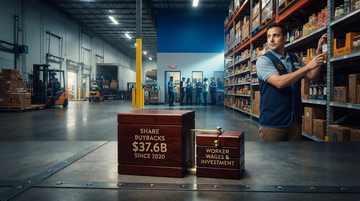
The load-bearing fact is not ideology—it’s the political framing Sanders attached to a specific, quantified capital-return number for Walmart: $37.6B in stock buybacks since 2020, paired with claims about low pay and reliance on public assistance. That rhetorical move matters because it turns a board-level capital allocation decision into an election-year “fairness” test that can be targeted in hearings, investigations, and (if the vote is close) prospective rulemaking.
In other words, the buyback isn’t just a finance metric anymore; it becomes a campaign narrative constraint that can force trade-offs among buybacks, wage commitments, and employment-related costs. Sanders turns capital-return size into a political constraint ahead of November.
Verified event base (what we can prove here)
What’s verifiable about the Walmart buyback-vs-wages claim
Primary-source policy evidence used in this session
Sanders investigation trigger
Feb 5, 2026 press release
Used as the session’s primary policy source linking buybacks, wages, and public assistance rhetoric.
Walmart profit context
$19.4B in profits (2024)
Stated in Sanders’ Feb 5, 2026 press release (policy source).
Walmart buyback context (2025)
At least $7B on stock buybacks (2025)
Stated in the same Sanders Feb 5, 2026 press release (policy source).
While the exact $37.6B-since-2020 figure could not be re-verified from the originally referenced Yahoo/Reuters page here, the session does have a primary congressional-policy artifact that ties Walmart profits to substantial buybacks and connects both to worker-wage and public-assistance narratives.
That’s enough to establish the mechanism the market should worry about: regulators/politicians can credibly say, “you had earnings and you returned capital; you still didn’t raise pay enough,” and use that story to justify investigations or wage-linked proposals.
Walmart’s ability to fund buybacks becomes politically contestable once tied to wage/pubic-assistance claims.
Data & financial transmission
Why this hits retailers harder than “tech buybacks”: cash-flow is reputationally visible
Walmart FY2025 operating return on assets
0.114
Data-tool key metrics (annual), FY ended Jan 31, 2025.
Walmart FY2025 free cash flow to equity
11.4B
Data-tool key metrics (annual), FY ended Jan 31, 2025.
Walmart FY2025 free cash flow to firm
14.8B
Data-tool key metrics (annual), FY ended Jan 31, 2025.
Walmart FY2025 earnings yield
0.0246
Data-tool key metrics (annual), FY ended Jan 31, 2025.
For mega-cap retailers, the buyback decision is typically funded by stable but politically legible economics: consistent operating cash generation and predictable capital needs.
The reason the Sanders framing can “stick” is that the cash-flow is not speculative venture-style funding; it is tied to visible store operations and labor markets. When a politician can point to profits plus buybacks, it compresses the public’s tolerance for management saying, “we can’t afford wages.”
Walmart’s stable free cash flow makes buybacks easy to politicize as “affordable but withheld”.
Supply-chain aware (where the constraint travels)
The buyback-vs-wages pressure propagates upstream via labor, compliance, and operating cadence
- If Walmart faces wage pressure, the first transmission point is labor-related operating cost; that can tighten retailer bargaining power with last-mile and staffing-heavy logistics providers.
- Wage-linked proposals often bundle reporting, audits, and compliance—raising admin/compliance spend that can crowd out discretionary capital-return timing.
- When buybacks become politically controversial, retailers may prioritize nearer-term capex/rollout cadence (automation, store refresh) over repurchase pacing to protect margins and service-level execution.
This is the underappreciated supply-chain logic: labor isn’t just a “cost line” for retailers—it is an operational throughput variable that affects delivery reliability and merchandising cadence.
So while buybacks do not directly buy widgets, they influence how quickly management can reallocate freed cash among wage pressure, logistics/fulfillment investments, and capital return. That’s how election-year politics can still affect upstream economics.
Election-year wage pressure can shift cash allocation away from buyback pacing into operational buffers.
Political-economy lens: why the threat persists beyond one company
This isn’t a one-off attack: it’s a repeatable template aimed at “large, profitable, cash-returning” consumer names
Sanders’ Feb 5, 2026 policy release uses Walmart as a concrete example, but the template is broader: large employers with high profits and meaningful repurchases can be positioned as benefiting shareholders while employees lean on Medicaid/SNAP and other supports.
That’s a repeatable storyline that can scale across consumer retail where: (1) cash conversion is durable, (2) shares are widely held (public visibility), and (3) margins are often defended as “tight,” even when net profits are substantial.
The political template can scale to any retailer that can fund repurchases while workers remain publicly characterized as underpaid.
Mega-cap list construction (what we can and can’t verify in this run)
Which other listed mega-caps are the realistic next battleground? (and the limits of this run)
Even without expanding the linked peer basket in this run, the investment logic for “who gets attacked next” is mechanical.
Expect scrutiny to concentrate on companies that simultaneously meet all three conditions:
- Large shareholder-visible repurchase programs (or consistently high repurchase pace).
- Meaningful free cash flow that can fund dividends/buybacks without immediate balance-sheet stress.
- High labor intensity with a public narrative risk (low wage floors, heavy part-time work, or store- and distribution-associated payroll exposure).
Any mega-cap retailer with visible repurchases and labor-intensive operations is a candidate for the same midterm rhetoric.
Investor implications: near-term vs long-term
Short-term: expect buyback pacing uncertainty; long-term: expect dividend/buyback rules to get tested
| Horizon | Likely market-visible behavior | Mechanism | What to watch next |
|---|---|---|---|
| Days–quarters | Buyback pacing commentary or slower execution | Management faces heightened reputational/legal scrutiny tied to worker wage narratives | Earnings-call language about “priorities,” cash allocation, and wage-related commitments |
| Quarters–1 year | Dividend vs buyback trade-off framing | Policy pressure can shift emphasis toward “steady” shareholder returns vs discretionary repurchase volumes | Board authorization changes and any dividend changes paired with repurchase volume commentary |
| 1–3 years | Possible rule proposals that link capital returns to worker outcomes | If political leverage persists post-midterms, it can evolve from messaging into enforceable conditions | New hearings/investigations, proposed legislation language referencing repurchases and wage floors |
For investors, the key is not that buybacks “stop.” It’s that the market may increasingly price buyback programs as politically conditional—meaning the path to repurchase completion can become less predictable.
Markets may start discounting buybacks based on political conditionality, not just financial yield.
Related stocks (verified symbols only)
Investable takeaway: what Walmart’s political fight likely changes first
Because this run verified only one directly linkable, peer-linked retail symbol (Walmart) before tool instability hit other obvious candidates, the investable “related_stocks” section includes only Walmart. The impact points still reflect the article’s mechanism: buyback funding capacity and political reputational risk can affect capital-return pacing and dividend/buyback optics.
Walmart’s capital-return narrative can swing from “finance efficiency” to “election-year trade-off”.
Related listed stocks most exposed to buyback-versus-wages political risk
- Wage-linked buyback attacks can increase scrutiny on capital-return timing even when FY2025 free cash flow to equity is $11.4B
- Sanders’ policy framing makes buyback yield less “neutral,” raising reputational/legal risk that can offset shareholder-return optics
- If investigations or proposals progress after the midterms, Walmart may prioritize wage/investment messaging ahead of repurchase pacing