Financials
Banks, credit, and where the risk is sitting
Net interest margins, credit quality, capital rules and deal flow — what the numbers say about the banks, insurers and asset managers reporting them.
2026-09-07
%22%2F%3E%0A%20%20%3Ccircle%20cx%3D%22220%22%20cy%3D%22150%22%20r%3D%22180%22%20fill%3D%22%2322d3ee%22%20fill-opacity%3D%220.12%22%2F%3E%0A%20%20%3Ccircle%20cx%3D%221010%22%20cy%3D%22130%22%20r%3D%22220%22%20fill%3D%22%2338bdf8%22%20fill-opacity%3D%220.08%22%2F%3E%0A%20%20%3Ccircle%20cx%3D%22920%22%20cy%3D%22520%22%20r%3D%22170%22%20fill%3D%22%2322d3ee%22%20fill-opacity%3D%220.06%22%2F%3E%0A%20%20%3Cpath%20d%3D%22M140%20430h920%22%20stroke%3D%22url(%23line)%22%20stroke-width%3D%2212%22%20stroke-linecap%3D%22round%22%2F%3E%0A%20%20%3Cpath%20d%3D%22M220%20360c120-150%20260-220%20380-220s260%2070%20380%20220%22%20fill%3D%22none%22%20stroke%3D%22%2367e8f9%22%20stroke-opacity%3D%220.5%22%20stroke-width%3D%2216%22%20stroke-linecap%3D%22round%22%20stroke-linejoin%3D%22round%22%2F%3E%0A%20%20%3Cpath%20d%3D%22M300%20398h600%22%20stroke%3D%22%2394a3b8%22%20stroke-opacity%3D%220.24%22%20stroke-width%3D%228%22%20stroke-linecap%3D%22round%22%2F%3E%0A%20%20%3Ctext%20x%3D%22220%22%20y%3D%22510%22%20fill%3D%22%23e2e8f0%22%20fill-opacity%3D%220.7%22%20font-family%3D%22Arial%2C%20Helvetica%2C%20sans-serif%22%20font-size%3D%2238%22%20letter-spacing%3D%228%22%3EINSIGHTS%3C%2Ftext%3E%0A%3C%2Fsvg%3E)

Citi’s China Brokerage License Re-Entry Is a “Fee Wallet” Event—But the Stock May Still Be Underpricing the Friction Risk
Reuters reports Citigroup. expects approval for a wholly-owned mainland China brokerage business as soon as September 2026, enabling onshore A-share brokerage, underwriting, research, and principal trading. The move directly upgrades Citi’s China fee pipeline, but the same re-entry faces policy and execution frictions that can delay monetization, which helps explain why the market may not fully re-rate Citigroup yet.

Italy's \"Voluntary\" Bank and Energy Ask Hides a €1.5–2B Extraction — and US ADR Investors Should Care
Italy's deputy prime minister Antonio Tajani asked banks and energy firms on Sept. 4 to \"bring forward\" tax payments for the 2027 budget, framing it as a negotiated, voluntary extension of two prior sector accords. Underneath the label sits a third round of cash from a banking system that has already paid €1.2B more tax in H1 2026 versus H1 2025, an energy sector that funded the August fuel-excise extension on the same model, and a coalition split where Deputy PM Salvini is publicly pushing a harder 5%-of-profits levy. The trade for US-based holders of UniCredit and Intesa Sanpaolo ADRs is not whether Italy hits the sector again — it already has — but whether Rome's template migrates to Spain or France and turns a managed extraction into a peripheral-Europe spread event.

Private Credit Marks Fell $2.3 Billion in H1—Software Is Where the Losses Are Concentrating
U.S. business-development-company portfolios were worth $92.88 billion at June 30, 2026, versus $95.19 billion at reported cost, a wider gap than at year-end. The immediate problem is not a system-wide default wave but a valuation and liquidity feedback loop: software borrowers are weakening, while investors in Blackstone Private Credit Fund are requesting redemptions faster than the fund can honor them.
2026-09-06

Fidelity's $5,000-per-customer cap is mostly illusion — $3.75M for 373,000 stolen images, settled the same month Reg S-P went live
A federal judge approved Fidelity Investments' $2.5 million class-action settlement on July 9, 2026 — on top of a $1.25 million Massachusetts Securities Division consent order — to resolve an August 2024 breach that exposed roughly 77,000 customer records (and the routing numbers of an additional 86,000 joint holders). The $5,000 per-claimant headline understates how little the cash pool actually buys: at full draw, the fund could fully compensate only 500 of the 163,000 eligible accounts, leaving roughly $100 pro rata for everyone else. The real cost landed in the Massachusetts docket: 23.7 million API calls, ~373,000 unique document images accessed, and an independent cybersecurity consultant with five years of record retention. For investors in custody and record-keeping peers — Charles Schwab, Bank of New York Mellon, State Street, LPL Financial — the settlement closes two weeks after the SEC's amended Regulation S-P small-firm compliance deadline, the rule designed precisely for breaches like this one.

$200bn of Frozen Russian Assets Just Re-Entered the Debate — Belgium Says 'Door Is Closed', Four EU States Just Pushed It Back Open
Sweden, the Netherlands, Spain and Poland are pressing the European Commission to revive a €210bn 'reparations loan' backed by immobilised Russian central bank reserves held at Euroclear in Belgium, after the €90bn Ukraine-support loan was finalized in April without touching those assets. The mechanics turn ~€195bn of sanctioned Russian securities into collateral behind EU-Bond issuance — a 'debt-backed demand floor' that funds Ukraine while repricing credit risk for the European banks and defense primes that sit in the transmission chain. Rheinmetall, Saab and BAE Systems are already converting the demand into backlog; Lockheed Martin, Northrop Grumman and Hensoldt extend the chain into air-defense interceptors and radars; BNP Paribas and ING carry the counterparty and primary-dealer exposure that decides who earns and who absorbs the legal tail.

Trump's $500M Late Bet Tilts the Midterm Trade — and the Sector Tape
Trump's pledge of $400–500M from MAGA Inc. in the final 60 days before the November 3 midterms turns healthcare, tariff-exposed retail, and energy into policy binaries the market has to price in real time. With Eli Lilly, Novo Nordisk, and Pfizer already absorbing a Most-Favored-Nation drug regime that now spans 89% of the branded market, and Walmart and Home Depot banking $20.6B in tariff refunds, the question isn't whether the spending shifts odds — it does, ~10-to-1 against Democrats in super-PAC firepower — but which equities carry the most asymmetric pain or upside across two horizons: a 60-day policy tape and a 2027–2028 codification tape.

Trump Wants the World's Lowest Interest Rates. The AI Boom Just Borrowed $167 Billion to Make Sure He Can't Have Them
Four hyperscalers spent $511 billion on capital expenditure in the year to June 30, 2026 — 75% more than a year earlier — and funded the gap with roughly $167 billion of net new debt. That is a private credit-demand shock landing on top of 3.4% headline inflation and a $1.17 trillion federal interest bill, and it is why futures price a September rate hike rather than the cuts the White House is demanding. The rate that actually governs the AI buildout is the 10-year at 4.77%, and political pressure on the Fed pushes that number up, not down.
2026-09-05

Why the August jobs beat became the worst news for the weakest US borrowers
A 162K payroll print reset Fed-cut bets and shoved the 30-year Treasury to 5.25%, dragging riskiest CCC spreads to 10.4% and pushing $40.1B of 2026 defaults onto a wall that already includes Ares Capital, Prospect Capital, FS KKR Capital, and an Oracle teetering one notch above junk. BDCs and middle-market direct lenders sit at the bottom of the chain — and the BDC sector is already down 20% from February highs with NAVs marking lower, so the transmission into share prices is mechanical, not a 2027 problem.
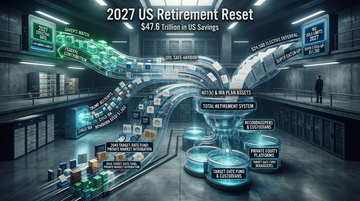
The 2027 Retirement Reset: How a Four-Part Policy Stack Re-Wires $47.6 Trillion in US Savings
On January 1, 2027, a federal Saver's Match, the new Trump Accounts child IRA, the Department of Labor's 401(k) alternatives safe-harbor, and the routine cost-of-living limit bump all take effect at once. Together they channel fresh dollars toward recordkeepers, target-date fund managers, and the private-market platforms positioned to ride the alt-401(k) wave. The trade is concrete: a $1,000 federal match per low-income saver, $5,000-a-year custodial IRAs seeded with $1,000 for newborns, and a DOL proposal that puts private equity inside the default investment of nearly every American worker's retirement plan.

Pulte's Universal VantageScore Order Just Cut FICO's $1.1B Mortgage Lock Down to a Side Door
On the evening of September 4, FHFA Director Bill Pulte ordered Fannie Mae and Freddie Mac to approve every GSE lender for VantageScore 4.0 effective immediately, ending a four-month, 50-lender pilot. Fair Isaac Corporation shares fell as much as 21% intraday the next morning — the worst session in years — because mortgage originations already account for 71% of FICO's B2B Scores revenue, a segment that grew 97% in the most recent quarter. The credit bureaus look like collateral damage on the surface, but VantageScore is jointly owned by Equifax, Experian, and TransUnion: every FICO share lost at the GSE gate is a bureau score gained, and Pulte's pricing pressure is aimed at FICO's $10 royalty, not at the bureaus' data layer.
2026-09-04

Apex runs more rigs than any other Haynesville operator — and Citadel owns it
When Ken Griffin's Citadel paid $1.2B for Paloma Natural Gas in March 2025, it became the first major hedge fund to run a US shale E&P at scale. Eighteen months later, Apex Natural Gas runs 14 Haynesville rigs, lifted production from 600 MMcf/d to 1.4 Bcf/d in a single winter, and drove more than half of the basin's 2 Bcf/d of growth since October 2025. The thesis: financial buyers can now set M&A multiples for US natural gas — Comstock Resources cashed out its Shelby Trough position to Apex for $430M within a year — and the midstream response is already in the billions, with Williams Companies closing a $5.5B acquisition of Momentum Midstream on Sept. 3, 2026.

Fannie Mae and Freddie Mac’s VantageScore switch re-routes the mortgage “credit toll” away from FICO
A federal Housing regulator ordered the Enterprises to fully implement [VantageScore 4.0] for loans sold to Fannie Mae and Freddie Mac, giving lenders a second conforming-mortgage credit-score option. The immediate effect is policy-driven pricing pressure at FICO and incremental monetization opportunities for the bureau-backed VantageScore ecosystem—especially Equifax, Experian, and TransUnion—with GSE distribution as the transmission channel.
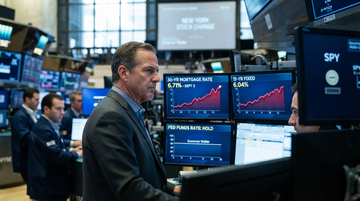
Mortgage rates hit a one-year high because the bond market repriced the “term premium”—not because the Fed suddenly turned hawkish
On Sept. 3, Freddie Mac reported the 30-year fixed mortgage rate at 6.71%, its highest level in over a year. At the same time, Fed Governor Christopher Waller signaled he would support holding the federal funds target—shifting attention from Fed policy transmission to the bond-market term premium channel that mortgage pricing must follow.

A $600M Turkish bank just got SDN-listed — that's a bull signal for JPM, Citi and BofA, not a crude headline
OFAC on September 4, 2026 put Golden Global Bank, Turkey's 35th-largest lender, on the SDN list under E.O. 13902 for laundering tens of millions for the IRGC-Qods Force. The small target is the point: by SDN-listing a niche correspondent-banking node, Treasury forces every larger Turkish and EM bank — and every US money-center that clears their dollars — to police Iran's residual reach or risk losing US account access. The trade is the correspondent gatekeepers (JPMorgan Chase, Citigroup, Bank of America) and short Turkish lira funding, not crude oil.
2026-09-03

2026-09-01

Ares's $435M student-housing bet is a cap-rate test: it underwrites rate risk where public REITs have already been burned
On Sep. 1, 2026, Ares (through an Ares Real Estate fund) and The Scion Group agreed to buy a 2,316-bed student-housing portfolio for about $435M, tying today’s housing-cycle anxiety to a higher-rate entry point. The deal matters to investors because it contrasts sharply with student-housing REIT earnings sensitivity in a higher-for-longer world, turning cap-rate math, financing costs, and enrollment-cycle timing into the core underwriting question.

A 2027 “bank dollar coin” threatens the stablecoin duopoly by moving the core float to balance sheets
A 21-bank consortium that includes Goldman Sachs and Bank of America plans to form a company in 2026 to issue a dollar-pegged stablecoin in the first half of 2027. The move targets the same demand that currently funds Tether and Circle, but does so by routing issuance, reserve management, and payments distribution through regulated bank balance sheets rather than crypto-native issuers.

FSB’s frontier-AI warning turns cyber into a financial-stability issue—and the US is the front line for banks, insurers, and security vendors
On Aug 31, 2026, the Financial Stability Board said the most immediate frontier-AI risk is its potential to alter the speed, scale, and economics of cyber risk across a highly interconnected financial system. For investors, the transmission path matters: AI-driven cyber capability concentrates shock through shared third-party providers, putting US banks and insurers in the crosshairs—while security vendors with strong resilience tooling are positioned to see demand acceleration.

HDFC Bank’s CEO exit is trading like a margin reset — not a risk premium
HDFC Bank said its MD & CEO Sashidhar Jagdishan will retire effective Oct 26, 2026, after deciding not to seek reappointment. The stock’s upbeat reaction matters because it shifts the market’s focus from slow NIM improvement to what a leadership change can restructure across pricing, funding, and decision-making speed.

Bessent’s Treasury buybacks aim to stop the bond market from turning into credit damage
On Aug. 19, 2026, the U.S. Treasury expanded its longer-dated nominal buybacks—raising the per-operation maximum to at least $4 billion effective Sept. 9, 2026—explicitly to add liquidity during a rates selloff. The investable takeaway is that when the Treasury curve starts behaving disorderly, the first transmission is not always “rates,” but funding stress that widens credit spreads and reprices duration across IG issuance and equity valuations—well before any clear policy win shows up.
What to expect
Evidence-first notes with a visible point of view.
This section collects sharp takes on earnings, shareholder meetings, and market structure. Each new piece should make the thesis, the facts, and the implications obvious within the first few screens.
Expect direct analysis, not generic commentary.
Expect the data to be explicit and the argument to be easy to follow.
Plutux is not an investment adviser. Market data and AI-generated analysis are for information and education only, not investment advice. Disclaimer