%22%2F%3E%0A%20%20%3Ccircle%20cx%3D%22220%22%20cy%3D%22150%22%20r%3D%22180%22%20fill%3D%22%2322d3ee%22%20fill-opacity%3D%220.12%22%2F%3E%0A%20%20%3Ccircle%20cx%3D%221010%22%20cy%3D%22130%22%20r%3D%22220%22%20fill%3D%22%2338bdf8%22%20fill-opacity%3D%220.08%22%2F%3E%0A%20%20%3Ccircle%20cx%3D%22920%22%20cy%3D%22520%22%20r%3D%22170%22%20fill%3D%22%2322d3ee%22%20fill-opacity%3D%220.06%22%2F%3E%0A%20%20%3Cpath%20d%3D%22M140%20430h920%22%20stroke%3D%22url(%23line)%22%20stroke-width%3D%2212%22%20stroke-linecap%3D%22round%22%2F%3E%0A%20%20%3Cpath%20d%3D%22M220%20360c120-150%20260-220%20380-220s260%2070%20380%20220%22%20fill%3D%22none%22%20stroke%3D%22%2367e8f9%22%20stroke-opacity%3D%220.5%22%20stroke-width%3D%2216%22%20stroke-linecap%3D%22round%22%20stroke-linejoin%3D%22round%22%2F%3E%0A%20%20%3Cpath%20d%3D%22M300%20398h600%22%20stroke%3D%22%2394a3b8%22%20stroke-opacity%3D%220.24%22%20stroke-width%3D%228%22%20stroke-linecap%3D%22round%22%2F%3E%0A%20%20%3Ctext%20x%3D%22220%22%20y%3D%22510%22%20fill%3D%22%23e2e8f0%22%20fill-opacity%3D%220.7%22%20font-family%3D%22Arial%2C%20Helvetica%2C%20sans-serif%22%20font-size%3D%2238%22%20letter-spacing%3D%228%22%3EINSIGHTS%3C%2Ftext%3E%0A%3C%2Fsvg%3E)
The trade
It was gas, not oil — and the deal closed eighteen months ago
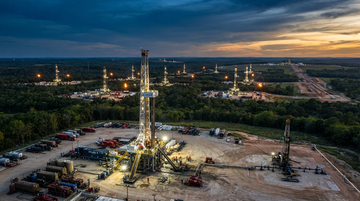
Public reporting ties Citadel's upstream entry to the Paloma Natural Gas acquisition disclosed March 13–19, 2025, not oil: Hart Energy and Bloomberg both valued the deal at $1.0–1.2 billion for a Haynesville-focused private operator carrying ~57,000 net mineral acres in Louisiana and roughly 350 MMcf/d of production at year-end 2024. Paloma was rebranded Apex Natural Gas, and by December 2025 Apex had paid a further $430 million to buy Comstock's Shelby Trough assets plus an undisclosed sum for Houston-based Azul's northwest Louisiana leasehold, lifting committed deal value to roughly $1.6 billion.
Operational thesis
Citadel brought trader thinking to a drilling rig — and the basin moved
Haynesville rigs running (Apex, April 2026)
14
Most active operator in the play; up from 2 rigs at acquisition
Apex DUC inventory (May 2026)
40 wells
Nearly all spudded after mid-2025; built deliberately
Apex production (Dec 2025 peak)
~1.4 Bcf/d
Up from ~600 MMcf/d in June 2025; 2.3x in one winter
Apex share of Haynesville growth (Oct '25–Aug '26)
>50%
Basin added ~2 Bcf/d; five largest peers added just ~600 MMcf/d
The playbook is more trader than operator. Measured Depth's August 2026 reporting shows Apex aggressively choking early-life wells and timing turn-in-lines to harvest gas-price contango — running one frac crew through summer 2025 to bank DUCs while production sat flat at 600 MMcf/d, then unleashing completions into the December 2025 cold snap. The result: production nearly tripled in roughly eight weeks, riding the same seasonal spread Citadel's financial book had been monetizing for years.
M&A bar
Citadel's bid reset the multiple — and the public E&Ps noticed
Apex committed deal value by transaction
Both transactions are private; valuations are from cited reports.
Unit: $B
Paloma (Mar 2025)
Hart Energy / Bloomberg
1.2
Comstock Shelby Trough (Dec 2025)
Bloomberg
0.4
Azul Louisiana (Dec 2025)
Undisclosed
0
Comstock Resources sold the Shelby Trough within twelve months of Apex paying the headline price for Paloma, a sequencing that effectively let Citadel underwrite the asset before writing the check on a follow-on. Comstock exited at $430 million in cash and immediately redirected its rig fleet to the Western Haynesville, where it is now running four rigs and guiding full-year 2026 production of 1.25–1.40 Bcfe/d on $1.4–1.5 billion of capex. The implied read across the basin: a private financial buyer validated Haynesville acreage at premium multiples, and the public operator pocketed the arbitrage.
Midstream response
Williams just paid $5.5B to keep up with the gas Citadel is producing
| Item | Detail |
|---|---|
| Headline value | Up to $5.5 billion |
| Cash + debt / equity split | ~$3.5B cash & debt / ~$2.0B Williams equity |
| Implied multiple | ~8.5x projected 2027 EBITDA |
| Pipeline mileage | More than 4,000 miles |
| Dedicated acres | Over 1 million |
| Gathering capacity | 6 Bcf/d across four areas |
| Take-or-pay transport | Three pipelines, 4.05 Bcf/d |
| Delta Access expansion | $1.5B; 2.25 Bcf/d; online Q1 2029 |
| Shelby Trough Connector | 750 MMcf/d initial; up to 1.5 Bcf/d; online Q2 2028 |
The logic is straightforward. Apex and Comstock are both feeding the Williams Companies system — Williams forecasts a 20% jump in Haynesville gathering-and-processing volumes from 2024 to 2025 alone — and Energy Transfer is taking barrels of incremental supply through its Enable and related systems. By buying Momentum Midstream at the same moment Citadel's play growth is peaking, Williams is locking in dedicated acreage and take-or-pay contracts ahead of the next wave of LNG feedgas demand.
Downstream demand
The LNG pull is what makes the whole trade work
- EIA forecasts total U.S. natural gas production to hit a record in 2026, with the Haynesville contributing about 1.2 Bcf/d of growth — more than half the basin's incremental supply is now coming from Citadel's portfolio.
- Cheniere Energy and Venture Global have roughly 13 Bcf/d of LNG capacity operating or ramping along the Gulf Coast; Plaquemines has crossed 4 Bcf/d of feedgas demand, pulling Haynesville molecules into export.
- Haynesville-to-Gulf pipelines are full. The Transco Delta Access and Shelby Trough Connector expansions (rolled into the Momentum deal) are scheduled to add 3 Bcf/d of incremental transport capacity by 2029.
- Henry Hub spot has been soft through summer 2026 — around $2.70/MMBtu in August per EIA — but forward curves for winter 2026/27 and LNG-linked netbacks justify the basin-construction cost curve that Apex is exploiting.
- The trading trick is timing completions to those winter peaks, which is exactly what Apex did: 600 MMcf/d in summer 2025, 1.4 Bcf/d by December, with another surge likely in early winter 2026.
Competitive impact
What a hedge-fund operator does to the public gas names
| Company | Ticker | Market cap | TTM revenue | EV/EBITDA | Net debt / EBITDA |
|---|---|---|---|---|---|
| Comstock Resources | CRK | $4.5B | $1.9B | 5.1x | 2.1x |
| Expand Energy | EXE | $22.9B | $12.7B | 3.9x | 0.4x |
| EQT Corporation | EQT | $34.8B | $9.3B | 6.4x | 0.9x |
| Williams Companies | WMB | $90.1B | $12.3B | 16.2x | 4.1x |
| Energy Transfer | ET | $73.6B | $107.4B | 9.8x | 4.8x |
| Cheniere Energy | LNG | $60.9B | $20.9B | 10.5x | 3.1x |
Apex's growth is enough to dilute the public gas names on a basin-share basis. Across the first half of 2026 the five largest incumbent operators — Aethon, BP, Comstock Resources, Expand Energy, and TG Natural Resources — collectively added only ~600 MMcf/d of new supply, while Apex alone added more than 1 Bcf/d. That means the public E&Ps need either higher realized prices or fresh M&A to defend output, and the cheaper public multiples (Comstock at 5.1x EV/EBITDA, Expand at 3.9x) sit next to a private operator with a multi-year capital advantage from Citadel's balance sheet.
Investment read
Where the trade goes next — short window, long runway
Over days to quarters, the marginal driver is winter weather and Plaquemines ramp. Apex will likely repeat its 2025 playbook of holding summer production flat and unleashing DUCs into the cold snap, so winter 2026/27 spot gas becomes the next observable test of Citadel's model. Over one to three years, the question is whether other financial buyers — the obvious names being Millennium, Balyasny, or a sovereign-wealth LP — replicate Citadel's move into adjacent basins. The infrastructure answer (Williams Companies' Momentum deal, Energy Transfer's Enable system, the Delta Access pipeline) is already being built.
Listed names this thesis actually touches
- Sold Shelby Trough to Apex at $430M in Dec 2025, locking in a premium M&A print above its own 5.1x EV/EBITDA multiple and recycling proceeds into Western Haynesville rigs.
- Q2 2026 production averaged 1.2 Bcfe/d, up 16% QoQ after the divestiture — the company is now reinvesting in tighter Western Haynesville rock with shorter lateral benchmarks.
- RV Myers keeps Comstock at trading at 8.4x trailing earnings, but with Henry Hub below $3 through summer 2026, gas-only economics cap upside unless winter demand spikes.
- Became the largest U.S. natural gas producer in Q2 2026 after the Chesapeake-Southwestern merger, with 42% of 2025 production from the Haynesville.
- Trades at the cheapest multiple in the basin comp set — 3.9x EV/EBITDA and 0.4x net debt/EBITDA — leaving room for re-rating if LNG export demand keeps Haynesville gas in deficit.
- Direct Apex competitor for rig crews and takeaway capacity; Williams' Momentum deal expands the gathering system Expand already feeds.
- Appalachia-focused, not a Haynesville direct play, but the closest listed comp for free-cash-flow yield at 11% TTM and the same LNG-bull thesis.
- Net debt/EBITDA at 0.9x is the lowest among gas-levered peers, giving it balance-sheet optionality if private-equity-style consolidation spreads east.
- Watch the 2027 hedging book: any signal of Citadel-style price-timing strategy from EQT would validate the operator-side answer to the Apex model.
- Closed the $5.5B Momentum Midstream acquisition on Sept. 3, 2026 — adds 4,000 miles of Haynesville pipe and 6 Bcf/d of gathering capacity directly tied to Apex and Comstock volumes.
- EV/EBITDA of 16.2x is the richest in the basin comp set, but the deal implies 8.5x 2027 EBITDA, which compresses the entry multiple by ~7.7 turns relative to the public multiple.
- Delta Access and Shelby Trough Connector expansions bring 3 Bcf/d of new transport online by 2029 — underwritten directly by the gas Citadel's portfolio is producing.
- Enable and related Haynesville systems take incremental Apex production that doesn't flow to Williams; the midstream duel means more take-or-pay contracts for both.
- Trades at 9.8x EV/EBITDA with a 6.2% dividend yield — the most direct yield play on the Haynesville volume wave.
- Quarterly earnings growth of +85% YoY (Q2 2026) shows the gas-NGL volume ramp is already hitting the income statement, not just the press releases.
- Sabine Pass and Corpus Christi terminals absorb Haynesville gas that Apex and Expand are producing — feedgas demand is the structural reason the basin is reactivated.
- Trades at 22.4x trailing earnings but 14.5x forward, the gap reflecting the contracted nature of LNG cash flows.
- Free cash flow yield of 11.6% on TTM — direct beneficiary of any winter 2026/27 gas spike that Apex's deferred-TIL strategy is designed to capture.