Financials
Banks, credit, and where the risk is sitting
Net interest margins, credit quality, capital rules and deal flow — what the numbers say about the banks, insurers and asset managers reporting them.
2026-08-05
%22%2F%3E%0A%20%20%3Ccircle%20cx%3D%22220%22%20cy%3D%22150%22%20r%3D%22180%22%20fill%3D%22%2322d3ee%22%20fill-opacity%3D%220.12%22%2F%3E%0A%20%20%3Ccircle%20cx%3D%221010%22%20cy%3D%22130%22%20r%3D%22220%22%20fill%3D%22%2338bdf8%22%20fill-opacity%3D%220.08%22%2F%3E%0A%20%20%3Ccircle%20cx%3D%22920%22%20cy%3D%22520%22%20r%3D%22170%22%20fill%3D%22%2322d3ee%22%20fill-opacity%3D%220.06%22%2F%3E%0A%20%20%3Cpath%20d%3D%22M140%20430h920%22%20stroke%3D%22url(%23line)%22%20stroke-width%3D%2212%22%20stroke-linecap%3D%22round%22%2F%3E%0A%20%20%3Cpath%20d%3D%22M220%20360c120-150%20260-220%20380-220s260%2070%20380%20220%22%20fill%3D%22none%22%20stroke%3D%22%2367e8f9%22%20stroke-opacity%3D%220.5%22%20stroke-width%3D%2216%22%20stroke-linecap%3D%22round%22%20stroke-linejoin%3D%22round%22%2F%3E%0A%20%20%3Cpath%20d%3D%22M300%20398h600%22%20stroke%3D%22%2394a3b8%22%20stroke-opacity%3D%220.24%22%20stroke-width%3D%228%22%20stroke-linecap%3D%22round%22%2F%3E%0A%20%20%3Ctext%20x%3D%22220%22%20y%3D%22510%22%20fill%3D%22%23e2e8f0%22%20fill-opacity%3D%220.7%22%20font-family%3D%22Arial%2C%20Helvetica%2C%20sans-serif%22%20font-size%3D%2238%22%20letter-spacing%3D%228%22%3EINSIGHTS%3C%2Ftext%3E%0A%3C%2Fsvg%3E)
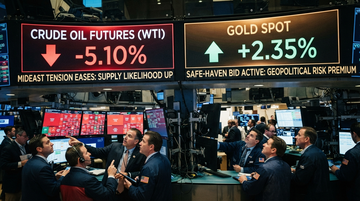
A “deal is imminent” reprice flips oil-and-gold the other way—here’s what it means for Exxon Mobil, Chevron, Delta Air Lines, and Barrick Mining
When reports that a US-Iran “imminent” peace package would reduce Middle East risk hit, oil fell sharply while gold rose—signaling markets are pricing supply-likelihood and safe-haven bid at the same time, but in opposite directions for different asset classes. The first-order implication is not just “lower escalation risk”: it’s a capex and margin timing shift across oil majors, refiners/airlines, and gold miners—turning July’s escalation-premium framework inside out.

S&P 500’s first 7,700 close rewards cyclicals, not AI—because Hormuz de-escalation reprices the “oil risk premium”
The Aug. 4 move looks like a pure tech-led rally, but the Dow’s +907 point surge vs the Nasdaq’s +2.6% pop signals investors are rotating into cyclicals that benefit directly when Hormuz-risk compresses oil and shipping insurance. With oil trading below ~$80 amid de-escalation chatter, the first 7,700 print becomes a sector composition signal—not just a momentum milestone.
2026-08-04

AI’s $1 Trillion Lease Tab: Hyperscalers Shift Utilization and Refinancing Risk—But It Reappears Everywhere
Moody’s estimates $662B of future data-center lease commitments across the largest U.S. hyperscalers sit off balance sheets because they’re not yet commenced—despite the projects being financed and under construction. That shifts occupancy and refinancing risk down the supply chain, turning “leased compute” into a system-wide obligation map investors can’t ignore.

Apollo Is Proving Its Fee Engine Works—But Q2’26 Shows Realization Markets Still Decide “Principal Investing”
In Apollo’s Q2’26 results, Fee Related Earnings rose to $785M (+25% YoY) and Spread Related Earnings to $877M, reinforcing the recurring “fee engine.” But Realized performance fees were only $130M and total realizations were $(32.0)B, showing that equity/credit exit timing can still move the earnings mix—and potentially mask growth quality if asset sales are used to smooth quarter-to-quarter results.
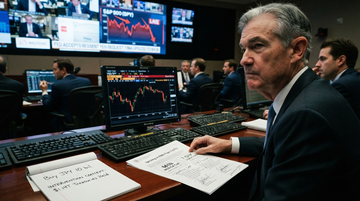
Bessent’s yen request turned the Fed’s FX backstop into a global market-shock switch—starting with $60B per week
When Scott Bessent urged the Fed to “upsiz[e]” its FIMA Repo Facility, the US stopped treating yen defense as just a Treasury operation. That matters because the Fed backstop (up to $60B in USD lending for up to seven days) can amplify cross-border funding stress and make “155 per dollar” a global volatility trigger rather than a Japan-only headline.

Broadridge’s “Profit Gain” Isn’t the Event Cycle—It’s Recurring Market Plumbing Getting More Utilized
Broadridge’s latest earnings show profit rising faster than event-driven activity, with recurring revenue growth lifting both segment earnings and adjusted EPS. The key tell: governance/communications (ICS) keeps scaling, and new proxy/disclosure coverage for tokenized securities suggests the “shareholder communications toll booth” is widening rather than just riding transaction spikes.

Prudential Financial's PGIM beat is real—but the deeper signal is whether the business is shifting toward less capital-heavy earnings
In Q1 2026, Prudential Financial reported PGIM adjusted operating income of $190m (+22% YoY), while its insurance-side profitability weakened in the same quarter. The implication for investors: if fee-based growth keeps pacing (and insurance capital intensity keeps easing), PRU may deserve a valuation framework closer to asset managers than traditional insurers.
2026-08-03

Berkshire’s Abel week is a value-rotation tell: cutting Chevron yet elevating Alphabet into a “virtual monopoly” position
In Greg Abel’s first-week-era moves, Berkshire reduced Chevron exposure while pushing Alphabet into a new top-5 “virtual monopoly” role—using concentration to express a new conviction stack rather than pure cash-and-yield defensiveness. For active managers, the investable takeaway is that Berkshire’s re-rating map is shifting from “dividend insulation” toward “moat + compounding” inside the public-equity sleeve, even when it means exiting parts of the energy/cash yield complex.

JPMorgan Chase's $750B housing signal shifts mortgage REIT math and homebuilder unit paths through 2035
JPMorgan Chase says it will deploy over $750B through 2035 to expand U.S. housing supply, homeownership, and mortgage lending. The supply impulse is real, but the tradable read-through hinges on rate-cut timing because mortgage-spread and funding-cost dynamics drive mortgage REIT earnings and lock in homebuilder lot economics.

The July Jobs Report Must Clear a 57,000 Payroll Bar—But the 4.70% 10-Year Has Already Priced a Hawkish Rebound
The Federal Reserve’s 9–3 hold on July 29 was more hawkish than the headline: three officials wanted an immediate hike, and Chair Kevin Warsh said higher underlying inflation would trigger tightening. July payrolls therefore matter through wages and labor supply, not merely the job count. A hot combination would validate the 68% prediction-market odds of a 2026 hike and pressure duration-sensitive assets; a weak, broad-based report would challenge a 10-year Treasury yield already at 4.70%.

US regulators aren’t just policing fair lending—they’re forcing banks to prove where “community development” grant money actually goes
The OCC/FDIC proposal ties CRA-adjacent fair-lending scrutiny to a concrete “credit-allocation” proof: banks must demonstrate that most community development grant funds are spent in the relevant communities—and that grant recipients don’t run high overhead. The economic effect is simple: this rule shifts cost and compliance burden toward relationship banks that rely on mission spending, compressing the returns on “CRA-style” balance-sheet and programmatic allocations.

Okta Paid Nearly $200M for the Missing Layer in AI Security
Okta is buying Permiso Security to extend identity protection from login and access control into the behavior of human, machine, and agentic identities. The reported price is nearly $200 million, but the more important signal is strategic: the security platform that owns post-access telemetry may control the next AI-security budget.
2026-08-02

Ares Printed $36B in a Quarter. The Same Quarter It Capped Withdrawals on a $10.7B Fund.
Ares Management hauled a record $36B in Q2 2026 and stacked it on top of $30B in Q1 — yet the same firm capped redemptions at 5% on its Ares Strategic Income Fund because quarterly withdrawal demand hit 14.4% of NAV. The fundraising headline conceals a two-speed market: closed-end flagship and BDC vehicles absorb a record wave of institutional capital, while the open-end retail-facing fund faces the worst redemption stress in its history. For investors, the trade is not 'private credit is the risk' or 'private credit is the trade' — it is the wedge between them.

Capital One's 'AML, Not Politics' Filing Hits a Court Where the White House Already Sits as Prosecutor — That's Why the 0.5% Stock Move Is the Wrong Read
On August 1, 2026, Capital One told a federal court it closed 300+ Trump Organization accounts in March 2021 after a months-long AML review — not political bias. COF shares closed down just 0.54% on the news, but the filing lands inside a coordinated Washington push (EO 14331, the December 2025 OCC report naming nine banks including COF, and a June 2026 DOJ debanking subpoena sweep) that has already converted reputational risk from a private accounting concept into a regulatorily-actionable claim. The brief is correct that this hasn't been priced; the better read is that the market is treating an AML defense as a fact pattern, when it is actually a precedent that re-opens every PEP-exit file across the consumer bank complex.

Chime's 10% Layoff Is a Fintech Earnings Story, Not an AI Story — and That's the Trade
Chime Financial cut 10% of staff on July 31, 2026 — the first post-IPO deposit-franchise fintech to break a cost story at scale — but the math is more about a $2.19B revenue company trying to widen a 1-month-old GAAP profit margin than about AI replacing engineers. With Visa's 7% cut landing three days earlier, Robinhood's 10% cut pre-positioned, and Affirm's CEO publicly rejecting the AI layoff narrative, the real question for investors is whether AI becomes an excuse for ordinary post-IPO discipline, or a structural opex reset that re-rates the entire consumer-fintech cohort.

Citadel Just Became the AI Correction's Buyer of Last Resort
Ken Griffin's Citadel quietly absorbed roughly $16B of public AI-stock exposure from Leopold Aschenbrenner's Situational Awareness after the 24-year-old's fund dropped 67% in July. The first true whale-buying event of the 2026 chip rout removes a leveraged marginal long, hands the bag to a $67B multi-strategy shop, and leaves private AI names like Anthropic as the only place the survivors still want to be.

Private Credit Splits in Two: Ares Management Hoards $36B While Blue Owl Capital Scrapes $7.6B — and the $15.6B Retail Redemption Queue Names the Loser
In a single 48-hour window, Ares Management printed a record $36B of Q2 fundraising (Jul 31) while Blue Owl Capital reported its slowest quarter in three years at $7.6B (Jul 30). The same week, $15.6B of redemptions were requested from retail private-credit funds — and only $5.9B, or 38%, were actually returned. The ranking is now quantifiable: institutional-scale managers with diversified platforms and asset-based finance (Ares) are vacuuming up capital, while retail-marketed direct lenders (Blue Owl, Apollo, Blackstone) are repricing access. Ares Management trades at 57x trailing earnings for the privilege; Blue Owl Capital trades at 86x for a direct-lending franchise that fell to 35% of AUM.

The Small-Cap Rally Is Real—but August Must Prove It Is More Than a Rate-Cut Trade
The Russell 2000’s reported 10.3% July gain against a 1.2% rise for the S&P 500 marked a sharp breadth shift, but the evidence is not yet strong enough to call it a durable earnings cycle. Regional banks, industrials, energy and AI-infrastructure names all contributed to the broader move, while the Federal Reserve’s 3.50%–3.75% policy range keeps the trade highly sensitive to rates. August’s test is simple: do earnings revisions and credit conditions validate the rally, or does crowded positioning reverse?
2026-08-01

2026-07-31

What to expect
Evidence-first notes with a visible point of view.
This section collects sharp takes on earnings, shareholder meetings, and market structure. Each new piece should make the thesis, the facts, and the implications obvious within the first few screens.
Expect direct analysis, not generic commentary.
Expect the data to be explicit and the argument to be easy to follow.
Plutux is not an investment adviser. Market data and AI-generated analysis are for information and education only, not investment advice. Disclaimer