Financials
Banks, credit, and where the risk is sitting
Net interest margins, credit quality, capital rules and deal flow — what the numbers say about the banks, insurers and asset managers reporting them.
2026-07-31
%22%2F%3E%0A%20%20%3Ccircle%20cx%3D%22220%22%20cy%3D%22150%22%20r%3D%22180%22%20fill%3D%22%2322d3ee%22%20fill-opacity%3D%220.12%22%2F%3E%0A%20%20%3Ccircle%20cx%3D%221010%22%20cy%3D%22130%22%20r%3D%22220%22%20fill%3D%22%2338bdf8%22%20fill-opacity%3D%220.08%22%2F%3E%0A%20%20%3Ccircle%20cx%3D%22920%22%20cy%3D%22520%22%20r%3D%22170%22%20fill%3D%22%2322d3ee%22%20fill-opacity%3D%220.06%22%2F%3E%0A%20%20%3Cpath%20d%3D%22M140%20430h920%22%20stroke%3D%22url(%23line)%22%20stroke-width%3D%2212%22%20stroke-linecap%3D%22round%22%2F%3E%0A%20%20%3Cpath%20d%3D%22M220%20360c120-150%20260-220%20380-220s260%2070%20380%20220%22%20fill%3D%22none%22%20stroke%3D%22%2367e8f9%22%20stroke-opacity%3D%220.5%22%20stroke-width%3D%2216%22%20stroke-linecap%3D%22round%22%20stroke-linejoin%3D%22round%22%2F%3E%0A%20%20%3Cpath%20d%3D%22M300%20398h600%22%20stroke%3D%22%2394a3b8%22%20stroke-opacity%3D%220.24%22%20stroke-width%3D%228%22%20stroke-linecap%3D%22round%22%2F%3E%0A%20%20%3Ctext%20x%3D%22220%22%20y%3D%22510%22%20fill%3D%22%23e2e8f0%22%20fill-opacity%3D%220.7%22%20font-family%3D%22Arial%2C%20Helvetica%2C%20sans-serif%22%20font-size%3D%2238%22%20letter-spacing%3D%228%22%3EINSIGHTS%3C%2Ftext%3E%0A%3C%2Fsvg%3E)

2026-07-30

Did the Fed’s “worst-long-bond-day” finally break the 30-year Treasury auction? The market is about to learn via the bid-cover vs. tail
Today’s $25B 30-year auction is the first real stress test of whether foreign/indirect demand still absorbs US long-end supply at a 5%+ post-Fed backdrop. The key isn’t the headline yield alone—it’s whether bid-cover holds while the tail (price concession) stays contained versus recent auctions, i.e., whether the “Fed put” is transmitting into auction clearing.

Blue Owl hits $319B AUM—here’s whether fee-related earnings actually scale with it
Blue Owl’s $319B AUM headline is the starting point, but the investable question is whether more AUM is converting into higher-quality, recurring fee-related earnings without showing stress in fee-earning engines. Based on the data available from this session, the key performance signal to watch is whether fee-related earnings rise alongside AUM that is already “paying fees” versus AUM “not yet paying fees.”

Coinbase's Third Straight Loss Confirms the Split: Volume Exchanges Are Toll Booths, Robinhood-Style Brokers Are Not
Coinbase reported a $359.5M net loss on $1.22B revenue for Q2 2026 — its third consecutive quarterly miss — even as Robinhood printed a record $1.31B (+32% YoY) on the same day. The structural lesson: transaction-revenue exchanges bleed when spot volumes cool, while diversified consumer brokers hedge with event contracts, equities, and Gold subscriptions. The losers include the listed crypto-treasury cohort — Strategy just logged an $8.3B bitcoin write-down — while stablecoin policy (GENIUS Act yield ban) now threatens Coinbase's most defensive line.
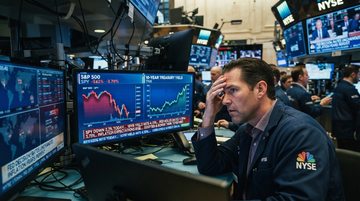
Fed’s 9–3 “hawkish hold” turns internal dissent into a credibility premium for rates
When three voting regional presidents dissented in a 9–3 hold, it didn’t just change the policy path—it changed how markets price the next move. For investors, the actionable risk is not the hold itself, but that repeated visible dissent can widen the policy-risk premium and stress rate-sensitive earnings narratives—especially for banks whose income depends on the curve.

Fitch Calls an “AI Market Correction” a Top Global Credit Risk—So Hyperscaler Downgrades Look Like the First Domino, Not the Last
Fitch’s framing turns AI capex from a company-credit story into a system-credit variable: a potential market correction would hit funding costs, debt rollovers, and even credit quality across sectors and geographies. When paired with the hyperscaler warning line (capex/leases straining near-term credit metrics), it implies bond investors may reprice not just a few mega-cap issuers, but the broader credit “plumbing” that finances the AI build-out.

Goldman Sachs's "private markets platform" shows the real AI threat: distribution, not models
Goldman Sachs is formalizing a private-markets/alternatives platform for wealthy clients and creating a dedicated team structure to source direct private-company stakes. That matters to public asset managers because the easiest way to monetize AI in wealth is to ship allocations and portfolio access as software, shifting economics away from fees-on-AUM and toward product-led, account-sticky distribution.

ICE’s $5.7B MarketAxess bid can’t be modeled as “more liquidity”—it’s a fixed-income toll booth shift that squeezes execution and data economics
The paper-thin wedge regulators will focus on is not total bond liquidity—it’s who gets to charge for the electronic plumbing after ICE and MarketAxess consolidate fixed-income trading. If the $5.7B bid is approved on the stated economics, electronic credit and corporate-bond ETF “pick-up” spreads become a pricing battleground between the new duopoly’s toll booth and the ETF/dealer demand chain.
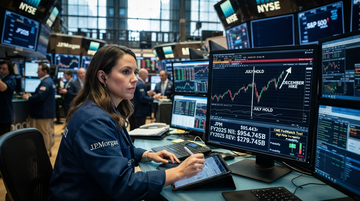
JPM: The first sell-side vote of confidence that makes “hawkish hold” the base case—December hike, not March-2027
J.P. Morgan Global Research moved its next Fed hike call to a quarter-point in December after the July hold, aligning with the hawkish-hold interpretation that Warsh signaled. For US banks, that timing shift matters most for NII sensitivity to the September path—and it changes how much “duration risk” the market is forced to price before year-end.
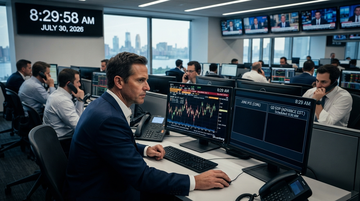
The “double-print” (PCE + Q2 GDP) is a single Fed test—because both prices and growth hit at 8:30 a.m.
Today’s BEA calendar stacks Personal Income and Outlays (June PCE) and GDP (Advance Estimate) (Q2) on the same 8:30 a.m. window, turning the usual macro routine into one all-in policy-input read. The market should treat the next 24 hours as a fork: core PCE cooling is what lets the Fed plausibly look through hot growth, while both running hot is what feeds a 30-year auction-driven duration selloff.
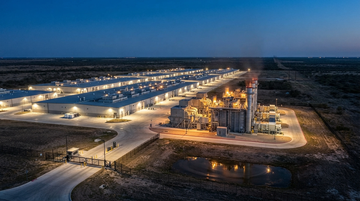
Google's $15B Nexus Loan Is Sovereign Finance in Disguise — and Alphabet's Capex Math Just Got Worse
Alphabet is guaranteeing the Morgan Stanley-led $14B bridge loan on Nexus Data Centers' 1.6 GW Texas gas-powered AI campus for Anthropic, taking ~20% equity in return — the third leg of a $35B+ backstop program that moves frontier compute off Google's balance sheet while keeping it on the hook. With Q2 capex already at $44.9B and free cash flow turning negative, the structure reveals the real constraint: not capital, but the gap between Google Cloud growth and depreciation absorption. Lenders win fees; Broadcom, AMD, and gas-turbine suppliers win volume; the question is what triggers Google's cash calls.
2026-07-29
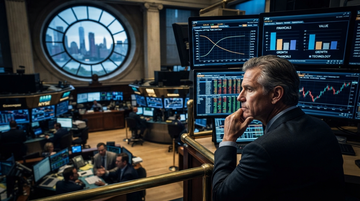
A Hawkish Fed Hold Can Still Ease Financial Conditions—So September Pricing Becomes a Sector-Shift, Not a Rate-Path Story
The Fed’s July hawkish hold (rates unchanged, but inflation risk and a wider policy-path conversation) can still transmit to markets through the financial-conditions channel—not just the policy-rate channel. That means September repricing is likely to favor banks and value-style cashflows that benefit when funding costs don’t tighten as much as the Fed’s tone implies, while duration-heavy growth remains hostage to term-premium volatility.

Robinhood's profit beat looks like a volume-quality win, but only if net interest stays sticky while crypto swings fade
Robinhood HOOD reported Q1 2026 net income of $346M on $1.07B of total net revenue, with transaction-based revenues up 7% and net interest revenues up 24%. The key durability question is whether higher trading activity is coming from broader, recurring funded engagement (and improving ARPU) versus a temporary volatility tailwind—especially as crypto revenue fell 47% YoY.

SoFi's record lending meets a funding-cost advantage—so the real test is credit volatility
SoFi raised full-year 2026 adjusted net revenue guidance to $4.75B–$4.85B while reporting record loan originations and higher members. The underappreciated part isn’t fintech momentum—it’s whether its deposit-driven cost-of-funds edge and low-to-mid single-digit net charge-offs can persist as loan books scale.
![S&P Global [SPGI] just showed “AI cost-down” didn’t break its pricing power—yet the tollbooth is shifting from “data volume” to “trusted decision workflow” insight cover](https://images-1379091077.cos.na-ashburn.myqcloud.com/insights/covers/20260729_spgi_data_tollbooth_360px.png)
S&P Global [SPGI] just showed “AI cost-down” didn’t break its pricing power—yet the tollbooth is shifting from “data volume” to “trusted decision workflow”
In its latest quarter, [SPGI] grew total revenue to $4.146B (+10% y/y) while pushing adjusted operating margin to 54.3% (+200 bps y/y), including strong momentum in Ratings (+17% revenue) and Indices (+20%). The key durability test for an AI-led commoditization cycle is whether clients still pay for S&P Global’s workflow-trust layer—not whether AI can generate generic analysis cheaply.

UBS Group AG's $3B buyback is a capital-friction test: wealth growth can’t save the payout if RoCET1 drops
UBS says it will buy back another $3 billion of registered shares in 2026, with the program running from 30 July 2026 to no later than 28 July 2028. The investable question is whether UBS can keep turning wealth inflows into enough distributable earnings (RoCET1 and net profit), even when wealth-management flows and regulators create “capital friction.”

Visa’s Beat Says “Strong Volumes”—but the Travel Signal It Hides Changes the Mix Question
Visa’s latest beat is strongly supported by payments-volume growth and cross-border expansion, with travel-related activity explicitly cited as a driver of cross-border volume. But the filings do not disclose a U.S. “travel share of spend” or merchant-category mix, so investors can’t tell whether travel is lifting the quality of U.S. spending (higher ticket, more recurring spend) or whether weaker non-travel categories are being masked.
2026-07-28
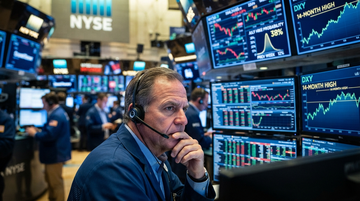
A “Hawkish Hold” Can Cut the Same Way as a Hike: Why September’s Fed Path Is Now Trading Like It’s Tightening Again
Ahead of the July 28–29 FOMC decision, market pricing has jumped toward a near-term hike outcome (CME FedWatch around the high-30% range), while the U.S. dollar is already acting like policy tightening (DXY at a 14-month high). The result is a positioning mismatch: even if the Fed holds, the updated SEP signaling for later in 2026 can still transmit a hawkish shock to chips, banks, and the dollar.

Visa’s 7% tech workforce cut signals a new AI-efficiency baseline—Mastercard and PayPal will be judged on cost/ROI, not just growth
Visa’s planned ~2,600-job (7%) cut—primarily in technology and product—frames AI not as “extra spend,” but as a mandate to reset operating leverage. That raises the bar for Mastercard and PayPal: investors will likely reward any proof that AI reduces unit costs faster than it increases opex, while BNPL and other fintech models must show similar cost discipline or face multiple compression.
2026-07-27

What to expect
Evidence-first notes with a visible point of view.
This section collects sharp takes on earnings, shareholder meetings, and market structure. Each new piece should make the thesis, the facts, and the implications obvious within the first few screens.
Expect direct analysis, not generic commentary.
Expect the data to be explicit and the argument to be easy to follow.
Plutux is not an investment adviser. Market data and AI-generated analysis are for information and education only, not investment advice. Disclaimer