%22%2F%3E%0A%20%20%3Ccircle%20cx%3D%22220%22%20cy%3D%22150%22%20r%3D%22180%22%20fill%3D%22%2322d3ee%22%20fill-opacity%3D%220.12%22%2F%3E%0A%20%20%3Ccircle%20cx%3D%221010%22%20cy%3D%22130%22%20r%3D%22220%22%20fill%3D%22%2338bdf8%22%20fill-opacity%3D%220.08%22%2F%3E%0A%20%20%3Ccircle%20cx%3D%22920%22%20cy%3D%22520%22%20r%3D%22170%22%20fill%3D%22%2322d3ee%22%20fill-opacity%3D%220.06%22%2F%3E%0A%20%20%3Cpath%20d%3D%22M140%20430h920%22%20stroke%3D%22url(%23line)%22%20stroke-width%3D%2212%22%20stroke-linecap%3D%22round%22%2F%3E%0A%20%20%3Cpath%20d%3D%22M220%20360c120-150%20260-220%20380-220s260%2070%20380%20220%22%20fill%3D%22none%22%20stroke%3D%22%2367e8f9%22%20stroke-opacity%3D%220.5%22%20stroke-width%3D%2216%22%20stroke-linecap%3D%22round%22%20stroke-linejoin%3D%22round%22%2F%3E%0A%20%20%3Cpath%20d%3D%22M300%20398h600%22%20stroke%3D%22%2394a3b8%22%20stroke-opacity%3D%220.24%22%20stroke-width%3D%228%22%20stroke-linecap%3D%22round%22%2F%3E%0A%20%20%3Ctext%20x%3D%22220%22%20y%3D%22510%22%20fill%3D%22%23e2e8f0%22%20fill-opacity%3D%220.7%22%20font-family%3D%22Arial%2C%20Helvetica%2C%20sans-serif%22%20font-size%3D%2238%22%20letter-spacing%3D%228%22%3EINSIGHTS%3C%2Ftext%3E%0A%3C%2Fsvg%3E)
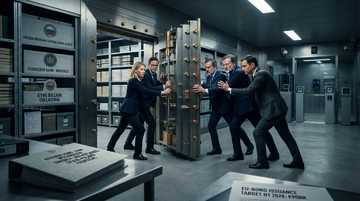
Russian central bank assets frozen at Euroclear
€195bn
End-FY2025, per Euroclear's 2025 annual results press release, Feb 4, 2026
EU-Bond issuance target, H1 2026
€90bn
€45.4bn issued by mid-June, per European Commission press release, Jun 2026
Ukraine defense funding gap, 2026
€23bn
Per Politico, Aug 24, 2026; on top of €30bn already pledged from the €90bn EU loan
Windfall profit paid to EU from Russian assets (5th transfer)
€1.4bn
EUobserver, Aug 5, 2026; cumulative €8bn since 2022
The trigger
Four capitals just reopened a fight Belgium thought it had won
On August 27, 2026, the Financial Times reported that Sweden, the Netherlands, Spain and Poland have written to the European Commission asking it to revive a plan to fund Ukraine using more than €200bn of immobilised Russian central bank assets, Reuters confirmed the same day. The push comes less than four months after EU leaders finalised an alternative €90bn Ukraine loan on April 23, 2026 — one that deliberately did not touch the Russian reserves, after Belgian Prime Minister Bart De Wever blocked the so-called reparations loan in December 2025. Belgium's defence minister Theo Francken responded on the record that the door on using the Russian assets is \"non-negotiable\" and \"closed,\" but the four-country letter has now forced the issue back onto the agenda before EU foreign ministers met in Ireland the week of September 1, 2026.
Mechanically, the \"reparations loan\" proposed by the European Commission on December 3, 2025 would have the EU borrow cash balances associated with the immobilised Russian assets — ~€210bn in total — and on-lend to Ukraine as a zero-coupon facility that Kyiv only repays after it receives reparations from Russia. The Commission has framed the structure as debt-neutral for Ukraine and as a way to put the principal at risk rather than only the windfall profit. That is the version Belgium rejected, and it is the version the August 27 letter wants back.
The mechanism
What 'debt-backed demand floor' actually means in bond math
Even without the reparations loan, the EU is already running the second iteration of the same idea. The €90bn loan finalised on April 23, 2026 is funded by EU-Bond issuance on the capital markets; the Commission raised its H1 2026 issuance target from €80bn to €90bn and disclosed €45.4bn issued by mid-June 2026, with a separate €80bn funding target set for H2 2026. The structure used today borrows against the EU's \"headroom\" in the long-term budget. The reparations-loan variant would swap that headroom collateral for the Russian reserves themselves — the same cash balances, lent at zero coupon, that today sit on Euroclear's balance sheet earning interest for the EU.
- Collateral: ~€195bn sanctioned Russian securities at Euroclear (FY2025) plus the ~€15bn of related cash balances — a notional collateral pool larger than the entire H1+H2 2026 EU-Bond issuance programme combined.
- Servicing: ~€3–5bn in annual windfall interest, paid into the EU budget since 2024, with €8bn cumulative since 2022 — enough to cover roughly 5% of annual debt service on a €90–210bn programme at current rates.
- Credit enhancement: bondholders carry a claim on the EU budget plus a contingent claim on the immobilised reserves — making new EU-Bond issuance structurally over-collateralised relative to its nominal value.
- Funding throughput: €90bn H1 2026 + €80bn H2 2026 issuance target = ~€170bn of EU sovereign-supranational paper scheduled, with ~€60bn of that earmarked for Ukraine and the rest for recovery and defence.
That is the \"demand floor\" — investors price the bonds knowing that even in a tail scenario where Ukraine defaults and Russia never pays reparations, the principal is anchored to a pool of G7-controlled reserves whose face value already exceeds the issued debt. For pension funds, insurers and reserve managers the structure looks closer to a collateralised EU obligation than a plain sovereign loan, and that is exactly why Belgium's objection is about legal title to the assets, not credit risk.
The reality check
Euroclear is the de facto central bank of the reparations-loan idea
Russian-asset windfall profit: declining with rates, still enormous in absolute terms
Interest earnings on sanctioned Russian assets and corresponding windfall contributions to the EU budget (€ billions).
Unit: € billion
Q1 2025 interest earnings
Down 7.5% YoY on rate cuts
1.5
FY2025 interest earnings
Down 26% YoY
5
FY2025 windfall contribution provisioned
Paid €1.6bn in Jul 2025; €1.4bn due early 2026
3.3
Cumulative windfall profit, 2022–2025
Across all five transfers, per EUobserver, Aug 5, 2026
8
Euroclear's FY2025 results are the cleanest summary of why Belgium and the company are nervous. Underlying business income excluding Russia rose 6% to nearly €1.9bn, but the headline profit line of €1.1bn still leans on €5bn of interest earned on the immobilised reserves. The company has provisioned €342m of additional direct operating expenses for Russian sanctions and countermeasures — a one-line number that captures the legal, compliance and operational cost of being the place where €195bn of another country's reserves is parked. Move those balances, or change their status, and the €5bn earnings stream becomes a different question entirely: a loan principal rather than windfall profit.
Downstream
Defense primes are already monetising the demand — and the backlog tells you who wins
| Company | Backlog | Reporting date | Direct Ukraine link | EV/EBITDA |
|---|---|---|---|---|
| Rheinmetall (rhm.de) | €73bn (Q1 2026); past €80bn by Jul | Q1/Q2 2026 | €1.8bn Ukraine artillery ammo H1 2026; 155mm shell order Jun 30, 2026 | 21.5x |
| BAE Systems (ba.l) | £84.0bn (record) | H1 2026, Jul 30 | Light Gun license agreement with Ukrainian partner, Jul 2026; resupply orders to support Ukraine cited in H1 results | 17.9x |
| Saab AB (saab-b.st) | SEK 318bn (record) | Q2 2026, Jul 17 | Gripen E fighters for Ukraine (SEK 24.6bn contract); €106.6m Tridon air-defense sale | 27.1x |
| Northrop Grumman (noc) | $105bn (record) | Q2 2026, Jul 22 | $3bn PAC-3 MSE acceleration agreements, Aug 2026; Patriot motor production starts FY2026 | 11.7x |
| Lockheed Martin (lmt) | ~$160bn (implied; FY26E) | Q2 2026, Jul 29 | $58.62bn multiyear PAC-3 MSE contract, Jul 29, 2026; 50% production target lift | 14.0x |
| Thales (ho.pa) | Multi-year book ~€45bn est. | H1 2026 | Air-defense missile electronics, EU €6.1bn Ukraine disbursement | 13.8x |
| Hensoldt (hag.de) | Multi-year book ~€5bn est. | H1 2026 | €340m TRML-4D/SPEXER Ukraine radar orders, Jul 2025 | 24.2x |
Rheinmetall is the cleanest single read on the transmission chain. Q2 2026 sales came in at €3,289m, up 69% year-on-year, with operating profit of €562m — and order intake of roughly €11bn, up 476% YoY, was driven by an ammunition package for Hungary and 155mm artillery ammunition for Ukraine. Management ended Q1 2026 with €73bn of backlog and the order book blew past €80bn by late July 2026 on Ukraine onshoring announcements. The implication is mechanical: every additional euro the EU channels through the Ukraine loan ultimately lands in Rheinmetall's weapon-and-ammunition book at margins that have lifted gross profit margin to 37.3%.
- Saab AB — Q2 2026 order intake of SEK 68.4bn (vs SEK 28.4bn prior year) included a SEK 24.6bn Gripen E contract earmarked for Ukraine; the SEK 318bn backlog now represents ~3.1 years of revenue at run-rate.
- BAE Systems — H1 2026 order intake of £16.4bn lifted backlog to a record £84.0bn; the company called out resupply orders to support Ukraine as a contributor in its H1 trading update.
- Northrop Grumman — $3bn of PAC-3 MSE agreements in August 2026 follow the Q2 record backlog of $105bn; production of Patriot solid rocket motors is now starting, closing the supply gap on the interceptor that Ukraine is shortest of.
- Lockheed Martin — the $58.62bn multiyear PAC-3 MSE contract awarded July 29, 2026 commits to roughly doubling interceptor production from ~600/year today toward 2,000/year, with a 50% increase in jobs at the Camden, Arkansas facility.
- Hensoldt — €340m of TRML-4D and SPEXER radar orders placed by Ukraine in July 2025 keep expanding; the radar is one of the few Western sensors with combat-proven data from the Ukraine conflict.
- Thales — €6.1bn of EU defense procurement approved by the Commission in 2026 covers air-defense missiles, ammunition and radars — categories where Thales is a primary European supplier.
Counterparty risk
European banks sit in the middle — and Belgium's fight is really about them
BNP Paribas and ING Groep are the two European banks most often named in any Russian-asset transmission. Direct Ukraine/Russia exposure is in fact modest — BNP Paribas disclosed combined gross exposure of roughly €3bn in March 2022, equivalent to 0.16% of its risk-weighted assets, and has since wound down its Russian subsidiary business. ING terminated the sale agreement for its Russian business in April 2026 after the proposed buyer could not complete the deal, but offshore exposure has fallen roughly 90% to €0.6bn at year-end 2025. The transmission is therefore not credit risk on Russian counterparties — it is legal and operational exposure as primary dealer and settlement agent for the EU-Bond programme that funds the Ukraine loan.
What changes for the banks is the marginal balance-sheet and fee line. EU-Bond issuance is syndicated through a handful of primary dealers; the planned €170bn of issuance across 2026 generates underwriting fees, market-making P&L and repo exposure for the dealer group. BNP Paribas's 4.97x EV/Sales and 9.0x trailing P/E — among the cheapest large European banks — already reflect a market that is not paying for repricing; if the reparations loan goes through, that multiple gap narrows because BNP is structurally long the EU bond complex. ING Groep sits closer to the Dutch political momentum driving the plan and benefits asymmetrically if the issue is reframed as a Dutch-led initiative.
Causal chain
The three steps that turn a frozen asset into a balance sheet, a missile, and a bond
Step one: the EU issues debt against Russian collateral rather than budget headroom. This converts a frozen-but-earning €195bn securities book into the formal junior-senior structure behind EU-Bond issuance — the legal wrapper around what is effectively a G7-coordinated claim on Russian state assets. Step two: the proceeds are on-lent to Ukraine at zero coupon, debt-neutral for Kyiv, and routed through the €6.1bn-per-tranche EU defense procurement disbursements that have already begun. Step three: those disbursments are bid out by Ukraine's Defence Procurement Agency DOT — Ukraine has contracted more than 22,000 unmanned ground vehicles in 2026 alone — and the bulk of the marginal European kit flows through Rheinmetall for shells, Saab for airframes and missiles, Hensoldt for sensors, BAE Systems for vehicles and light artillery. The US interceptor and avionics line gets pulled through Northrop Grumman and Lockheed Martin under FMS contracts funded by allied contributions from EU member states. The chain is the legal wrapper → EU bond demand → defense procurement → prime order book → component supply chain, and the slack variable in the system is whether Belgium concedes on legal indemnity in the September–October 2026 window.
Horizons
What moves first, what moves last, and where the thesis breaks
- Days–quarters: EU foreign ministers meeting in Ireland the week of September 1, 2026 is the next concrete catalyst; a Commission legal workstream on shared indemnity would unlock the door that Belgium currently blocks, and would also re-rate European bank primary-dealer exposure.
- Days–quarters: EU-Bond supply is already running at €45.4bn issued by mid-June toward a €90bn H1 target, with €80bn more targeted for H2 — every month of delay in the reparations loan simply means more of the issuance is uncollateralised against the Russian pool, marginally weakening the demand floor.
- Days–quarters: defense-procurement disbursements — €6.1bn tranche already approved — translate into order intake over 6–18 months, with Rheinmetall, BAE Systems and Saab backlog growth in Q2 2026 showing that the demand is already visible in order books.
- 1–3 years: if the reparations loan passes, Russian retaliatory measures (asset freezes, payment-system disruption) become more likely, raising the operational tail risk for Euroclear and the dealer banks and validating the Belgian position ex post.
- 1–3 years: Ukraine-onshore manufacturing — Rheinmetall's four announced factories, Saab's \"Build in Ukraine\" program, BAE Systems' Light Gun license agreement — shifts defense primes from exporters to embedded producers, extending the revenue tail beyond the active conflict.
- 1–3 years: PAC-3 MSE production scaling from 600 to 2,000 interceptors per year under the July 29, 2026 Lockheed Martin multiyear contract closes the most acute Ukrainian air-defense gap and locks in multi-year revenue at Northrop Grumman, RTX and Lockheed Martin regardless of the EU reparations-loan outcome.
Investable names touched by the reparations-loan debate
- Q2 2026 order intake of ~€11bn (+476% YoY) and backlog past €80bn by July 2026 put the company ~5 years of revenue deep on a TTM pace — and €1.8bn of H1 2026 sales were already Ukraine artillery ammunition.
- Every incremental euro in the EU Ukraine loan has a high probability of landing in the weapon-and-ammunition book at gross margins above 30%, lifting EBIT margin from the current 18.4% as mix shifts.
- Near-term (0–12 months): continued pull-through from the €6.1bn EU defense disbursement tranche; long-term (1–3 years): the four-factory Ukraine-onshore JV extends TAM beyond the active conflict horizon.
- Q2 2026 order intake of SEK 68.4bn (vs SEK 28.4bn prior) lifted backlog to a record SEK 318bn, including the SEK 24.6bn Gripen E contract earmarked for Ukraine.
- EV/EBITDA of 27.1x already prices the demand; the upside comes from the Build-in-Ukraine program turning Saab into an embedded supplier rather than an exporter.
- Near-term (0–12 months): SEK 318bn backlog converts to revenue at 25%+ organic sales growth; long-term (1–3 years): Ukraine-onshore production diversifies the customer base beyond NATO.
- H1 2026 record backlog of £84.0bn and order intake of £16.4bn explicitly include resupply orders to support Ukraine; the Light Gun license agreement signed July 2026 extends that pipeline into Ukraine-onshore production.
- EV/EBITDA of 17.9x is the cheapest among European primes — a margin of safety if the reparations loan is delayed but Ukraine demand persists through the €90bn loan.
- Near-term (0–12 months): £16.4bn H1 order intake translates to revenue over 24–36 months; long-term (1–3 years): UK/European defence uplift plus Ukraine license deals compound the order book.
- €340m of TRML-4D and SPEXER radar orders placed by Ukraine in July 2025 are pure-play exposure to Ukrainian air-defense demand — and Hensoldt is the only Western sensor company with combat-proven radar data from Ukraine.
- At 24.2x EV/EBITDA, the multiple already reflects the premium for sensor exposure, but contract momentum has not slowed and Hensoldt sits inside the EU €6.1bn disbursement chain.
- Near-term (0–12 months): continued TRML-4D orders as Ukraine's air-defense gap persists; long-term (1–3 years): combat-proven radar drives follow-on NATO procurement and extends Hensoldt's positioning into the €170bn 2026 EU-Bond programme.
- The $58.62bn multiyear PAC-3 MSE contract awarded July 29, 2026 commits the company to scaling Patriot interceptor production from ~600/year toward 2,000/year — and Ukraine is the single largest source of incremental demand.
- At 14.0x EV/EBITDA, Lockheed trades cheaper than European primes despite owning the air-defense franchise; the spread is the trade.
- Near-term (0–12 months): PAC-3 MSE deliveries to allied stockpiles feeding Ukraine via FMS transfer; long-term (1–3 years): Ukraine license-production talks for Patriot interceptors extend the platform lifecycle into the 2030s.
- $3bn of PAC-3 MSE acceleration agreements signed August 2026 sit on top of a Q2 2026 record backlog of $105bn — Patriot solid rocket motor production is starting in FY2026, closing the supply gap.
- EV/EBITDA of 11.7x makes Northrop the cheapest major US prime; the EU Ukraine funding flow lifts Patriot interceptor demand regardless of who issues the underlying debt.
- Near-term (0–12 months): Patriot motor and interceptor deliveries feeding allied transfers; long-term (1–3 years): production scaling to 2,000 interceptors/year locks in multi-year revenue visibility.
- Direct Russia/Ukraine exposure is small (~€3bn, 0.16% of risk-weighted assets) but the bank is a primary dealer for EU-Bond issuance — the planned €170bn of 2026 issuance drives underwriting fees and repo P&L.
- 9.0x trailing P/E is the cheapest among large European banks; if the reparations loan passes and tightens spread, the multiple gap narrows. If it fails, BNP still earns the existing programme.
- Near-term (0–12 months): primary-dealership fees on EU-Bond issuance; long-term (1–3 years): legal tail risk if a Russian counterclaim reaches BNP as settlement agent — the asymmetric scenario.