%22%2F%3E%0A%20%20%3Ccircle%20cx%3D%22220%22%20cy%3D%22150%22%20r%3D%22180%22%20fill%3D%22%2322d3ee%22%20fill-opacity%3D%220.12%22%2F%3E%0A%20%20%3Ccircle%20cx%3D%221010%22%20cy%3D%22130%22%20r%3D%22220%22%20fill%3D%22%2338bdf8%22%20fill-opacity%3D%220.08%22%2F%3E%0A%20%20%3Ccircle%20cx%3D%22920%22%20cy%3D%22520%22%20r%3D%22170%22%20fill%3D%22%2322d3ee%22%20fill-opacity%3D%220.06%22%2F%3E%0A%20%20%3Cpath%20d%3D%22M140%20430h920%22%20stroke%3D%22url(%23line)%22%20stroke-width%3D%2212%22%20stroke-linecap%3D%22round%22%2F%3E%0A%20%20%3Cpath%20d%3D%22M220%20360c120-150%20260-220%20380-220s260%2070%20380%20220%22%20fill%3D%22none%22%20stroke%3D%22%2367e8f9%22%20stroke-opacity%3D%220.5%22%20stroke-width%3D%2216%22%20stroke-linecap%3D%22round%22%20stroke-linejoin%3D%22round%22%2F%3E%0A%20%20%3Cpath%20d%3D%22M300%20398h600%22%20stroke%3D%22%2394a3b8%22%20stroke-opacity%3D%220.24%22%20stroke-width%3D%228%22%20stroke-linecap%3D%22round%22%2F%3E%0A%20%20%3Ctext%20x%3D%22220%22%20y%3D%22510%22%20fill%3D%22%23e2e8f0%22%20fill-opacity%3D%220.7%22%20font-family%3D%22Arial%2C%20Helvetica%2C%20sans-serif%22%20font-size%3D%2238%22%20letter-spacing%3D%228%22%3EINSIGHTS%3C%2Ftext%3E%0A%3C%2Fsvg%3E)
Europe rearmament • supply-chain economics
The headline isn’t the missile range—it’s where the factory sits
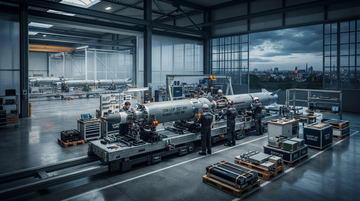
Germany’s missile expansion is moving into a new procurement phase: instead of paying to import completed rounds (or paying a premium purely for European “local content”), a U.S.-linked startup is reportedly planning to build production capacity inside Europe.
According to Reuters, Covenant plans to begin producing intermediate-range missiles near Leipzig from 2027, targeting ranges of more than 1,500 km and capacity of up to 1,000 missiles per year.
Planned start
2027
Reuters report on Covenant’s planned missile production near Leipzig (Germany)
Range target
>1,500 km
Reported missile range requirement in the Reuters report
Capacity target
≤1,000/yr
Reported potential production capacity in the Reuters report
What changed in the upstream logic
Why “local production” flips the buy-local math for U.S. primes
The traditional buy-local critique against U.S. defense primes is that localizing assembly without transferring core production “stays expensive”: Europe buys the prime’s design and then still needs European capacity, leading to higher unit costs, schedule slips, or duplicated tooling.
But a localized plant can also invert that equation if the prime (or its supply base) can internationalize bill-of-materials and manufacturing steps quickly. In that scenario, the premium shifts from “importing finished missiles” to “exporting industrial know-how and subsystems into a European production line.”
- If Covenant’s line ramps in Germany, European procurement teams can fund throughput inside Europe instead of repeatedly re-qualifying imported rounds.
- For U.S. primes, localized production can support longer-cycle revenue visibility (multi-year production contracts vs. episodic shipments).
- A European factory also compresses “last-mile” logistics risk—meaning the supplier bottleneck shifts upstream to motors, navigation/controls, and guidance components rather than freight.
Supply-chain map
Where the localization premium likely lands in the missile bill of materials
Even when the prime delivers the system, missile production is a system-of-systems: propulsion, warhead integration, guidance and control, seekers, and precision manufacturing matter at scale.
Reuters’ report also notes that most components are expected to be sourced from Germany and other European countries—so the “economic capture” of localization should be shared with European industrial suppliers that can meet qualification and volume requirements.
| Supply-chain node | What local factories change | What investors should watch |
|---|---|---|
| Propulsion & motors | Qualification cycles shrink when production is domestic; procurement batches stabilize | Whether European suppliers can scale without price spikes or lead-time blowups |
| Guidance, navigation & control | European production can de-risk export and lead-time variability | Qualification throughput and firmware/tooling reuse across sites |
| Precision manufacturing & integration | Local lines reduce logistics friction but require industrial tooling capacity | New plant capex and throughput ramp plans from primes and key subcontractors |
| Warhead & safety subsystems | Local sourcing can shorten delivery windows for fill/assembly steps | Whether bottlenecks move to energetic materials capacity |
Capacity precedent in Europe
This isn’t the first time Europe paid for production—Patriot co-production shows the model
The key pattern is that Europe increasingly wants “plants, not just platforms.” Reuters previously described a co-production approach for Patriot components: MBDA will build a new Patriot production facility in southern Germany for PAC-2 missiles, described as doubling global production capacity. Reuters also reported a $5.1 billion contract to purchase up to 1,000 PAC-2 missiles, with production scheduled to start at the end of 2026 and deliveries beginning in early 2027.
That timeline rhymes with the Covenant plan to start production in 2027 near Leipzig—suggesting Europe is aligning procurement cadence to industrial ramp-up cycles.
Reuters-detailed European missile production milestones (two examples of the ‘plant-first’ model)
Both cases emphasize European manufacturing capacity coming online around late 2026–2027.
Unit: Year
Patriot PAC-2 facility start (MBDA, southern Germany)
Reported scheduled production start at end of 2026
2,026
Patriot PAC-2 deliveries begin (early 2027)
Reported first deliveries beginning in early 2027
2,027
Covenant Leipzig missile production start
Reported start from 2027
2,027
What it means for U.S. defense primes’ fundamentals
Why “production scale” is a better earnings catalyst than “Europe buy-local” rhetoric
If production capacity expands inside Europe, U.S. primes that can supply subsystems or manage production integration can benefit even if the final assembly occurs overseas. In practice, that means investor focus should shift from unit-cost debates to fundamentals that track industrial execution: revenue durability, margin stability, and cash conversion during ramp years.
As a concrete anchor for how scale-ready primes behave, Lockheed Martin’s financial base shows the kind of cash-generating engine that can absorb ramp costs. In FY2025 (reported Jan 29, 2026), Lockheed Martin reported revenue of $75.06B, operating income of $7.73B, and net income of $5.02B—figures that support the ability to finance program execution and sustain backlog-driven demand.
Lockheed Martin FY2025 revenue
$75.1B
FY2025, reported Jan 29, 2026
Lockheed Martin FY2025 net income
$5.0B
FY2025, reported Jan 29, 2026
Lockheed Martin FY2025 operating cash capacity proxy
EV/FCF ~18.7x
FY2025 metrics as reported in the key metrics set
Horizons
What moves first (quarters) vs. what compounds (1–3 years)
- Near term: investors should watch contract-visibility signals—framework agreements, supplier qualification awards, and any mention of component sourcing in program updates.
- Near term: the fastest-to-price effect is usually capex and working-capital planning at primes and key subcontractors supporting European line builds.
- 1–3 years: the compounding effect comes from throughput-linked follow-on orders once early lots prove out performance and reliability.
- 1–3 years: the main risk is qualification bottlenecks—if guidance, propulsion, or energetic-material supply can’t scale in Europe, the local-production plan can slip even with factories in place.
Investor synthesis
The thesis: localized missile production rewards primes that already run “scale systems”
The strategic takeaway from Reuters’ Leipzig-report is not that missiles will be “made in Europe.” It’s that Europe is increasingly funding production plants with timelines that force industrial scale—turning procurement from a buy-vs-build political question into an industrial-output question.
That dynamic can benefit primes (and prime ecosystems) with proven ramp capability and cash generation, because they’re positioned to supply subsystems, manage integration across sites, and bid follow-on lots as European lines prove they can sustain output.
Listed stock plays the event’s most likely transmission channels
- FY2025 revenue of $75.1B supports program financing while European production scales over 2027–2029.
- FY2025 operating income of $7.7B indicates margin durability that can absorb ramp costs better than weaker cash generators.
- If European localization expands subsystem demand, Lockheed Martin’s backlog-linked revenue should stay less shipment-volatile than pure import models.
- Guidance, electronics, and systems integration are likely localization beneficiaries; watch for Europe-specific qualification awards tied to missile production lines into 2027.
- European plant timelines tend to surface in contracting patterns; expect the first price-relevant disclosures in 2026–early 2027 if line-build procurement is formalized.
- If demand shifts to locally produced missiles, RTX should benefit only if it wins repeat subsystem scope rather than one-off R&D.
- If European procurement shifts toward sustained output, watch for production-linked contracts that extend revenue visibility beyond single deliveries.
- A build-at-scale model increases the value of companies with proven manufacturing execution; GD is a watch candidate for supplier scope expansion into 2027.
- The risk is that qualification cycles delay shipments; if that happens, GD’s near-term order conversion could lag expectations.
- Localization in Germany should increase demand for European integration and energetic/systems supply; Rheinmetall is well placed to capture industrial-volume orders as output ramps.
- If most components shift toward Germany and European sourcing, Rheinmetall’s role could move from tactical suppliers to steady production enablers.
- Near-term uncertainty remains until specific subsystem awards are disclosed; still, the Leipzig-area plant raises the probability of sustained German sourcing.