%22%2F%3E%0A%20%20%3Ccircle%20cx%3D%22220%22%20cy%3D%22150%22%20r%3D%22180%22%20fill%3D%22%2322d3ee%22%20fill-opacity%3D%220.12%22%2F%3E%0A%20%20%3Ccircle%20cx%3D%221010%22%20cy%3D%22130%22%20r%3D%22220%22%20fill%3D%22%2338bdf8%22%20fill-opacity%3D%220.08%22%2F%3E%0A%20%20%3Ccircle%20cx%3D%22920%22%20cy%3D%22520%22%20r%3D%22170%22%20fill%3D%22%2322d3ee%22%20fill-opacity%3D%220.06%22%2F%3E%0A%20%20%3Cpath%20d%3D%22M140%20430h920%22%20stroke%3D%22url(%23line)%22%20stroke-width%3D%2212%22%20stroke-linecap%3D%22round%22%2F%3E%0A%20%20%3Cpath%20d%3D%22M220%20360c120-150%20260-220%20380-220s260%2070%20380%20220%22%20fill%3D%22none%22%20stroke%3D%22%2367e8f9%22%20stroke-opacity%3D%220.5%22%20stroke-width%3D%2216%22%20stroke-linecap%3D%22round%22%20stroke-linejoin%3D%22round%22%2F%3E%0A%20%20%3Cpath%20d%3D%22M300%20398h600%22%20stroke%3D%22%2394a3b8%22%20stroke-opacity%3D%220.24%22%20stroke-width%3D%228%22%20stroke-linecap%3D%22round%22%2F%3E%0A%20%20%3Ctext%20x%3D%22220%22%20y%3D%22510%22%20fill%3D%22%23e2e8f0%22%20fill-opacity%3D%220.7%22%20font-family%3D%22Arial%2C%20Helvetica%2C%20sans-serif%22%20font-size%3D%2238%22%20letter-spacing%3D%228%22%3EINSIGHTS%3C%2Ftext%3E%0A%3C%2Fsvg%3E)
Verified event • contracts are the mechanism
Golden Dome’s next procurement round is explicitly structured as a multi-year, multi-design prototype sprint
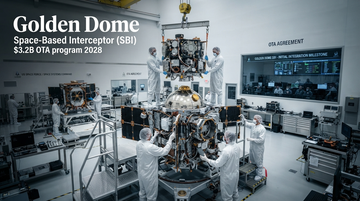
On April 24, 2026, the U.S. Space Force’s Space Systems Command (SSC) announced Other Transaction Authority (OTA) agreements under the Space-Based Interceptor (SBI) program in support of Golden Dome.
Announcement date
Apr 24, 2026
SSC SBI / Golden Dome OTA agreements announced by Space Force
Agreement structure
OTA
20 OTA agreements
Potential combined value
Up to $3.2B
Combined award value for the OTA agreements
Awardees
12 companies
20 agreements distributed across 12 organizations
Prototype integration milestone
By 2028
Demonstrate an initial capability integrated into Golden Dome architecture by 2028
- The Space Force named the SBI OTA awardees (including SpaceX, Northrop Grumman, Lockheed Martin, and RTX) alongside multiple non-typical defense primes and subsystem-focused firms.
- The stated goal is not a single winner-procure-and-produce path; it funds multiple competing prototypes and then converges on integration timing.
What changed • why it matters to investors
The contract cycle turns integration bottlenecks into the dominant driver of who gets pulled forward
This procurement approach changes what “winning” means. When prototypes are funded via OTA across many designs and the stated convergence point is 2028, the limiting factor becomes execution timing: sensor/kinetic integration readiness, interface maturity, test throughput, and the ability to scale supply for the converged architecture—not simply proposal quality.
| Supply-chain choke point | What the contract structure rewards | What slips when integration lags |
|---|---|---|
| Component procurement lead-time (specialized space, defense electronics, propulsion/actuation subsystems) | Suppliers who can keep qualified lead times stable while designs iterate during OTA phases | Production-relevant schedules slip, pushing revenue recognition out of near-term quarters |
| Interface maturity (data links, guidance/proxy handoffs, kill-chain integration) | Subsystem teams that can harden interfaces early for multiple candidate architectures | Prime integration timelines lengthen; testing becomes the critical path |
| System-level testing and verification throughput | Teams with repeatable test procedures and available test capacity | Demonstration-by-2028 turns into “demonstrate partially,” delaying full-rate transition |
| Production-scaling readiness (repeatability, supply assurances, QA discipline) | Primes with established manufacturing/QA muscle and line-of-sight to supplier ecosystems | When budgets move from planning to deployment, tier that can scale gets pulled forward |
Execution timing • evidence from the disclosed schedule
2028 is the convergence year—so “who benefits” depends on where each firm sits on the critical path
The Space Force announcement ties the SBI effort to a demonstration and integration into the Golden Dome architecture by 2028. SpaceNews also reinforces the same integration goal and frames the awards as part of an OTA-driven competitive prototype approach.
- Short-term (next few quarters): monitoring shifts toward delivery/verification milestones inside OTA phases (prototype build completion, interface readiness, test outcomes).
- Medium-term (through 2028): the market will likely re-rate firms based on evidence of integration progress and production transition readiness.
Fundamentals bridge • primes can fund execution, but integration decides timing
For public primes, balance-sheet capacity matters—but the SBI structure still makes integration the revenue gate
Public primes participating in the SBI ecosystem will have more room to fund engineering and test cycles, but the SBI’s OTA prototype-to-integration logic means the decisive step is still systems convergence. As a result, investors should connect fundamentals (ability to absorb execution risk) with program-specific execution timing (integration-by-2028).
Five investable research angles
What to track next (and what to ignore) in the Golden Dome award cycle
- Track evidence that interface definition and data-link integration work is moving from concept to testable, repeated procedures; OTA phases can iterate designs, but integration success requires interface stability.
- Watch for signs of supply-chain qualification progress (qualified components with stable lead-times); Golden Dome’s convergence window makes lead-time slips financially asymmetric.
- Use the 2028 integration milestone as the anchor for re-rating timing: market expectations will shift when firms demonstrate initial capability readiness, not when they announce participation.
- Separate “prototype momentum” from “production readiness.” A firm can build demos yet still lose out if it can’t harden the design for repeatability and scale.
- In valuation terms, prioritize execution-timing risk over headline backlog: the OTA structure makes near-term outcomes path-dependent and schedule-sensitive.
Horizons • what moves first vs. what matters later
Short-term: milestone execution; long-term: who converts prototypes into deployable capacity
In the short term, the market should reward signals that prototypes are progressing toward the integration-by-2028 objective (test outcomes, interface hardening, and demonstration readiness). Over 1–3 years, the bigger question becomes whether the converged architecture pulls specific tiers forward—primes and subsystem suppliers that can scale production-relevant supply once budgets transition from planning to deployment.
| Time horizon | Catalyst to watch | What it changes in the model |
|---|---|---|
| Days–quarters | Clear milestone completion in OTA prototype work and early integration evidence | Reduces probability of schedule slip; supports near-to-mid term program-related earnings visibility |
| 1–3 years | Evidence of production transition readiness for the converged architecture | Impacts capacity growth assumptions and longer-dated revenue/margin profile |
| Any time | Component qualification delays or interface rework cycles | Increases execution risk premium; can push cash flows later even if prototypes “exist” |
Listed coverage tied to SBI / Golden Dome award ecosystem
- Integration-by-2028 alignment can convert SBI prototype activity into 2028 demonstration readiness if space-systems interface maturation holds.
- FY2025 revenue scale of $41.954B can support test-and-integration execution capacity through the OTA-to-convergence window.
- If SBI integration milestones slip, execution risk can delay deployable-capacity transition despite continued engineering spending.
- FY2025 revenue of $75.057B can fund parallel engineering and integration workloads needed for multi-interface convergence toward 2028.
- If interface hardening progresses, prototype progress can tighten schedule variance for the Golden Dome architecture demonstration by 2028.
- If production-scale readiness lags, revenue conversion can trail prototype visibility even when OTA milestones complete.
- RTX’s $88.603B FY2025 revenue base can absorb integration bottleneck costs during OTA iteration while aiming for 2028 convergence.
- If kill-chain integration interfaces mature early, integration readiness can pull forward program-relevant deliveries into the 2027–2028 window.
- If supplier lead-times destabilize, testing bottlenecks can widen the path to full-rate deployment after 2028.
- Participation in the SBI OTA ecosystem can increase the odds of early integration roles as the program converges toward 2028 demonstrations.
- Near-term returns depend less on headline contracts and more on whether launch/systems delivery can match the 2028 integration timetable under evolving requirements.
- Because RTX/Northrop/Lockheed provide prime-scale integration, SpaceX’s upside is most sensitive to tier placement inside the converged architecture for 2028 onward.