%22%2F%3E%0A%20%20%3Ccircle%20cx%3D%22220%22%20cy%3D%22150%22%20r%3D%22180%22%20fill%3D%22%2322d3ee%22%20fill-opacity%3D%220.12%22%2F%3E%0A%20%20%3Ccircle%20cx%3D%221010%22%20cy%3D%22130%22%20r%3D%22220%22%20fill%3D%22%2338bdf8%22%20fill-opacity%3D%220.08%22%2F%3E%0A%20%20%3Ccircle%20cx%3D%22920%22%20cy%3D%22520%22%20r%3D%22170%22%20fill%3D%22%2322d3ee%22%20fill-opacity%3D%220.06%22%2F%3E%0A%20%20%3Cpath%20d%3D%22M140%20430h920%22%20stroke%3D%22url(%23line)%22%20stroke-width%3D%2212%22%20stroke-linecap%3D%22round%22%2F%3E%0A%20%20%3Cpath%20d%3D%22M220%20360c120-150%20260-220%20380-220s260%2070%20380%20220%22%20fill%3D%22none%22%20stroke%3D%22%2367e8f9%22%20stroke-opacity%3D%220.5%22%20stroke-width%3D%2216%22%20stroke-linecap%3D%22round%22%20stroke-linejoin%3D%22round%22%2F%3E%0A%20%20%3Cpath%20d%3D%22M300%20398h600%22%20stroke%3D%22%2394a3b8%22%20stroke-opacity%3D%220.24%22%20stroke-width%3D%228%22%20stroke-linecap%3D%22round%22%2F%3E%0A%20%20%3Ctext%20x%3D%22220%22%20y%3D%22510%22%20fill%3D%22%23e2e8f0%22%20fill-opacity%3D%220.7%22%20font-family%3D%22Arial%2C%20Helvetica%2C%20sans-serif%22%20font-size%3D%2238%22%20letter-spacing%3D%228%22%3EINSIGHTS%3C%2Ftext%3E%0A%3C%2Fsvg%3E)
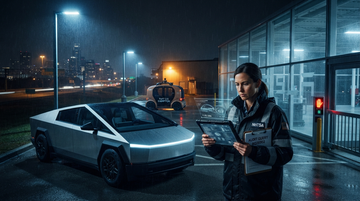
Audit Query opened
AQ26002
NHTSA Office of Defects Investigation, opened Sept. 3, 2026 — same day as the Austin commercial launch
Cybercabs in scope
~1,000
Population estimated by NHTSA; only 45 Cybercabs registered with the Texas DMV as of Aug. 31, 2026
FMVSS standards in dispute
8 (plus inapplicability test)
Same eight FMVSS (Nos. 103, 104, 108, 111, 135, 201, 205, 208) NHTSA exempted for Zoox on July 31, 2026
Cybercab production capacity
125,000+ units/yr
Giga Texas Cybercab line, per Tesla's July 22, 2026 disclosure
Tesla Q2 FY2026 capex/revenue
20.5%
Capex $5.79B on revenue $28.24B (10-Q for Q2 FY2026, filed Jul. 23, 2026); up from 11.1% in Q1 FY2026
The AQ didn't catch Tesla — it caught Tesla's regulatory shortcut
Tesla began commercial Cybercab service in Austin on Sept. 3, 2026, and on the same day notified NHTSA that it had self-certified the vehicle as compliant with all applicable Federal Motor Vehicle Safety Standards. NHTSA responded by opening Audit Query AQ26002 within hours. The OVSC Resume, posted by the Office of Defects Investigation, is blunt: NHTSA will \"examine the process and technical data on which Tesla relied when certifying the Cybercab\" and \"the extent to which Tesla's certification depended on determinations that certain FMVSS are inapplicable to the Cybercab.\"
That phrasing matters because it surfaces the legal mechanism Tesla used to escape the 2,500-vehicle annual cap under Part 555. In an April 2026 interview, Tesla VP of Vehicle Engineering Lars Moravy said the Cybercab \"is not subject to NHTSA's 2,500-vehicle annual production cap for autonomous vehicles\" because Tesla designed it to comply with all existing FMVSS — like a Camry or F-150 — using self-certification, not a petition. NHTSA's AQ26002 now asks whether that \"compliance\" claim is real, or whether Tesla simply declared eight standards inapplicable and walked through the door Zoox opened legitimately.
The Zoox playbook makes Tesla's \"inapplicable\" defense legally thin
Five weeks before AQ26002, NHTSA granted Amazon-owned Zoox the first-ever Part 555 commercial exemption for a purpose-built robotaxi, published as Federal Register docket 2026-15485. Zoox's exemption package is the closest comparable Tesla has — and the eight FMVSS Zoox successfully argued are inapplicable to a no-controls robotaxi are the same eight Tesla now has to defend. The Zoox exemption, capped at 2,500 vehicles annually for two years, covers FMVSS Nos. 103 (windshield defrost/defog), 104 (wipers/washers), 108 (lamps and reflective devices), 111 (rear visibility), 135 (light-vehicle brake systems), 201 (interior impact), 205 (glazing) and 208 (occupant crash protection).
| FMVSS | Subject | Cybercab impact |
|---|---|---|
| No. 103 | Windshield defrosting & defogging | No HVAC manual controls; tested for ADS operation |
| No. 104 | Windshield wiping & washing | No driver-actuated controls; function automated |
| No. 108 | Lamps, reflective devices | No mirrors; uses cameras instead |
| No. 111 | Rear visibility | No rear window or mirrors; relies on cameras |
| No. 135 | Light-vehicle brake systems | No brake pedal; ADS-actuated braking |
| No. 201 | Occupant protection (interior) | Reconfigured cabin, no driver controls to strike |
| No. 205 | Glazing materials | Glazing redesigned for visibility-only use |
| No. 208 | Occupant crash protection | No driver position; new seating/airbag geometry |
The structural difference is procedural. Zoox filed a public petition under 49 CFR 555.6(d) in August 2025, let NHTSA run notice-and-comment, and accepted the 2,500-vehicle annual cap as the price of admission. Tesla skipped the petition, told NHTSA the standards simply did not apply, and self-certified up to ~1,000 Cybercabs. AQ26002 is the regulator asking, in effect: \"If FMVSS 135 (brakes) and 108 (lamps/mirrors) are inapplicable to a robotaxi, why did Zoox petition for the exemption — and why won't you?\"
Supply chain exposure is concentrated and now volume-conditional
Tesla confirmed continuous Cybercab production at Giga Texas on its Q1 FY2026 earnings call in April 2026, and in July 2026 disclosed a Cybercab production capacity above 125,000 units per year. Q2 FY2026 capex tells the same story: capex-to-revenue jumped to 20.5% in the quarter ended June 30, 2026, up from 11.1% in Q1 and 8.0% a year earlier — the highest capex intensity Tesla has booked since the Model 3 ramp. CapEx reached $5.79B against revenue of $28.24B, per the 10-Q filed July 23, 2026.
Tesla capex intensity is at a multi-year high as Cybercab and AI5/AI6 ramp
Capex as a percent of revenue, quarterly
Unit: %
Q3 FY2025
Sept. 30, 2025
8%
Q4 FY2025
Dec. 31, 2025
9.6%
Q1 FY2026
Mar. 31, 2026
11.1%
Q2 FY2026
Jun. 30, 2026 — Cybercab + AI5 ramp
20.5%
That spend is now underwritten by a fixed supply-chain footprint. Samsung Electro-Mechanics and LG Innotek won all of the Cybercab camera-module business, with each vehicle carrying eight cameras; the initial order is reported at 20,000–30,000 Cybercabs, or 160,000–240,000 camera modules. The compute side is anchored by Tesla's $16.5 billion AI5/AI6 supply pact with Samsung Electronics — 2nm production at Samsung's Texas fab — and shared production at TSMC. LG Innotek also feeds the broader Tesla vision stack, and Cybercab units roll on the in-house 4680 cell, supplied by Samsung SDI and LG Energy Solution for Tesla's other 4680-equipped vehicles.
The competitive clock against Waymo is what forced the timing
Cybercab's Sept. 3 launch lands against a robotaxi incumbent that is already a year ahead. Alphabet-owned Waymo operated roughly 4,000 vehicles across 14 U.S. metros as of early September 2026, logging about 500,000 paid public rides and 4 million autonomous miles per week. Tesla's entire robotaxi footprint in Texas — 420 registered autonomous vehicles as of Sept. 2, 2026 — is about one-tenth Waymo's U.S. fleet, and only 45 of those are Cybercabs. The Austin launch was framed as a \"Day 1\" moment, but on volume metrics it is closer to a pilot.
| Operator | Vehicles in service | U.S. metros | Weekly paid rides |
|---|---|---|---|
| Alphabet (Waymo) | ~4,000 | 14 | ~500,000 |
| Tesla Robotaxi + Cybercab | ~420 (all TX) | 7 (5 fully driverless) | Not disclosed |
| — of which Cybercab | 45 | 1 (Austin only) | Not disclosed |
That gap is the reason Tesla chose self-certification over a Part 555 petition. A petition would have capped Cybercab at 2,500 vehicles per year for two years — the same ceiling Zoox accepted. To hit Musk's \"exponential ramp by year-end\" framing and reach the millions-of-robotaxis narrative, Tesla needed the cap to disappear. AQ26002 now threatens the math in both directions: if NHTSA forces Tesla to retroactively petition, Cybercab inherits the 2,500-unit ceiling; if NHTSA accepts the inapplicability argument, Zoox's head start on the petition path becomes the competitive moat instead.
What moves first, and what changes structurally
Short-term (days to quarters). The immediate catalysts are procedural: NHTSA typically completes Audit Queries in 30–120 days, and the AQ26002 record already references \"related issues\" beyond the inapplicability test. A negative finding could force a Part 555 petition, which carries a multi-month public comment period and a likely 2,500-unit annual cap. A positive finding validates the self-certification strategy and lifts the regulatory ceiling. Watch for any NHTSA Federal Register notice or Tesla 8-K disclosure of a petition filing; the next Tesla 10-Q (Q3 FY2026) is the first hard surface for management to disclose AQ26002 in risk factors.
Long-term (one to three years). The structural question is whether the U.S. settles on a petition pathway for no-controls AVs — as NHTSA signaled in its June 2025 streamlining of Part 555 — or accepts industry self-certification of inapplicability for purpose-built robotaxis. Zoox has now locked in the petition path; Tesla is litigating the self-certification path. The June 2025 NHTSA proposal to drop the federal brake-pedal requirement for AV-only vehicles, if finalized, would soften the immediate FMVSS friction but not unwind AQ26002. Watch for the final rule and for any follow-on Cybercab recall or stop-sale that AQ26002 may surface.
- Cybercab deployment is no longer production-rate-bound; it is audit-bound — the FMVSS clock is now the binding Cybercab timeline.
- Zoox's eight-FMVSS exemption list is the explicit legal precedent Tesla's self-certification must now defeat to keep its >125,000-unit Giga Texas line running uncapped.
- Every Cybercab unit already in Texas (45) and every additional build is exposed to retroactive regulatory action — making Q3 FY2026 Cybercab deliveries the first test of NHTSA's enforcement appetite.
- Tesla carries the AQ as the lone operator in the AQ population; competitors using the petition path (Amazon/Zoox) or operating traditional AVs (Alphabet/Waymo) face no comparable federal action.
Stocks the AQ26002 actually moves
- AQ26002 outcome caps Cybercab volume at 2,500/yr if NHTSA forces a Part 555 petition — well below the >125,000-unit Giga Texas line Tesla already disclosed.
- Q2 FY2026 capex-to-revenue jumped to 20.5% (vs. 11.1% Q1), funding Cybercab + AI5; a regulatory ceiling forces a write-down or line retool.
- Stock is already down ~17% YTD into the Q2 print, so AQ26002 is a binary catalyst on top of a depressed setup — sentiment can shift on NHTSA's first written response.
- Zoox's July 31, 2026 Part 555 exemption over eight FMVSS locks in the petition path Amazon chose — AQ26002 confirms that path is the only one regulators currently accept.
- Zoox's 2,500/yr cap is now a feature, not a bug, if Tesla's self-certification gambit fails; the regulatory playing field tilts back to the operator that petitioned first.
- Q2 FY2026 Amazon revenue of $200.6B (TTM $775.7B) absorbs any Zoox capex without a margin impact.
- Alphabet's Waymo runs ~4,000 vehicles across 14 metros at ~500K paid rides/week — a scale lead AQ26002 gives Tesla no obvious way to close in 2026.
- Waymo's purpose-built vehicle avoided the Cybercab control-removal question by keeping steering and pedals through the Jaguar I-PACE platform, sidestepping AQ26002-class risk entirely.
- Q2 FY2026 Alphabet revenue of $119.8B (TTM $445.9B) makes Waymo Other-Bets spend invisible to consolidated margins.
- Wins all Cybercab camera-module business at 8 modules/vehicle; initial 20,000–30,000 Cybercab order book implies 160,000–240,000 modules in flight.
- AQ26002 caps Cybercab volume at 2,500/yr if forced to petition — a >95% downside to the visible Cybercab pull-through for Samsung Electro-Mechanics.
- Camera modules are a multi-vehicle platform win regardless of Cybercab outcome, so the thesis is less binary than Tesla's.
- Co-supplier of all Cybercab camera modules with Samsung Electro-Mechanics; same 8-per-vehicle ratio exposes LG Innotek to the same AQ-driven volume ceiling.
- Diversified Apple iPhone and general auto camera mix cushions any single-program shortfall but caps upside if AQ26002 resolves cleanly.
- HQ at 562,000 KRW (Sept. 4, 2026) already reflects the optionality — the next move is binary on NHTSA's first written response.
- Shares Cybercab's AI4 today and AI5 volume production from 2027; a Cybercab cap protects some AI5 wafer demand from being fully consumed by the program.
- Other hyperscaler AI5-class demand from NVIDIA, AMD, and Apple absorbs any wafer slack at TSMC's N3/N2 nodes.
- Tesla's $16.5B Samsung AI5/AI6 pact routes ~half of Tesla's compute volume to Samsung, structurally capping TSMC's Tesla-specific exposure.
- $16.5B AI5/AI6 pact with Tesla, disclosed July 31, 2025, anchors the Texas-fab 2nm line — Cybercab volume swings the wafer allocation between consumer and auto.
- Through Samsung Electro-Mechanics the group also captures all Cybercab camera modules, doubling the program exposure inside one conglomerate.
- Samsung's broader foundry and HBM franchise dilutes any single-program risk; AQ26002 is a watch item, not a thesis-breaker.
- Supplies 4680 cells for Tesla's 4680-equipped vehicles; Cybercab uses the same cell format, so AQ26002 directly affects LG Energy Solution's Cybercab-attributable cell volume.
- Q2 FY2026 capex/revenue of 20.5% at Tesla underwrites the 4680 ramp; a Cybercab cap likely pushes more 4680 capacity back to Model Y and Cybertruck.
- Diversified GM, Honda, and Hyundai-Kia cell contracts insulate consolidated revenue, but the marginal Cybercab cell is the most efficient unit on the line.