%22%2F%3E%0A%20%20%3Ccircle%20cx%3D%22220%22%20cy%3D%22150%22%20r%3D%22180%22%20fill%3D%22%2322d3ee%22%20fill-opacity%3D%220.12%22%2F%3E%0A%20%20%3Ccircle%20cx%3D%221010%22%20cy%3D%22130%22%20r%3D%22220%22%20fill%3D%22%2338bdf8%22%20fill-opacity%3D%220.08%22%2F%3E%0A%20%20%3Ccircle%20cx%3D%22920%22%20cy%3D%22520%22%20r%3D%22170%22%20fill%3D%22%2322d3ee%22%20fill-opacity%3D%220.06%22%2F%3E%0A%20%20%3Cpath%20d%3D%22M140%20430h920%22%20stroke%3D%22url(%23line)%22%20stroke-width%3D%2212%22%20stroke-linecap%3D%22round%22%2F%3E%0A%20%20%3Cpath%20d%3D%22M220%20360c120-150%20260-220%20380-220s260%2070%20380%20220%22%20fill%3D%22none%22%20stroke%3D%22%2367e8f9%22%20stroke-opacity%3D%220.5%22%20stroke-width%3D%2216%22%20stroke-linecap%3D%22round%22%20stroke-linejoin%3D%22round%22%2F%3E%0A%20%20%3Cpath%20d%3D%22M300%20398h600%22%20stroke%3D%22%2394a3b8%22%20stroke-opacity%3D%220.24%22%20stroke-width%3D%228%22%20stroke-linecap%3D%22round%22%2F%3E%0A%20%20%3Ctext%20x%3D%22220%22%20y%3D%22510%22%20fill%3D%22%23e2e8f0%22%20fill-opacity%3D%220.7%22%20font-family%3D%22Arial%2C%20Helvetica%2C%20sans-serif%22%20font-size%3D%2238%22%20letter-spacing%3D%228%22%3EINSIGHTS%3C%2Ftext%3E%0A%3C%2Fsvg%3E)
Verified probe into a specific child-collision incident
NHTSA is pressing for Waymo’s child-collision records in a formal ODI investigation
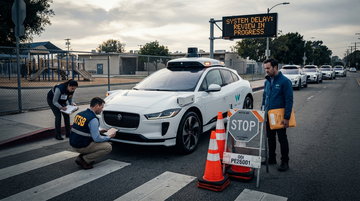
NHTSA’s Office of Defects Investigation (ODI) opened a federal safety inquiry into a Waymo robotaxi incident in which a child was struck near an elementary school area in Santa Monica, California. The crash itself has a parallel NTSB investigation track, while ODI is focused on whether Waymo’s automated driving system met safety expectations and what design, data, or validation gaps need to be corrected.
This matters commercially because ODI inquiries require structured responses, document production, and—critically—regulatory staff time. In robotaxi economics, “days-to-permission” is not a footnote; it can directly delay expansion, training updates, and hardware/software rollouts across the fleet.
What is verified about the incidents and requests
NTSB crash details
HWY26FH008, Event Date Jan 23, 2026
NTSB describes a 2024 Jaguar I-Pace (Waymo ADS-equipped) striking a 9-year-old pedestrian in a school-zone area in Santa Monica; injuries reported as minor and remote assistance contacted 911.
ODI investigation record request
PE26001
ODI inquiry identified publicly as PE26001; Waymo provided responses to NHTSA questions and ODI posted redacted documents after receipt.
How the probe is structured
ODI’s question-and-response timeline is the mechanism that can bottleneck scaling
In a typical ODI process, the agency identifies a potential safety issue and sends targeted questions to the operator/manufacturer, then evaluates submitted materials for evidence of defect, adequacy of validation, and whether mitigation actions are sufficient.
Here, the publicly reported ODI record request cadence is explicit: ODI sent a set of questions (with sub-questions), Waymo responded by an initial deadline, ODI granted an extension for a portion of the questions, and additional responses were submitted later. At publication time, ODI posted an initial batch of materials on its site, with portions redacted under confidential business information rules.
For investors, the timing is the signal. Redactions don’t weaken the causal story; they mean the scrutiny is active, and the operational answers required are substantial enough that documents are withheld from public view.
| Milestone | Verified timing | What it implies for scaling |
|---|---|---|
| ODI questions issued (count reported) | 12 questions sent (some with sub-questions) | Sets the scope of what Waymo must substantiate about behavior, detection, and mitigation in school-zone conditions. |
| Initial response deadline | May 8 (initial deadline reported) | Creates an immediate “regulatory SLA” that can delay internal analysis-to-deployment loops. |
| Extension requested and granted | Waymo extension letter dated May 1; extension granted for 10 of 12 questions | Signals the review workload exceeds initial estimates—often consistent with complex data-production needs. |
| Additional response submission | Second letter dated July 8 | Extends the evaluation window, which can delay downstream actions such as route permitting refreshes. |
Supply chain and operational knock-ons
A child-collision probe transmits upstream into sensors/compute and downstream into permissioning
- Upstream validation: fleets must be ready to demonstrate how perception, braking, and remote assistance behave in school-zone edge cases under stress.
- Upstream documentation: OEMs and ADS software teams often need traceability—what data was used, how it was labeled, and how safety metrics were derived.
- Downstream permissioning: municipal/state route approvals and operator operating scopes typically react to federal scrutiny and interim guidance.
- Downstream public acceptance: while not a statutory constraint, ongoing high-salience safety probes can slow rider adoption—changing utilization math before autonomy tech improves.
What the probe is really asking Waymo to prove is whether the system’s intended behavior in school-zone conditions is safe and repeatable. The NTSB parallel investigation underlines that the crash remains under investigation for probable cause, even as ODI advances the defect/safety evaluation track.
The supply-chain “full stack” implication is that safety evidence is not only a software question. It requires coordination across simulation/labeling pipelines, perception model evaluation, sensor calibration/maintenance practices, and remote-assistance procedures used at the time of the incident.
Market relevance: why this lands just as robotaxi competition accelerates
Regulatory throughput becomes the swing variable right when competitors are pushing for market entry
The competitive relevance is that robotaxi “scale” is not simply a manufacturing or vehicle availability problem. It’s a permissioning and safety-evidence problem with real lags.
As Tesla prepares its robotaxi concept (often discussed in market terms as Cybercab timing), the investor question becomes: what happens if federal scrutiny is still active when commercialization targets hit? Even if different companies face different regulatory paths, ODI’s process shows the common constraint: time and evidence burden.
For Tesla, the immediate linkage is not “ODI investigates Tesla today.” It’s that the entire sector’s commercialization math in the US now has a visible precedent for how quickly agencies can close specific safety evidence loops—and how long fleets may need to keep data production and mitigation planning in motion.
Alphabet (GOOGL) free cash flow
≈$105B (FY2025)
FY2025, reported in the company’s latest disclosed fundamentals dataset; used here as context for balance-sheet capacity to fund long-duration safety and autonomy programs.
Tesla (TSLA) operating margin
≈4.2% (TTM)
Trailing twelve months; indicates operating profitability sensitivity if autonomy spending or delays create cost pressure.
Investor playbook: what to watch next
Three forward indicators that separate “process drag” from real defect risk
- Whether ODI transitions from document review into a defect determination step (or closes the matter without a defect finding).
- Whether NHTSA/OID-related safety recommendations or mitigation expectations become publicly summarized in ways that affect school-zone operations.
- Whether operator guidance changes—e.g., route scope, operational design domain constraints, or additional safety operator behaviors—in the period immediately after the ODI document postings.
Until ODI’s analysis concludes, the most investable stance is “timeline risk.” The probe can still be completed without a public defect label, but the burden of proof is ongoing: fleets must keep their safety evidence consistent with whatever ODI has requested.
Listed stocks most exposed to regulation-led autonomy timelines
- A sector-wide ODI precedent can extend autonomy rollouts through US evidence cycles in the next 1–4 quarters.
- Tesla’s profitability depends on volume; if delays force incremental compliance spend, margin pressure rises in the near term versus base-case launch timing.
- ODI record-production for Waymo type operations shows regulators demand extensive traceability; funding needs persist even if scale is delayed over the next 1–3 years.
- If ODI closure is favorable, it can reduce perceived operational headline risk and support longer-horizon autonomy confidence.
- Even when timelines slip, safety evidence work increases simulation and validation workloads; demand for AI compute can remain sticky over the next several quarters.
- If autonomy fleets need rapid model revalidation, GPU-intensive iteration cycles can accelerate rather than stop.
- More high-salience safety scrutiny can raise the bar for perception reliability claims, which can pressure commercial timelines for AV partners.
- At the same time, regulators’ focus on evidence supports systems with strong validation tooling; certification-ready workflows become more valuable over 1–2 years.