%22%2F%3E%0A%20%20%3Ccircle%20cx%3D%22220%22%20cy%3D%22150%22%20r%3D%22180%22%20fill%3D%22%2322d3ee%22%20fill-opacity%3D%220.12%22%2F%3E%0A%20%20%3Ccircle%20cx%3D%221010%22%20cy%3D%22130%22%20r%3D%22220%22%20fill%3D%22%2338bdf8%22%20fill-opacity%3D%220.08%22%2F%3E%0A%20%20%3Ccircle%20cx%3D%22920%22%20cy%3D%22520%22%20r%3D%22170%22%20fill%3D%22%2322d3ee%22%20fill-opacity%3D%220.06%22%2F%3E%0A%20%20%3Cpath%20d%3D%22M140%20430h920%22%20stroke%3D%22url(%23line)%22%20stroke-width%3D%2212%22%20stroke-linecap%3D%22round%22%2F%3E%0A%20%20%3Cpath%20d%3D%22M220%20360c120-150%20260-220%20380-220s260%2070%20380%20220%22%20fill%3D%22none%22%20stroke%3D%22%2367e8f9%22%20stroke-opacity%3D%220.5%22%20stroke-width%3D%2216%22%20stroke-linecap%3D%22round%22%20stroke-linejoin%3D%22round%22%2F%3E%0A%20%20%3Cpath%20d%3D%22M300%20398h600%22%20stroke%3D%22%2394a3b8%22%20stroke-opacity%3D%220.24%22%20stroke-width%3D%228%22%20stroke-linecap%3D%22round%22%2F%3E%0A%20%20%3Ctext%20x%3D%22220%22%20y%3D%22510%22%20fill%3D%22%23e2e8f0%22%20fill-opacity%3D%220.7%22%20font-family%3D%22Arial%2C%20Helvetica%2C%20sans-serif%22%20font-size%3D%2238%22%20letter-spacing%3D%228%22%3EINSIGHTS%3C%2Ftext%3E%0A%3C%2Fsvg%3E)
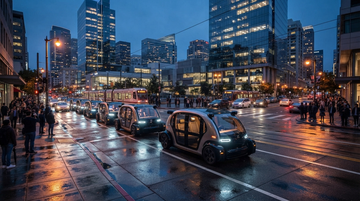
Zoox just cleared a key U.S. federal regulatory hurdle to charge for rides in steering-wheel-free robotaxis. The important part isn’t the headline “approval.” It’s what NHTSA allowed Zoox to do structurally: operate a purpose-built autonomous vehicle in commercial service under an exemption framework that is written to handle vehicles that do not carry the human-control interfaces embedded in FMVSS.
That single shift changes the downstream incentives for OEMs and suppliers, because your safety case, your vehicle architecture, and your scaling plan stop being forced into the same shape as driver-in-the-loop products.
Verified event → what NHTSA actually granted
This is a temporary exemption for commercial deployment of steering-wheel-free Zoox robotaxis
NHTSA announced it would grant Zoox a temporary exemption that allows the company to commercially deploy its robotaxis, with a firm cap on fleet size.
It authorizes up to 2,500 vehicles per year for two years, subject to an enhanced oversight approach.
Authorized commercial fleet size
2,500 vehicles/year
NHTSA temporary exemption terms
Exemption duration
2 years
NHTSA temporary exemption term
Why this exemption is structurally different
Vehicle posture
no steering wheel / no required human driver controls
Exemption pathway is for vehicles not equipped with required human controls
Regulatory mechanism
FMVSS exemptions under temporary authorization
NHTSA evaluated specific FMVSS requirements with an equivalence + public-interest framing
Facts in the record → the exact FMVSS scope
Zoox’s petition targeted eight FMVSS rules that assume human-control-equipped vehicles
In Zoox’s exemption application receipt, NHTSA documents the specific Federal Motor Vehicle Safety Standards for which exemptions were sought (the list matters because it shows where the “human controls” legacy standards bite).
The receipt identifies exemptions requested for: FMVSS 103, 104, 108, 111, 135, 201, 205, and 208.
| FMVSS number | What it covers (as titled in the notice) | Why it matters for a no-human-controls architecture |
|---|---|---|
| 103 | Windshield defrosting and defogging systems | Design must maintain visibility functions without driver-assist controls |
| 104 | Windshield wiping and washing systems | Must maintain visibility performance through automated actuation |
| 108 | Lamps, reflective devices, and associated equipment | Lighting compliance remains required even without human control interfaces |
| 111 | Rear visibility | Replaces human verification with vehicle/sensor and automated safety case |
| 135 | Light vehicle brake systems | Safety case must cover braking without relying on driver pedal control |
| 201 | Occupant protection in interior impact | Crash-safety engineering remains required regardless of controls |
| 205 | Glazing materials | Material-level requirements still apply to cabin safety |
| 208 | Occupant crash protection | Constraint that pushes cabin restraint design in parallel with autonomy |
Causal chain → why “no steering wheel” changes the AV economics
Removing the steering-wheel-and-fallback assumption changes the scaling bottleneck
The AV industry often treats “driver fallback” as a regulatory backstop. But the moment your commercial design is not built with those human control interfaces, your business model depends on the exemption framework to substitute for what FMVSS assumes.
This turns regulatory approval into a manufacturing-and-cost lever, not just a launch checklist.
- If the vehicle architecture is fixed to exclude steering wheels and pedals, exemptions must cover the FMVSS gaps—so compliance becomes a design constraint from day one.
- A fleet cap (2,500/year) limits early scale, but it also forces early unit-economics to be built on autonomy performance and reliability rather than “human takeover” narratives.
- Purpose-built platforms can reduce interior integration complexity (one less driver-control interface family), but they increase the dependency on automated safety performance evidence.
Supply chain mapping → who benefits and who pays
The supply chain doesn’t only sell sensors; it sells “exemption-ready” safety engineering
Regulators don’t ask whether you bought the best chips. They ask whether the whole vehicle—visibility systems, braking, crash protection, and occupant protection—meets an equivalence standard under the autonomy architecture.
That means upstream components and downstream manufacturing partners who can provide validated systems (and the evidence trail to match the exemption scope) become more central than they would be in a retrofit-heavy approach.
| FMVSS cluster (from notice) | Engineering workload it implies | Supply-chain linkage (upstream → downstream) |
|---|---|---|
| Visibility (103/104/111) | Automated visibility maintenance + fail-safe actuation | Upstream sensors/actuators and control software → downstream integration/test & validation |
| Lighting & signaling (108) | Reliable lighting conformity across automated operation modes | Upstream lighting modules → downstream homologation & QA |
| Braking & crash response (135/201/208) | Braking actuation safety + occupant protection engineering | Upstream braking systems + cabin restraint tech → downstream vehicle assembly + crash testing |
| Glazing materials (205) | Cabin glass material safety performance | Upstream materials suppliers → downstream compliance certification |
Why it’s not a Waymo story
This is a regulatory template for purpose-built AVs, not a retrofit approval narrative
Waymo and others have relied on operating strategies that often coexist with human-control-equipped assumptions. Zoox’s steering-wheel-free approach puts the “human fallback” question on trial.
NHTSA’s record shows Zoox’s petition explicitly targets multiple FMVSS areas that are normally addressed within a driver-interface context—so it’s not merely “where can you geofence?” It’s “what constraints must you replace when the driver controls are absent?”
Fundamentals cross-checks → what listed markets might trade on
Listed proxies: who could move when “commercial scale without steering wheels” becomes credible
Zoox is private, so we can’t pull its financials via the listed-company data tools. Instead, we use listed companies as proxies for different parts of the supply chain and platform stack that are most sensitive to a new U.S. regulatory precedent.
Below are a small set of listed names whose operating models connect to the kinds of evidence, compute, and ecosystem scaling that follow from commercial robotaxi exemptions.
NVIDIA: current scale and margin profile as a proxy for compute demand sensitivity
Snapshot from data tools (not an estimate of Zoox revenue impact).
Unit: value
Revenue (TTM)
Data-tool snapshot; used only for scale context
253,491,003,000
EBITDA margin (TTM)
Data-tool snapshot; interpret as fraction
0.8
Horizons → what changes now vs. what changes later
Short term: rollout pacing and compliance scrutiny. Long term: a new AV OEM template
- Short-term weeks–quarters: expect NHTSA oversight and reporting to become the gating item that determines whether the cap (2,500/year) translates into fast revenue-start rather than “demo-only.”
- Medium-term quarters: suppliers tied to visibility/braking/cabin safety will likely see qualification work reprioritized toward autonomy architectures that match the exemption scope.
- Long-term 1–3 years: OEMs can treat the exemption pathway as a template for design freedom (steering-wheel deletion) instead of a one-off exception, compressing the AV-IPO timeline risk premium.
Listed market links to this exemption precedent
- If more commercial robotaxi fleets pursue steering-wheel-free designs, compute intensity supports continued AI-vehicle platform demand over coming quarters (via ecosystem qualification cycles).
- NVIDIA’s current scale shows a high-margin base that can fund ongoing automotive platform work, supporting resilience if robotaxi demand ramps unevenly in the next 1–2 years.
- Steering-wheel-free operations increase the need for robust perception and safety-system evidence, so ADAS/autonomy qualification work can accelerate for Mobileye’s stack in days-to-quarters.
- However, Mobileye’s fundamentals are weaker (negative margins in the tool snapshot), so commercial timing risk can still dominate near-term valuation until fleet ramps are visible.
- If the regulatory model shifts toward architectures without human driver interfaces, Tesla’s autonomy roadmap could face stronger “controls-free” comparability pressure over 1–3 years.
- But Tesla’s broader business provides cushion, so near-term financial impact is uncertain until “paid robotaxi” economics prove out within the next few quarters.
- A confirmed exemption pathway can help OEMs design for higher autonomy reliability targets, so Toyota can justify more autonomy investment earlier as a 1–3 year strategic bet.
- With Toyota’s current operating profitability profile, the company has capacity to absorb early regulatory and engineering iteration costs as requirements evolve.
- Aurora’s market depends on autonomy deployment confidence; if regulators treat controls-free commercial service as a new gold standard, Aurora may face tougher differentiation challenges in days-to-quarters.
- Aurora’s tool snapshot indicates negative profitability, so capital-market funding pressure can increase if “exemption templates” consolidate benefits toward better-validated pathways.