%22%2F%3E%0A%20%20%3Ccircle%20cx%3D%22220%22%20cy%3D%22150%22%20r%3D%22180%22%20fill%3D%22%2322d3ee%22%20fill-opacity%3D%220.12%22%2F%3E%0A%20%20%3Ccircle%20cx%3D%221010%22%20cy%3D%22130%22%20r%3D%22220%22%20fill%3D%22%2338bdf8%22%20fill-opacity%3D%220.08%22%2F%3E%0A%20%20%3Ccircle%20cx%3D%22920%22%20cy%3D%22520%22%20r%3D%22170%22%20fill%3D%22%2322d3ee%22%20fill-opacity%3D%220.06%22%2F%3E%0A%20%20%3Cpath%20d%3D%22M140%20430h920%22%20stroke%3D%22url(%23line)%22%20stroke-width%3D%2212%22%20stroke-linecap%3D%22round%22%2F%3E%0A%20%20%3Cpath%20d%3D%22M220%20360c120-150%20260-220%20380-220s260%2070%20380%20220%22%20fill%3D%22none%22%20stroke%3D%22%2367e8f9%22%20stroke-opacity%3D%220.5%22%20stroke-width%3D%2216%22%20stroke-linecap%3D%22round%22%20stroke-linejoin%3D%22round%22%2F%3E%0A%20%20%3Cpath%20d%3D%22M300%20398h600%22%20stroke%3D%22%2394a3b8%22%20stroke-opacity%3D%220.24%22%20stroke-width%3D%228%22%20stroke-linecap%3D%22round%22%2F%3E%0A%20%20%3Ctext%20x%3D%22220%22%20y%3D%22510%22%20fill%3D%22%23e2e8f0%22%20fill-opacity%3D%220.7%22%20font-family%3D%22Arial%2C%20Helvetica%2C%20sans-serif%22%20font-size%3D%2238%22%20letter-spacing%3D%228%22%3EINSIGHTS%3C%2Ftext%3E%0A%3C%2Fsvg%3E)
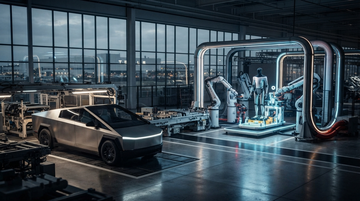
Tesla’s robotaxi story is getting a new kind of media gravity: less “robotaxi unlocks everything,” more “timelines are being managed.” The key investor question is whether this is a true robotaxi deprioritization—or whether Tesla is simply moving capital to where it believes the autonomy + robotics stack can compound fastest.
In this piece, I verify what Tesla actually said about Robotaxi expansion and capital intensity, then connect the dots to the supply chain of “AI-in-the-real-world” investments (compute, semiconductors, factories, and robotics production capability).
Verified event base
Tesla’s “tone shift” starts with continued Robotaxi expansion—while the company simultaneously escalates 2026 CapEx
- Tesla’s Q2 2026 update says Robotaxi rollout continued in the U.S. and is now live in seven major metros (with different supervision/ramping modes by city/region).
- The same Tesla Q2 2026 update also describes Optimus Fremont factory line decommissioning and installation work, implying real factory reconfiguration rather than an AV-only posture.
- Tesla’s SEC 10-Q and associated financial disclosures (and Tesla’s own investor messaging) frame 2026 as a very high CapEx year: capital expenditures expected to be in excess of $25 billion.
What Tesla disclosed (Q2 2026 update): Robotaxi + Optimus + CapEx pressure
Robotaxi status
Live in seven major metros (U.S.)
From Tesla’s Q2 2026 update; city-by-city status varies (e.g., “ramping unsupervised” vs “safety driver” depending on metro).
Optimus factory work
Fremont Model S & X lines decommissioned; Optimus line installation targeted for production later in 2026
From Tesla’s Q2 2026 update.
2026 CapEx stance
Excess of $25B expected in 2026
From Tesla’s SEC filing risk/disclosure language and earnings/forward commentary captured in the SEC update.
Cause mechanism
Musk’s “spend as fast as we can” comment is a constraint choice: efficiency is not the goal—timelines are
Musk’s own explanation matters because it reframes what investors should watch. The stated philosophy is not “maximize capital efficiency,” but “spend on capex as fast as we can… without it being too wasteful.” That is an aggressive throughput mindset: build capacity, secure compute + production readiness, and only then accelerate commercialization.
“We should be spending on capex as fast as we can spend — as fast as we can without it being too wasteful. So we're not trying to aim for some extremely high-efficiency capital spend because that would slow things down.”
- Under this framing, “robotaxi delay” rhetoric can coexist with progress: if the bottleneck is compute + deployment infrastructure + production lines, Tesla will buy down that bottleneck first.
- Tesla’s SEC filing language also warns that CapEx can’t be perfectly forecast beyond the short term and may require additional funding during heightened CapEx periods—consistent with a throughput-first posture.
- The result is predictable investor optics: short-term robotaxi milestones can get de-emphasized even while Robotaxi operations scale.
Data triangulation
The capital reallocation shows up in the cash flow shape: CapEx is rising, and free cash flow can go negative quickly
Q2 2026 CapEx
$5.789B
Tesla Q2 2026 update states capital expenditures of (5,789) million.
Q2 2026 Free cash flow
-$1.092B
Tesla Q2 2026 update states free cash flow of (1,092) million (negative).
Q2 2026 Operating cash flow
$4.697B
Tesla Q2 2026 update states operating cash flow of 4,697 million.
2026 CapEx regime
>$25B
Tesla expects capital expenditures to be in excess of $25 billion in 2026 (SEC disclosure/earnings messaging).
Tesla: quarterly operating cash flow vs. quarterly CapEx (recent quarters)
Illustrative from data-tool quarterly cash flow; used to show how rapidly CapEx can compress free cash flow.
Unit: $
Operating cash flow (Q1 2026)
3,937,000,000
CapEx (Q1 2026)
CapEx reported as negative cash flow in the dataset; shown as absolute for visual comparability.
2,493,000,000
Operating cash flow (Q4 2025)
3,813,000,000
CapEx (Q4 2025)
Absolute value.
2,393,000,000
Supply chain mapping (full stack)
If Tesla is truly pivoting capital, it should concentrate spending in 4 supply-chain choke points: compute, silicon/AI infrastructure, robotics factories, and deployment ops
| Choke point | Why it matters to robotaxi vs. Optimus | What Tesla’s disclosures imply | Observable company-level proxy to watch |
|---|---|---|---|
| AI compute & data/teleoperation plumbing | Autonomy performance and robotics perception/control depend on large-scale training + rapid iteration; deployment needs operational tooling. | Tesla ties Robotaxi scaling to dedicated operational scaling (including teleoperations mentioned in its Q2 2026 update context). | Quarterly CapEx magnitude and whether it stays elevated despite volatile free cash flow. |
| Silicon/AI infrastructure & semiconductor supply readiness | If autonomy/robotics is “spend-as-fast-as-possible,” compute capacity and silicon lead times become a constraint. | Tesla’s 2026 CapEx regime (> $25B) plus its AI/robotics posture suggests infrastructure build rather than EV-only capex. | Progress milestones around in-house compute/semiconductor programs (captured in filings/updates, not news paraphrases). |
| Robotics production lines & factory conversion | Optimus is a factory-centric product; converting Fremont lines is a non-trivial reallocation of industrial capacity. | Tesla says Fremont Model S & X lines were decommissioned and first-generation Optimus lines are being installed, with production expected later in 2026. | Signs that automotive line conversion doesn’t pause despite robotaxi rhetoric changes. |
| Autonomy deployment operations (vehicles + service + regional expansion) | Robotaxi rollout is operational, regulatory, and service logistics heavy; it can advance while software readiness evolves. | Tesla reports continued Robotaxi rollout and metro-by-metro ramp/supervision phases. | Metro count/status updates and whether the mix shifts toward less supervision over time. |
Financial interpretation
Robotaxi isn’t being abandoned—but Tesla is telling investors commercialization won’t fund the pace of spending in the near term
The core economic tension is simple: autonomy/robotics programs can require high up-front capital before producing consistent “robotaxi revenue” cash flows. Tesla’s numbers show how quickly CapEx can overwhelm free cash flow even when operating cash flow is positive.
That combination—(1) ongoing Robotaxi scaling and (2) factory conversion for Optimus—and (3) an aggressive CapEx outlook suggests the company is funding the pipeline internally rather than waiting for near-term monetization to pace the build.
| Signal | What Tesla shows in disclosed numbers | Investor interpretation under a “capex-first” thesis | What would falsify the thesis |
|---|---|---|---|
| CapEx pace | Q2 2026 CapEx was $5.789B and free cash flow was -$1.092B. | High CapEx is being used to build the autonomy/robotics stack faster than it can be funded by near-term monetization. | CapEx drops sharply while Robotaxi deployment continues expanding at the same rate. |
| Factory conversion for robotics | Fremont Model S & X decommissioning and Optimus line installation work is described. | Tesla treats robotics manufacturing capability as part of the “robotaxi timeline,” not a separate story. | Optimus production line work stalls or is reversed while Robotaxi scaling continues—implying robotaxi priority over robotics build. |
| Robotaxi operational scaling | Robotaxi is reported live in seven major metros with ramp/supervision states by city. | Robotaxi software + operations are progressing, but commercialization is still not the immediate capital source. | Robotaxi scaling halts or contracts while CapEx stays high. |
Horizons
Short-term (days–quarters): watch CapEx “stickiness” and free cash flow volatility more than robotaxi PR cycles
- If Tesla’s philosophy holds, CapEx will remain elevated into the next few quarters; expect cash flow volatility even if Robotaxi expands operationally.
- The market will likely “discount” robotaxi headlines that imply delays, but the harder check is whether metro rollout continues and whether supervision/ramp states improve over time (as Tesla discloses).
- Near-term winner setup: companies that benefit from AI compute + factory conversion inputs that are “must-buy” for Tesla’s 2026 throughput model.
Horizons
Long-term (1–3 years): the thesis survives only if factory conversion + autonomy scaling translate into a monetization curve
- If Optimus factory conversion moves from installation into stable production while Robotaxi coverage and ramp supervision states improve, Tesla could shift from “funding build” to “funding growth from operations.”
- If instead CapEx stays high but operational autonomy progress doesn’t accelerate, the spend-as-fast-as-possible approach becomes a capital impairment risk.
- Key risk to watch in Tesla filings: explicit language that CapEx forecasting is difficult and may require additional funding beyond operating cash flow during heightened CapEx periods.
Synthesis
So what is the “robotaxi tone shift” really? A reallocation decision: build the bottlenecks first, monetize later
Investor takeaway: treat robotaxi timeline headlines as outputs of a broader capital-allocation machine. The machine’s visible input is CapEx; the machine’s visible output is whether autonomy and robotics systems become production-and-deployment ready fast enough to eventually fund themselves.
This is why a “delay” story can coexist with Robotaxi scaling: timelines in autonomy are constrained by compute + integration + operations, not by PR calendars.
Listed-stock linkages (what this capex-first pivot most likely transmits to)
- If Tesla’s >$25B 2026 CapEx plan is compute-heavy, AI accelerator demand tends to be front-loaded; that supports NVDA revenue mix via AI infrastructure spending.
- Near-term: CapEx stickiness raises incremental AI buildout, supporting NVDA gross margin stability if pricing holds.
- 1–3 years: sustained AI infrastructure builds raise the chance Tesla’s autonomy/robotics roadmap can reach monetization sooner.
- Higher AI infrastructure spending from capex-first strategies can support AMD’s accelerator/server CPU exposure, but competition with NVDA can cap share gains.
- Near-term: volatility in customer capex timing may translate into quarter-to-quarter order variability.
- 1–3 years: if Tesla scales training/inference at higher throughput, AMD benefits only if platform adoption strengthens.
- AI data-center expansion associated with autonomy/robotics compute tends to increase memory intensity; that supports DRAM/NAND demand channels.
- Near-term: elevated 2026 CapEx at a major AI consumer can pull forward memory orders.
- 1–3 years: higher compute utilization can sustain memory demand beyond a single product cycle.
- Tesla’s $25B+ 2026 CapEx stance implies more semiconductor and AI infrastructure build-out; equipment vendors that support wafer processing can see demand lift.
- Near-term: equipment procurement cycles can lag customer capex announcements, so benefits appear in later quarters.
- 1–3 years: if Tesla-backed “Terafab”-style capacity proceeds, wafer-fab tooling demand can extend.
- Factory conversion and large construction projects increase heavy industrial equipment demand, but timing is uncertain.
- Near-term: if Tesla’s Optimus factory work requires expanded industrial build-out, machinery orders can firm with a quarter or two lag.
- 1–3 years: sustained fab/factory capex would be supportive; reversals would be visible in equipment order softness.