%22%2F%3E%0A%20%20%3Ccircle%20cx%3D%22220%22%20cy%3D%22150%22%20r%3D%22180%22%20fill%3D%22%2322d3ee%22%20fill-opacity%3D%220.12%22%2F%3E%0A%20%20%3Ccircle%20cx%3D%221010%22%20cy%3D%22130%22%20r%3D%22220%22%20fill%3D%22%2338bdf8%22%20fill-opacity%3D%220.08%22%2F%3E%0A%20%20%3Ccircle%20cx%3D%22920%22%20cy%3D%22520%22%20r%3D%22170%22%20fill%3D%22%2322d3ee%22%20fill-opacity%3D%220.06%22%2F%3E%0A%20%20%3Cpath%20d%3D%22M140%20430h920%22%20stroke%3D%22url(%23line)%22%20stroke-width%3D%2212%22%20stroke-linecap%3D%22round%22%2F%3E%0A%20%20%3Cpath%20d%3D%22M220%20360c120-150%20260-220%20380-220s260%2070%20380%20220%22%20fill%3D%22none%22%20stroke%3D%22%2367e8f9%22%20stroke-opacity%3D%220.5%22%20stroke-width%3D%2216%22%20stroke-linecap%3D%22round%22%20stroke-linejoin%3D%22round%22%2F%3E%0A%20%20%3Cpath%20d%3D%22M300%20398h600%22%20stroke%3D%22%2394a3b8%22%20stroke-opacity%3D%220.24%22%20stroke-width%3D%228%22%20stroke-linecap%3D%22round%22%2F%3E%0A%20%20%3Ctext%20x%3D%22220%22%20y%3D%22510%22%20fill%3D%22%23e2e8f0%22%20fill-opacity%3D%220.7%22%20font-family%3D%22Arial%2C%20Helvetica%2C%20sans-serif%22%20font-size%3D%2238%22%20letter-spacing%3D%228%22%3EINSIGHTS%3C%2Ftext%3E%0A%3C%2Fsvg%3E)
Industry News • AI & Mobility
The robotaxi thesis just got its first real-world stress test—on Tesla’s own campus
Tesla’s “robotaxi” narrative has often been argued as a timing and capex story: when the software is ready, economics follow. But Tesla’s latest milestone is operational, not marketing.
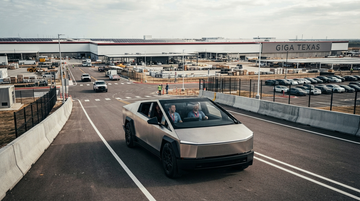
Tesla’s official Robotaxi account posted that Cybercab employee rides start soon at Giga Texas, anchoring the first phase of live autonomy testing to a controlled factory environment rather than a public, revenue-generating deployment.
What happened
Tesla confirms the “employee rides” milestone and pins it to Giga Texas
Milestone checklist investors should track
Who gets the rides first
Tesla employees (not the general public)
This reduces safety/regulatory exposure during early autonomy iteration.
Where the rides are framed
Giga Texas (factory/outbound lot context)
Tesla’s wording ties the first phase to its site operations.
What it implies for the broader launch
A staged path toward public robotaxi service
The launch path appears linked to data collection and reliability ramp.
In Tesla’s Robotaxi-related posting, Tesla states that Cybercab employee rides at Giga Texas will begin soon—and the timestamped post shows Tesla treating the milestone as a near-term transition from engineering tests toward live campus transport.
Why August matters more than the headline
Cadence changes the economics: “data capture” arrives before “paid miles”
The important question is not whether Cybercab will eventually support robotaxi operations. The important question is how Tesla gets there.
When Tesla shifts the rollout sequence to employee-first rides, it is effectively prioritizing four things before mass public service: 1) repeatable autonomy scenarios inside a repeatable environment, 2) faster iteration cycles based on edge-case behavior, 3) integration validation with factory operations, and 4) a lower-friction operational layer while insurance and regulatory procedures are still forming.
- Employee-first testing compresses the iteration loop because failure feedback stays inside Tesla’s control and operational knowledge base.
- Campus-first deployment reduces regulatory complexity early because the service is not marketed as public transportation yet.
- Using Cybercab in live movements prioritizes autonomy coverage under production constraints (sensors, compute, and manufacturing variance).
- The rollout cadence pushes investor focus from capex headlines to ramp reliability metrics that typically surface later in disclosures.
Evidence tie-in
Linking this milestone to Tesla’s robotaxi commercialization signals
Separately, Tesla’s ongoing robotaxi service footprint has been communicated as operating in multiple US metros (starting with Model Y) while Cybercab is positioned as a purpose-built fully autonomous future offering. On Tesla’s Robotaxi page, the service is described in terms of regions and an eventual Cybercab ride offering—meaning Cybercab’s first live rides fit the pattern of progressing from staged operations toward broader rollout.
Supply chain lens
A factory-first autonomy ramp changes what upstream vendors get paid for
Robotaxi skeptics often focus on a single bottleneck: compute + autonomy performance at scale. But in practice, the first operational test phases shift demand toward three supply-chain categories.
First, they increase the value of integrated sensor + perception reliability under real-world manufacturing variance—because failures become actionable only once the vehicle is moving in a repeatable environment.
Second, they create a near-term premium on maintenance-friendly autonomy operations (fleet handling, diagnostics, and component replacement cycles), even before the general public rides.
Third, they pull forward attention to software update cadence and verification workflows—since the fastest learning loop is only useful if Tesla can ship improvements without destabilizing behavior.
Fundamentals context
What matters for investors in the next few quarters: ramp shape, not narrative tone
Company scale
$103.6B
Q2 FY2026 revenue (quarter ended 2026-06-30), per Tesla’s latest quarterly disclosure context
Robotaxi thesis sensitivity
High
Tesla’s market valuation remains extremely forward-expectations-driven; autonomy milestones can move sentiment quickly
Investor takeaways
The “live test” changes who wins in the robotaxi race—starting with Tesla’s own operational clock
Waymo vs. Uber is a customer-and-scale comparison. Tesla’s current move looks more like a robotics-and-validation comparison.
The core investor shift is this: if Tesla’s first Cybercab miles are employee-first, the decisive milestone becomes operational reliability under fast iteration. That can take quarters to show up in any economic metric—but it can change the probability distribution of when commercialization becomes credible.
| Milestone | What it would prove | Why it changes the valuation debate |
|---|---|---|
| Expanded geography beyond Giga Texas campus | Autonomy handling of broader, less-repeatable environments | Reduces uncertainty around “unfenced” performance assumptions |
| More detailed reporting on ride outcomes | Whether Tesla can manage safety + reliability while iterating | Turns “robotaxi promise” into measurable ramp quality |
| Evidence of Cybercab integration into customer-facing workflow | Readiness of operational stack (dispatch, monitoring, updates) | Bridges the gap from testing to paid service economics |
Listed stocks most exposed to this milestone
- Validates Cybercab autonomy in live conditions and reduces the odds Tesla’s roadmap stalls at the demo stage.
- Shifts the near-term debate toward iteration velocity as employee rides become the proving ground before public scaling.
- Supports a faster probability upgrade for robotaxi commercialization if campus-first reliability holds into the next rollout step.