%22%2F%3E%0A%20%20%3Ccircle%20cx%3D%22220%22%20cy%3D%22150%22%20r%3D%22180%22%20fill%3D%22%2322d3ee%22%20fill-opacity%3D%220.12%22%2F%3E%0A%20%20%3Ccircle%20cx%3D%221010%22%20cy%3D%22130%22%20r%3D%22220%22%20fill%3D%22%2338bdf8%22%20fill-opacity%3D%220.08%22%2F%3E%0A%20%20%3Ccircle%20cx%3D%22920%22%20cy%3D%22520%22%20r%3D%22170%22%20fill%3D%22%2322d3ee%22%20fill-opacity%3D%220.06%22%2F%3E%0A%20%20%3Cpath%20d%3D%22M140%20430h920%22%20stroke%3D%22url(%23line)%22%20stroke-width%3D%2212%22%20stroke-linecap%3D%22round%22%2F%3E%0A%20%20%3Cpath%20d%3D%22M220%20360c120-150%20260-220%20380-220s260%2070%20380%20220%22%20fill%3D%22none%22%20stroke%3D%22%2367e8f9%22%20stroke-opacity%3D%220.5%22%20stroke-width%3D%2216%22%20stroke-linecap%3D%22round%22%20stroke-linejoin%3D%22round%22%2F%3E%0A%20%20%3Cpath%20d%3D%22M300%20398h600%22%20stroke%3D%22%2394a3b8%22%20stroke-opacity%3D%220.24%22%20stroke-width%3D%228%22%20stroke-linecap%3D%22round%22%2F%3E%0A%20%20%3Ctext%20x%3D%22220%22%20y%3D%22510%22%20fill%3D%22%23e2e8f0%22%20fill-opacity%3D%220.7%22%20font-family%3D%22Arial%2C%20Helvetica%2C%20sans-serif%22%20font-size%3D%2238%22%20letter-spacing%3D%228%22%3EINSIGHTS%3C%2Ftext%3E%0A%3C%2Fsvg%3E)
Verified milestone + the exact regulator condition
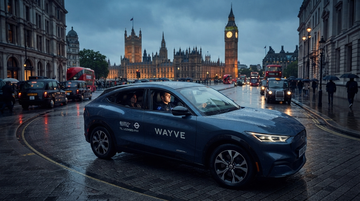
TfL cleared Uber + Wayve for supervised robotaxi rides by licensing the vehicles as PHVs—not as fully driverless AVs
What TfL actually licensed (from primary statements opened in this session)
Date
5 Aug 2026
Announced by Uber + Wayve regarding TfL PHV licensing and trial start.
Licence type
Private Hire Vehicle (PHV)
Vehicles were licensed as PHVs (not as driverless AV permits).
Core constraint
Qualified human driver onboard
A trained, TfL-licensed private hire driver must remain responsible during the trip.
Framework
AV Trialling Code of Practice + Uber’s operator licence
Trips run under the UK Government’s AV Trialling Code of Practice and Uber’s TfL Private Hire Operator licence.
“Triple-lock”
Operator + driver + vehicle all licensed
The licensing completes the “triple-lock” requirement for PHV trips.
Vehicle platform
All-electric Ford Mustang Mach-E
Uber/Wayve described the autonomous vehicles as autonomous all-electric Ford Mustang Mach-E vehicles.
This matters because the approval is not a simple “autonomous vehicle is allowed” signal. TfL’s PHV path forces the first production-like economics of robotaxis to include a human-in-the-loop cost and liability allocation. In practical terms, Wayve and Uber must treat the driver as an operational safety layer and a compliance system that remains legally and operationally responsible for each ride.
Why regulators care (and what it signals to other markets)
The UK framework turns robotaxi rollout into an integration problem: responsibility, inspection, and operator/driver/vehicle licensing all have to “agree”
- TfL’s PHV licensing forces a “responsibility stack” (operator + driver + vehicle) to be simultaneously licensed, reducing ambiguity about who can be held accountable during edge cases.
- The Government’s AV Trialling Code of Practice constrains testing to an approved trial regime, making the next regulator’s job easier: they can copy the trial governance rather than reinvent it.
- Because Wayve’s vehicles are described as operating autonomously with a trained, TfL licensed driver onboard, the early model shifts validation from “can it drive” to “can it run safely while supervised”.
For the “non-US AV economics” thesis in the brief: this is exactly the kind of approval that can be franchised. Regulators don’t just need to trust the autonomy— they need a repeatable structure for (1) vehicle eligibility, (2) operator licensing, (3) driver qualifications, and (4) how incident responsibility is handled. A PHV-licensed, supervised robotaxi trial becomes a regulatory template that can travel with far less translation than a fully driverless approval regime.
What’s novel versus “just a bigger fleet”
The fleet-size story is a distraction—the approval is a “capability-to-compliance” checkpoint that favors scalable operations, not just scalable vehicles
Uber/Wayve also tied the rollout to an interest list: Uber and Wayve stated that in the last eight weeks more than 100,000 Londoners signed up to an interest list to be matched at launch. That demand signal matters for near-term utilization, but the actual limiting factor for replication remains the licensing structure. Since the vehicles are licensed under PHV rules with an onboard trained driver, the “unit economics” will depend on the cost of maintaining that licensed-driver layer alongside dispatch, incident handling, and operational readiness.
Supply chain and operating model implications
A supervised UK PHV approval changes the operating supply chain: autonomy stops being the only “safety vendor” and becomes one component in an operator-led system
| Layer | What the UK PHV approval requires | Who it pulls into the loop (examples) |
|---|---|---|
| Regulatory compliance | PHV vehicle licensing + trial governance under AV Trialling Code | TfL; UK Government trial framework (operator-of-record governance) |
| Operational responsibility | A trained, TfL-licensed private hire driver must remain onboard and responsible | Uber (operator licence) + qualified private hire driver workforce |
| Autonomy integration | Autonomous driving runs with human support/override as needed | Wayve’s autonomy stack; vehicle controls integration on the Mach-E platform |
| Fleet hardware platform | Autonomous-capable all-electric vehicle eligibility for PHV inspection | Vehicle OEM platform (Mach-E as stated) and in-vehicle autonomy sensor/compute integration |
The investment consequence is that autonomy firms and ride platforms face a different go-to-market bottleneck. Under a supervised PHV regime, the limiting inputs can be operator compliance readiness and onboard driver throughput—not just model accuracy. That tends to favor players who can industrialize processes (licensing, compliance reporting, dispatch orchestration) alongside the autonomy software.
Tie to listed-company fundamentals (what investors can price)
Uber’s current scale already supports experimentation, but the key question is whether the supervised model can convert to lower-human-cost autonomy
Uber TTM revenue
$41.05B
TTM revenue in financial data (latest snapshot as of this session).
Uber TTM net income
$7.19B
TTM net income in financial data (latest snapshot as of this session).
Uber TTM EBIT
$4.74B
TTM operating income (EBIT proxy) in financial data.
Alphabet TTM revenue (context)
$445.87B
TTM revenue in financial data.
Uber can fund trials and compliance overhead because it is already operating at a massive global service scale (revenue in tens of billions). But the UK PHV approval implicitly highlights the near-term cost structure: the model must coexist with a trained driver. The upside case depends on whether supervised operations quickly become a path toward reduced supervision while preserving safety and regulatory sign-off.
Investor-relevant horizons
Near term: supervised rides unlock learning loops; long term: regulators determine whether autonomy graduates beyond the onboard-driver requirement
- Near-term catalyst: licensing completion and onboarding reduce time-to-first-ride in London from “approval uncertainty” to “operational execution” after 5 Aug 2026.
- Near-term KPI to watch: whether Uber/Wayve can scale ride dispatch and incident handling while maintaining the onboard driver condition described by the PHV framework.
- Long-term thesis driver: regulators will decide whether future approvals move from PHV-supervised constructs toward broader automated operation; this approval acts as the first checkpoint that can be reused in new cities without copying the US approach.
Non-obvious causal chain (brief angle validated)
Why this is the “regulatory template” investors should track: it benchmarks a non-US autonomy stack under constrained-supervised operating rules
The brief argues that London is a de facto proof-of-concept for non-US AV economics. The verified detail is that Wayve’s vehicles were granted PHV licences with a trained, TfL licensed private hire driver onboard under the AV Trialling Code of Practice. That turns the economic question into something regulators can test quickly: can a non-US platform run a constrained supervised service safely enough to expand. If other jurisdictions adopt similar supervised templates, the market will reward companies that can industrialize compliance and operations for each new regulatory “package,” not just companies that can demonstrate autonomy performance in isolation.
Who likely gets priced off this (listed-company linkages only)
- benefits from TfL’s PHV-supervised approval because Uber runs under its TfL Private Hire Operator licence during trial rides.
- turns compliance execution into a near-term scalable capability after 5 Aug 2026, improving odds of additional UK rollout under similar constraints.
- needs supervision cost to fall faster than demand scales for sustained margin upside, since the PHV rule keeps a trained driver onboard.
- faces competitive pressure for rider attention because London’s supervised robotaxi trial becomes a visible alternative alongside Waymo expansion plans (competition is indirect but real).
- retains a long-run mapping/ops optionality given its AI and autonomy ecosystem, but near-term UK pricing power may weaken as more services launch under constrained supervision.
- could see demand experimentation data flow into the wider autonomy market, which helps the category but may intensify competition for partners.
- faces a regulatory precedent that rewards supervised compliance first, which may separate “tone” from approvals as regulators standardize templates (watch how UK-style supervision spreads).
- may be judged by how quickly it can integrate a responsible supervised operating model, since PHV-style constraints are operationally non-trivial.
- could benefit or lose depending on whether future approvals relax supervision—this is not disclosed in the PHV licensing text.
- stands to benefit from autonomy compute adoption because supervised robotaxi deployments still require AI perception and driving stacks at scale.
- captures demand for training/inference compute in pilot-to-scale transitions, since trials require iteration even under onboard-driver constraints.
- could see longer-cycle upside if “template approvals” multiply deployments across cities where autonomy stacks must run reliably under governance.