%22%2F%3E%0A%20%20%3Ccircle%20cx%3D%22220%22%20cy%3D%22150%22%20r%3D%22180%22%20fill%3D%22%2322d3ee%22%20fill-opacity%3D%220.12%22%2F%3E%0A%20%20%3Ccircle%20cx%3D%221010%22%20cy%3D%22130%22%20r%3D%22220%22%20fill%3D%22%2338bdf8%22%20fill-opacity%3D%220.08%22%2F%3E%0A%20%20%3Ccircle%20cx%3D%22920%22%20cy%3D%22520%22%20r%3D%22170%22%20fill%3D%22%2322d3ee%22%20fill-opacity%3D%220.06%22%2F%3E%0A%20%20%3Cpath%20d%3D%22M140%20430h920%22%20stroke%3D%22url(%23line)%22%20stroke-width%3D%2212%22%20stroke-linecap%3D%22round%22%2F%3E%0A%20%20%3Cpath%20d%3D%22M220%20360c120-150%20260-220%20380-220s260%2070%20380%20220%22%20fill%3D%22none%22%20stroke%3D%22%2367e8f9%22%20stroke-opacity%3D%220.5%22%20stroke-width%3D%2216%22%20stroke-linecap%3D%22round%22%20stroke-linejoin%3D%22round%22%2F%3E%0A%20%20%3Cpath%20d%3D%22M300%20398h600%22%20stroke%3D%22%2394a3b8%22%20stroke-opacity%3D%220.24%22%20stroke-width%3D%228%22%20stroke-linecap%3D%22round%22%2F%3E%0A%20%20%3Ctext%20x%3D%22220%22%20y%3D%22510%22%20fill%3D%22%23e2e8f0%22%20fill-opacity%3D%220.7%22%20font-family%3D%22Arial%2C%20Helvetica%2C%20sans-serif%22%20font-size%3D%2238%22%20letter-spacing%3D%228%22%3EINSIGHTS%3C%2Ftext%3E%0A%3C%2Fsvg%3E)
A third-party compute commitment big enough to re-price balance-sheet risk
The Nscale deal matters less for model quality than for who underwrites compute utilization
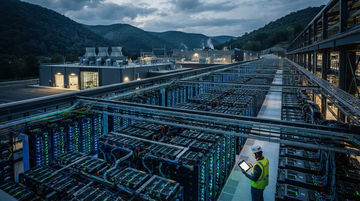
The reported Anthropic → Nscale arrangement is being treated like another infrastructure step. But the market impact is about risk allocation: a frontier lab is reportedly locking dollars into multi-year capacity at an independent AI hyperscaler, rather than building and owning the full data-center and GPU stack itself.
In practical terms, large compute “lock-ups” do two things investors can price: (1) they improve near-term visibility into how quickly GPUs must be deployed, and (2) they change who absorbs the financial damage if demand is slower than forecast. The second point is the crux: a capacity commitment is not the same as contracted revenue for the whole supply chain—so the winners depend on whether the contract structure forces utilization, reroutes capacity, or concentrates downside in the tenant operator.
What’s verified vs. what’s still unclear
The event is real; the exact MW slice and contract mechanics are still the key unknowns
On Aug 26, multiple reports said Anthropic agreed to spend about $45B to rent AI computing power from Nscale tied to Nscale’s West Virginia data center development. Those reports also referenced an order-of-magnitude capacity figure (hundreds of megawatts), but not all outlets confirmed the same MW number or the full contract details.
- Reports link the commitment to Nscale’s West Virginia campus build-out and a planned late-2027 start, suggesting a multi-year reserve that ramps into the next investment cycle.
- Because Anthropic is a private company, the most important missing datapoints are contract volume (the exact MW/GPU allocation), termination/swap rights, and whether the agreement guarantees minimum spend regardless of actual utilization.
- Nscale has been describing its “AI factory” approach for West Virginia, including a separate large-capacity MoU context, but those public pieces do not substitute for the Anthropic contract itself.
| Item | What sources support | Investor relevance |
|---|---|---|
| Reported commitment size | About $45B to rent AI computing power from Nscale (Aug 26, 2026 reports). | Sets the scale of reserved spending and the magnitude of utilization risk transfer. |
| Geography and timing | West Virginia campus development, with compute expected to be available in the late-2027 window (per reporting). | Determines when GPU install-base demand could become visible to the market. |
| Exact MW / GPU slice | Reported capacity figures vary by outlet; contract mechanics not fully disclosed publicly. | Controls how directly this maps into near-term device and server procurement. |
Supply chain lens
If utilization risk shifts, Nvidia capture becomes clearer while downstream cloud margin outcomes hinge on contract structure
AI infrastructure spending can be decomposed into three financial layers: (a) hardware procurement (GPUs/servers/network), (b) power + data-center build-out, and (c) orchestration/operations software and workload throughput. A tenant lock-up primarily changes layer (a) and (b) timing certainty—because someone must buy GPUs and secure power to satisfy reserved capacity—even when the ultimate workloads fluctuate.
To connect the dots with public financials: NVIDIA reported FY2024 revenue of $60.9B, rising to $130.5B in FY2025 and $215.9B in FY2026 (per annual income statements). The investor takeaway is not that the $45B deal alone drives those totals. It’s that the market is already pricing Nvidia around a continuing high-install-base trajectory—so a major new capacity reservation can reinforce that narrative by tightening the timeline for additional deployments.
NVIDIA revenue (FY2024)
$60.9B
FY2024, reported Feb 21, 2024
NVIDIA revenue (FY2025)
$130.5B
FY2025, reported Feb 26, 2025
NVIDIA revenue (FY2026)
$215.9B
FY2026, reported Feb 25, 2026
Upstream and operational linkage
Nscale’s “full stack” direction suggests the lock-up is about throughput—not just raw watts
Nscale isn’t only positioning itself as a GPU host. It is actively building toward a fuller AI platform stack by acquiring Anyscale (software + orchestration layer) while continuing to describe major compute campus builds.
From an investor’s viewpoint, that matters because a tenant that can improve scheduling, reduce idle time, and smooth workload placement effectively mitigates part of the utilization risk that otherwise lands on the infrastructure operator. In contrast, a pure “colocation” model shifts more risk onto capacity owners if workloads don’t land smoothly. Nscale’s public acquisition posture implies it wants to capture more than GPU hosting economics.
- If Anyscale’s workload platform can improve utilization on Nscale’s fleet, the operator can defend margins even when demand shifts between training and inference.
- If the Anthropic compute commitment comes with flexibility to swap workloads or GPUs, that reduces the probability of “dead capacity” and improves the operator’s ability to keep spending aligned with demand.
- If the commitment is rigid (minimum payments independent of usage), then downside can concentrate in Nscale, while upside can accrue to hardware suppliers and power infrastructure vendors.
What moves first vs. what decides outcomes
Near-term: GPU and server procurement optics. Long-term: whether capacity becomes scalable revenue or balance-sheet drag
In the short run (days to quarters), investors should expect the fastest “tells” to be in procurement visibility: GPU demand planning, server and networking lead times, and power contracting signals. Those are the items hardware supply chains can interpret quickly after a big reservation announcement.
Over 1–3 years, the question becomes structural: does a frontier lab’s multi-year reservation pull forward hardware installs and then deliver predictable cash flows to the tenant operator? Or does it create a high fixed-cost base that only profits when utilization hits the assumed levels? The answers vary by who owns the operational stack and who can re-route capacity.
| Horizon | What changes | Primary indicator |
|---|---|---|
| Next 1–3 quarters | Hardware procurement and rack-level deployment planning move faster than data-center completion. | GPU/AI server order commentary and supplier lead-time updates; company reporting about AI infrastructure build cadence. |
| 1–3 years | Utilization and pricing discipline decide whether reserved capacity becomes profit or fixed-cost pressure. | Public disclosures about AI datacenter capacity ramp, utilization metrics, and contract flexibility in earnings commentary. |
Investor synthesis
The contract is effectively a utilization wager—Nvidia benefits from certainty, while cloud margins depend on how risk is shared
The headline number—reported ~$45B—looks like an infrastructure story. The deeper takeaway is that this is a utilization wager written into a third-party capacity contract. That shifts bargaining power across the stack: hardware vendors often get clearer forward demand, while the operating entities that actually bear utilization risk (and the power and server capex that supports them) face a more complex margin path.
Listed stocks that can capture (or be exposed to) the deal’s downstream effects
- A large reservation supports continued GPU demand visibility, reinforcing the trajectory seen in FY2024–FY2026 revenue growth.
- If capacity ramps as planned, Nvidia benefits without needing tenant margin success, because hardware and platform demand precede utilization profitability.
- A compute lock-up elsewhere can tighten industry competition for power and GPUs, which may pressure broader cost expectations in Azure builds.
- Microsoft’s scale can offset shortages if it converts AI demand into contracted consumption rather than higher unutilized fixed costs over the next 1–3 years.
- If third-party commitments absorb near-term supply, Amazon could face higher-cost GPU/server procurement during the ramp window.
- Over 1–3 years, AWS profitability depends on whether enterprises respond with incremental workloads fast enough to monetize reserved capacity rather than only increasing depreciation.
- AI-oriented capacity growth across the market can alter power pricing signals; TeraWulf is a watch for power-market and deployment timing sensitivity as utilization competition intensifies.