%22%2F%3E%0A%20%20%3Ccircle%20cx%3D%22220%22%20cy%3D%22150%22%20r%3D%22180%22%20fill%3D%22%2322d3ee%22%20fill-opacity%3D%220.12%22%2F%3E%0A%20%20%3Ccircle%20cx%3D%221010%22%20cy%3D%22130%22%20r%3D%22220%22%20fill%3D%22%2338bdf8%22%20fill-opacity%3D%220.08%22%2F%3E%0A%20%20%3Ccircle%20cx%3D%22920%22%20cy%3D%22520%22%20r%3D%22170%22%20fill%3D%22%2322d3ee%22%20fill-opacity%3D%220.06%22%2F%3E%0A%20%20%3Cpath%20d%3D%22M140%20430h920%22%20stroke%3D%22url(%23line)%22%20stroke-width%3D%2212%22%20stroke-linecap%3D%22round%22%2F%3E%0A%20%20%3Cpath%20d%3D%22M220%20360c120-150%20260-220%20380-220s260%2070%20380%20220%22%20fill%3D%22none%22%20stroke%3D%22%2367e8f9%22%20stroke-opacity%3D%220.5%22%20stroke-width%3D%2216%22%20stroke-linecap%3D%22round%22%20stroke-linejoin%3D%22round%22%2F%3E%0A%20%20%3Cpath%20d%3D%22M300%20398h600%22%20stroke%3D%22%2394a3b8%22%20stroke-opacity%3D%220.24%22%20stroke-width%3D%228%22%20stroke-linecap%3D%22round%22%2F%3E%0A%20%20%3Ctext%20x%3D%22220%22%20y%3D%22510%22%20fill%3D%22%23e2e8f0%22%20fill-opacity%3D%220.7%22%20font-family%3D%22Arial%2C%20Helvetica%2C%20sans-serif%22%20font-size%3D%2238%22%20letter-spacing%3D%228%22%3EINSIGHTS%3C%2Ftext%3E%0A%3C%2Fsvg%3E)
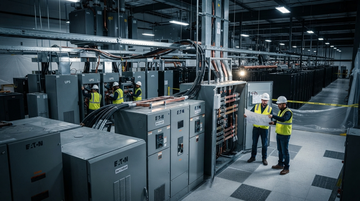
Supply-chain focus: power delivery, not compute
The “transformer shortage” framing misses where data-center timelines actually break
AI buildouts are often described as a single choke point—"transformers". In practice, project completion depends on a chain of interdependent assets and approvals: step-up and distribution transformers, substation civil/controls work, medium-/low-voltage switchgear, UPS distribution and busway/PDUs, backup generation tie-in, and finally utility interconnection and commissioning.
When one link moves slowly, downstream commissioning windows slide, even if transformers arrive. That’s why the binding constraint is shifting from “can the grid eventually provide power?” to “can the electrical lineup be scheduled, installed and energized fast enough to meet commissioning deadlines?”
Event verification: backlog signal in public reporting
Eaton’s Electrical backlog acceleration shows the equipment chain is already in a multi-year “queue” state
Eaton is giving investors a backlog-style signal that matches how electrical-equipment supply constraints propagate into data-center timelines. In its Q1 2026 results release, Eaton reported that Electrical Americas backlog and order momentum accelerated, with data-center momentum cited as a driver.
Why this matters for the grid-to-GPU map: if switchgear and UPS-related electrical orders accelerate while deliveries remain constrained, customers will pull forward spend where they can control installation/energization—while other projects get pushed to later years.
Electrical Americas backlog trend
+44%
Reported in Eaton’s Q1 2026 results release (backlog up 44% over March 2025, end of March 2026).
Electrical Global backlog trend
+73%
Reported in Eaton’s Q1 2026 results release (backlog up 73% over March 2025, end of March 2026).
Electrical Americas rolling book-to-bill
1.2x
Reported in Eaton’s Q1 2026 results release (rolling 12-month basis).
Supply-chain map
A full grid-to-GPU power-delivery stack nobody “owns” end-to-end
- Grid: utility upgrades and interconnection approvals decide when power is legally available at a specific substation point.
- Transformer layer: step-down/step-up and distribution transformers determine how quickly installed sites can reach stable voltage and current levels.
- Substation & controls: protection relays, SCADA/controls and switchyard wiring decide whether energization can pass inspections without long rework cycles.
- Switchgear: breaker and switchgear configuration decides how fast power can be routed, segmented and safely commissioned.
- UPS & power distribution: UPS runtime and bypass/transfer schemes decide whether data-center loads can ride through disturbances during cutover.
- Backup generation: generator procurement and synchronization decides whether outages can be tolerated while the grid is being stabilized.
- Site integration: racks, busways, containment and building electrical interfaces decide whether installation tolerances allow acceptance tests.
Transmission mechanism
Why switchgear + UPS become the scheduling choke point (not just the transformer lead time)
Transformers are headline news because they’re large, scarce and visible. But in commissioning reality, switchgear and UPS often become the gating items because they interface with both protection schemes and site power topology.
When an AI campus is brought online, it needs: (1) upstream power availability; (2) safe fault management and zoning; (3) UPS/bypass behavior that matches outage/transfer test procedures; and (4) acceptance testing windows that are hard to compress once equipment arrives. Even if transformer delivery timing improves, commissioning can still slide if switchgear and UPS components are constrained, configurations are customized, or test schedules are displaced by utility energization timing.
| Layer | Primary constraint | What happens to schedules | Investor signal to watch |
|---|---|---|---|
| Interconnection | Utility study + approval timelines | Commercial operation dates slip by quarters | Queue growth and utility upgrade lead-time commentary |
| Transformer | Manufacturing capacity + delivery lead time | Install windows shift later | Supplier backlog acceleration in grid/electrical segments |
| Switchgear | Configuration + protection engineering and delivery | Commissioning cutovers slip even with power-ready transformers | Backlog strength and bookings commentary tied to data-center momentum |
| UPS + power distribution | System integration + runtime test readiness | Cutover tests extend, delaying full load acceptance | Orders tied to data-center infrastructure and power reliability |
| Backup generation | Procurement + commissioning + synchronization | Phased energization becomes slower | Evidence of higher urgency spend on reliability hardware |
Fundamentals cross-check (listed suppliers)
Equipment makers are already translating electrical momentum into financial momentum—at least at the top line
Eaton has shown revenue expansion across recent fiscal years, consistent with the market narrative that electrification and power reliability hardware are capturing demand. While this doesn’t prove a single cause (industrial mix matters), it supports the plausibility that electrical capex momentum is finding its way into financial results.
For investors, the practical implication is that backlog acceleration and revenue growth can overlap—meaning the market can price in multi-quarter supply recovery rather than treating constraints as a one-off disruption.
Eaton revenue
$27.448B
FY2025 revenue, reported in Eaton’s income statement for fiscal year 2025 (filing date Feb 26, 2026).
Eaton revenue trend
+10.3%
FY2025 vs FY2024 revenue growth, using Eaton’s reported FY2024 and FY2025 income statement revenues.
Related end-markets
The winners are less about “the next transformer” and more about integrating power reliability into data-center timelines
In the grid-to-GPU stack, the most defensible positions aren’t necessarily the manufacturers with the most publicity. They’re often the companies that can:
1) ship configured electrical systems that match protection and topology requirements; 2) sustain backlog through long project cycles; 3) provide delivery-and-install support that reduces rework; and 4) align UPS/transfer behavior with commissioning test procedures.
That’s the “new CoWoS” analogy for power: the value concentrates at integration interfaces, not just at a single headline component.
Horizons
What changes in the next few quarters vs. what compounds over 1–3 years
- Short-term (days–quarters): watch whether electrical equipment suppliers keep reporting backlog growth tied to data centers, and whether their customer commentary shifts from “orders” to “deliveries” without a bookings collapse.
- Short-term (days–quarters): expect utility energization and interconnection readiness to become the next gating variable as equipment lead times partially normalize.
- Long-term (1–3 years): anticipate that multi-year grid-to-GPU scheduling capabilities become a competitive moat, rewarding suppliers that can engineer, deliver and support commissioning.
- Long-term (1–3 years): demand durability improves if reliability requirements persist (UPS runtime, protection and redundancy), rather than being treated as temporary “AI rush” load.
Conclusion
The grid-to-GPU chain is converging on a single investable hypothesis: integration interfaces are where pricing power lives
The core bet is not that transformers are irrelevant—it’s that the market is likely underpricing which layer controls commissioning and acceptance tests. Eaton’s Electrical Americas/Global backlog acceleration and elevated rolling book-to-bill signal that electrical equipment demand is already in a backlog regime, consistent with a multi-year scheduling queue.
For investors, this reframes power-delivery exposure: instead of owning only “bulk grid components,” consider the set of listed electrical-equipment suppliers whose offerings sit at the switchgear-to-UPS-to-commissioning interfaces.
The binding constraint is turning into the integration layer that converts available power into reliably delivered load—and that’s where margins and backlog visibility concentrate.
Listed stocks most exposed to the switchgear-to-UPS commissioning choke point
- Eaton reported Electrical Americas backlog rising 44% over the prior March in Q1 2026, indicating sustained demand in data-center-linked electrical equipment.
- Eaton’s Q1 2026 Electrical rolling book-to-bill rose to 1.2x, supporting the view that customers are still queuing for deliveries tied to grid-to-GPU integration.
- Eaton’s FY2025 revenue of $27.448B grew vs FY2024, consistent with backlog-to-revenue conversion rather than a one-quarter spike.
- If switchgear/UPS demand remains backlog-driven, Schneider’s long-duration electrification exposure should track backlog strength into 2027–2028—but the timing depends on deliveries and customer commissioning windows.
- Schneider’s FY2025 revenue was €40.152B after rising from FY2024, giving it financial capacity to sustain spend through constrained supply chains.
- The key risk: if utilities accelerate interconnection but data-center EPCs change architectures, UPS/switchgear integration demand could shift composition faster than equipment orders.
- As grid upgrades accelerate, Siemens Energy’s power infrastructure backlog trajectory can improve, but outcomes depend on whether interconnection readiness lags equipment installs.
- Long lead items beyond transformers can keep project timelines stretched; if that persists, capacity-focused grid spend should stay elevated into 2027.
- If grid politics and permitting slow down energization, project delays could push revenue recognition despite order growth.
- Power-delivery and commissioning rely on auxiliary systems; if electrical integration continues to extend, Parker-Hannifin’s industrial aftermarket/system demand can benefit as sites keep reworking.
- However, Parker’s end-market mix is broader, so AI-specific power capex can be diluted in reported results.
- In the next quarters, margin and order commentary matter more than topline for distinguishing supply-chain tailwinds from general industrial cycles.