%22%2F%3E%0A%20%20%3Ccircle%20cx%3D%22220%22%20cy%3D%22150%22%20r%3D%22180%22%20fill%3D%22%2322d3ee%22%20fill-opacity%3D%220.12%22%2F%3E%0A%20%20%3Ccircle%20cx%3D%221010%22%20cy%3D%22130%22%20r%3D%22220%22%20fill%3D%22%2338bdf8%22%20fill-opacity%3D%220.08%22%2F%3E%0A%20%20%3Ccircle%20cx%3D%22920%22%20cy%3D%22520%22%20r%3D%22170%22%20fill%3D%22%2322d3ee%22%20fill-opacity%3D%220.06%22%2F%3E%0A%20%20%3Cpath%20d%3D%22M140%20430h920%22%20stroke%3D%22url(%23line)%22%20stroke-width%3D%2212%22%20stroke-linecap%3D%22round%22%2F%3E%0A%20%20%3Cpath%20d%3D%22M220%20360c120-150%20260-220%20380-220s260%2070%20380%20220%22%20fill%3D%22none%22%20stroke%3D%22%2367e8f9%22%20stroke-opacity%3D%220.5%22%20stroke-width%3D%2216%22%20stroke-linecap%3D%22round%22%20stroke-linejoin%3D%22round%22%2F%3E%0A%20%20%3Cpath%20d%3D%22M300%20398h600%22%20stroke%3D%22%2394a3b8%22%20stroke-opacity%3D%220.24%22%20stroke-width%3D%228%22%20stroke-linecap%3D%22round%22%2F%3E%0A%20%20%3Ctext%20x%3D%22220%22%20y%3D%22510%22%20fill%3D%22%23e2e8f0%22%20fill-opacity%3D%220.7%22%20font-family%3D%22Arial%2C%20Helvetica%2C%20sans-serif%22%20font-size%3D%2238%22%20letter-spacing%3D%228%22%3EINSIGHTS%3C%2Ftext%3E%0A%3C%2Fsvg%3E)
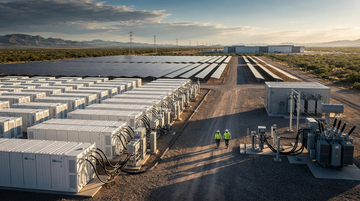
AI data centers are no longer just a GPU build-out story. They are a “power-shaping” story: utilities and developers must guarantee power on demand, with enough firm capacity to absorb outages, ramps, and multi-hour lulls.
The reported headline that Nvidia is in talks to invest as much as $3B into SB Energy puts a spotlight on the part of the supply chain that typically gets underpriced in AI narratives: grid-scale storage plus firming/dispatch capacity that makes 24/7 AI load physically possible. The winner set shifts from just transformers to the companies that deliver guaranteed megawatts.
Verified event + what it implies for “firm” AI power
The Nvidia–SB Energy report points to a new bottleneck: guaranteed grid capacity, not just generation
What the market reports (and what’s actually confirmed)
Reported Nvidia investment into SB Energy
As much as $3B (in talks/consideration)
Attribution: Reuters report published Aug 15, 2026.
Storage/firming relevance
SB Energy positions as a power + data-center platform
SB Energy describes itself as developing, constructing, and operating critical infrastructure.
SB Energy is a developer that explicitly connects data centers and power infrastructure. If Nvidia is funding the developer, the economic objective is not “more electrons,” it is the ability to deliver dependable power that keeps data-center IT online.
That is the causal bridge: AI systems drive high and fast load. But even when generation capacity exists on paper, grids struggle with ramping, congestion, and reliability obligations. Grid-firming capacity (storage, peakers, or long-duration solutions) converts variable renewable output—and variable grid headroom—into dispatchable power that operators can underwrite to finance and contract.
Supply-chain map: batteries, firming, and the “power conversion” layer
Why storage + firming is the missing leg of AI power supply-chain margin
- Grid-scale storage captures revenue when renewables are firmed into dispatchable capacity—not when they are merely installed.
- Battery + long-duration systems typically monetize through capacity availability, energy shifting, and ancillary services that data-center operators rely on implicitly for uptime.
- Power electronics and balance-of-system equipment (PCS, switchgear, protection, interconnection gear) become the throughput constraint once project pipelines accelerate.
Data anchors from listed companies: durability of cash and industrial scaling
Nvidia’s balance-sheet capacity to fund power assets is real—its scale supports a multi-year buildout
TTM revenue
$253.5B
TTM through Jun 30, 2026, reported in NVDA FY2027 10-K filing dated May 20, 2026
TTM free cash flow
$119.1B
TTM through Jun 30, 2026, in Nvidia cash flow reporting filed May 20, 2026
Net cash position
-$0.4B
Net debt approx. -$0.4B (net cash) at TTM through Jun 30, 2026, in Nvidia balance sheet reporting
Nvidia’s ability to write large checks into a power developer is consistent with its reported cash-generation scale. Nvidia generated $119.1B of TTM free cash flow through Jun 30, 2026, giving it funding flexibility for long-duration infrastructure plays that are measured in years—not quarters.
Upstream + downstream: the chain that turns “AI demand” into installed firming MW
From power-site development to grid conversion gear: who captures the margin
| Supply-chain leg | What it supplies | Where the reliability margin lives | Listed proxy companies (evidence-backed linkage) |
|---|---|---|---|
| Grid-scale storage hardware + LDES | Batteries and long-duration energy storage | Availability/capacity and dispatch performance vs. just installed energy | ESS Tech, Fluence Energy |
| Power conversion and grid integration | PCS, control, and system-level integration that lets storage safely serve grids | Throughput bottleneck once projects lock fast interconnection and dispatch tests | Eaton, Fluence Energy |
| Firming generation / flexible peaking | Gas peakers and flexible generation assets that complement storage | Reliability premiums when storage alone cannot cover multi-day/seasonal gaps | GE Vernova |
| Transmission + building-scale enabling | Construction materials, sitework, and power-site build execution | Project delivery risk-adjusted margin when schedules tighten | Builders FirstSource |
The investor-relevant shift is that the margin doesn’t only sit where electrons are produced. It sits where a developer can credibly guarantee dispatch. When AI operators contract for uptime, developers often backstop that uptime with storage plus firming—then the supply chain bills for certainty.
Company-level fundamentals tie-in: what to watch as “firm power” demand concentrates
Signal to watch: storage and electrical supply chains respond only after firming contracts convert to capex
The investment thesis is not “AI increases demand.” It is AI increases the fraction of power budgets spent on firming and integration—which changes who wins.
For storage specialists, the key is contract conversion and delivery schedules. For power-management and electrical equipment providers, the key is backlog and project pacing tied to grid interconnection timelines.
- Fluence Energy typically monetizes storage systems and services when projects enter delivery windows—watch for quarter-to-quarter revenue and contract execution in filings.
- ESS Tech faces an execution bottleneck typical of long-duration platforms—watch liquidity and signs of scaled deliveries rather than only partnership headlines.
- Eaton benefits when data-center power distribution and grid-connection equipment needs accelerate—watch segment backlog signals in earnings disclosures.
Horizons: what moves first vs. what compounds over 1–3 years
Near-term vs. long-term: where investors should expect firm-power spending to show up
| Horizon | What changes | Where it shows up | Investor takeaway |
|---|---|---|---|
| Days–quarters | Interconnection and dispatch study completion | Equipment purchase orders, project milestones, backlog updates | Favor firms with tight integration/throughput advantage. |
| 1–3 years | Grid-scale storage + firming capex cycles | Sustained revenue growth from delivered MW/GWh and long-duration contracts | Favor firms that can scale manufacturing and system delivery. |
| 1–3 years (risk) | Financing and schedule volatility | Margin pressure, working-capital swings, or delivery slippage | Discount businesses without credible liquidity/execution. |
Where the firm-power supply chain is most likely to show up in listed equities
- The reported $3B SB Energy talks tie Nvidia’s AI value chain to grid-firming risk, which can increase project certainty in the medium term while adding political/financing uncertainty near-term.
- Nvidia’s TTM free cash flow of $119.1B through Jun 30, 2026 supports multi-year infrastructure funding, improving its ability to underwrite uptime-related assets.
- Eaton's power-management products can face a throughput pinch as data centers scale power distribution, which should support demand resilience over quarters.
- The reliability-driven buildout increases the probability of higher-use electrical equipment per MW, shifting mix toward electrical components rather than only generators.
- Long-duration storage demand linked to 24/7 AI reliability increases the strategic ceiling for ESS Tech, but execution risk can dominate near-term outcomes.
- Investors should watch delivery cadence and liquidity because long-duration timelines are project- and manufacturing-dependent.
- GE Vernova can gain when firming relies on flexible generation alongside storage, improving dispatch options for constrained grids.
- A faster storage build could cap how quickly peaker additions clear, making near-term order timing uncertain.
- SoftBank exposure to SB Energy’s projects can turn renewable-plus-firming capex into a higher-quality asset profile, if financing and execution hold.
- Because SB Energy is a platform bet, value realization timing can lag, creating near-term valuation volatility.