%22%2F%3E%0A%20%20%3Ccircle%20cx%3D%22220%22%20cy%3D%22150%22%20r%3D%22180%22%20fill%3D%22%2322d3ee%22%20fill-opacity%3D%220.12%22%2F%3E%0A%20%20%3Ccircle%20cx%3D%221010%22%20cy%3D%22130%22%20r%3D%22220%22%20fill%3D%22%2338bdf8%22%20fill-opacity%3D%220.08%22%2F%3E%0A%20%20%3Ccircle%20cx%3D%22920%22%20cy%3D%22520%22%20r%3D%22170%22%20fill%3D%22%2322d3ee%22%20fill-opacity%3D%220.06%22%2F%3E%0A%20%20%3Cpath%20d%3D%22M140%20430h920%22%20stroke%3D%22url(%23line)%22%20stroke-width%3D%2212%22%20stroke-linecap%3D%22round%22%2F%3E%0A%20%20%3Cpath%20d%3D%22M220%20360c120-150%20260-220%20380-220s260%2070%20380%20220%22%20fill%3D%22none%22%20stroke%3D%22%2367e8f9%22%20stroke-opacity%3D%220.5%22%20stroke-width%3D%2216%22%20stroke-linecap%3D%22round%22%20stroke-linejoin%3D%22round%22%2F%3E%0A%20%20%3Cpath%20d%3D%22M300%20398h600%22%20stroke%3D%22%2394a3b8%22%20stroke-opacity%3D%220.24%22%20stroke-width%3D%228%22%20stroke-linecap%3D%22round%22%2F%3E%0A%20%20%3Ctext%20x%3D%22220%22%20y%3D%22510%22%20fill%3D%22%23e2e8f0%22%20fill-opacity%3D%220.7%22%20font-family%3D%22Arial%2C%20Helvetica%2C%20sans-serif%22%20font-size%3D%2238%22%20letter-spacing%3D%228%22%3EINSIGHTS%3C%2Ftext%3E%0A%3C%2Fsvg%3E)
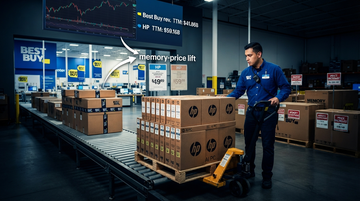
Retail earnings can mislead when a hardware category is dominated by input-cost inflation rather than unit-driven adoption. The current debate is whether “AI-PC momentum” is flowing through retail demand—or whether “computing strength” is partly a pricing mirage created by a memory spike.
In this piece, the goal is simple: separate what moves first in the chain—(1) memory/SSD cost pressure, (2) device price changes at the consumer channel, and (3) true AI-PC unit demand. The evidence base is earnings fundamentals for Best Buy and HP, plus industry/price signals about memory-driven PC pricing pressure and consumer device price hikes.
Earnings + pricing transmission
Best Buy’s category win can happen even if AI-PC units aren’t accelerating
Best Buy’s retail model converts product demand into revenue, but the revenue line alone cannot tell you whether buyers are increasing units or simply paying higher prices. When memory costs rise sharply, consumer electronics often reprice quickly—boosting sell-through dollars before end-demand volume has caught up.
That distinction matters because “computing strength” can be driven by at least two levers:
- Memory-price inflation increases average selling price without proportional unit growth.
- AI-PC adoption increases unit share of AI-capable systems (a different magnitude and timing pattern).
Best Buy revenue (TTM)
$41.86B
Trailing twelve months ended Apr 30, 2026 (reported Jun 5, 2026)
Best Buy gross profit (TTM)
$9.43B
Trailing twelve months ended Apr 30, 2026 (reported Jun 5, 2026)
HP revenue (TTM)
$59.16B
Trailing twelve months ended Apr 30, 2026 (reported Aug 26, 2026)
HP net income (TTM)
$2.45B
Trailing twelve months ended Apr 30, 2026 (reported Aug 26, 2026)
External cost pressure
Memory-cost pressure can lift consumer hardware revenue before units do
A credible way to test the “mirage” hypothesis is to look for upstream-to-retail pricing transmission. Gartner’s industry framing is that memory/DRAM cost escalation feeds directly into higher PC pricing expectations and can also pressure shipments.
Gartner estimated that surging memory costs would increase PC prices by 17% in 2026 and that global PC shipments would decline 10.4%.
| Source | Metric | Direction for PC category |
|---|---|---|
| Gartner press release, Feb 26, 2026 | PC price impact: +17% (2026) | Higher consumer pricing |
| Gartner press release, Feb 26, 2026 | PC shipments: -10.4% (2026) | Lower unit volume |
If retail is selling into that environment, “computing strength” can reflect a higher-dollar per unit mix (and forced re-pricing) even if buyers are not truly upgrading faster on AI capabilities.
Consumer channel repricing
Amazon’s device repricing supports the price-pass-through path
A second, more retail-tape-like indicator is whether consumer device makers/retailers quickly reprice when memory/storage costs jump. TechCrunch reported that Amazon raised prices on several hardware devices by as much as 60%, citing memory shortages and component cost increases.
This is not the same as a PC unit metric, but it strongly supports the mechanism: the consumer channel can translate memory pressure into end-product pricing quickly.
| Source | Event | Magnitude |
|---|---|---|
| TechCrunch, Aug 24, 2026 | Amazon hikes select device prices citing memory shortage | Up to +60% |
| TechCrunch, Aug 24, 2026 | Example: Echo Dot price jump | From $49.99 to $79.99 (+60%) |
OEM demand signal
HP’s mixed picture makes the retail-price mirage more plausible
The retail side can be strong even if OEM demand is not accelerating in the specific AI-PC direction investors want. The key check is whether OEM disclosures show convincing mix/unit momentum versus cost headwinds.
HP’s financial trajectory (revenue and profitability levels) still matters, because if AI-PC were strongly pulling forward unit demand, you’d typically expect clearer evidence of acceleration at the OEM line as well.
Using the available verified fundamentals in this environment, HP shows a sizable revenue base and positive trailing net income, but those totals alone cannot prove an AI-PC mix shift in units. That’s why this article treats HP as a demand cross-check rather than as definitive proof.
HP revenue (TTM)
$59.16B
Trailing twelve months ended Apr 30, 2026 (reported Aug 26, 2026)
HP net income (TTM)
$2.45B
Trailing twelve months ended Apr 30, 2026 (reported Aug 26, 2026)
Best Buy revenue (TTM)
$41.86B
Trailing twelve months ended Apr 30, 2026 (reported Jun 5, 2026)
Best Buy net income (TTM)
$1.14B
Trailing twelve months ended Apr 30, 2026 (reported Jun 5, 2026)
So who captures value in the chain?
AI-PC “value capture” likely shifts toward suppliers during memory stress
If the market is in a cost-stress regime, the immediate value capture typically shifts upstream to memory suppliers (and anyone able to pass through pricing or protect supply). Retailers and OEMs can benefit in revenue dollars, but margins can face two-way pressure:
- Higher component costs squeeze OEM margins.
- Retailers may gain revenue with re-pricing, but competitive pricing and promo cycles can limit incremental margins.
The investor implication: “computing strength” at Best Buy is not automatically an AI-PC adoption signal; it can be a commodity-style repricing event layered on top of a new feature cycle.
- Best Buy revenue can rise when the average selling price rises, even if PC shipments fall.
- Memory suppliers can capture more of the upside when component scarcity drives pricing power upstream.
- OEMs can show less AI-PC acceleration than retail dollars suggest if cost headwinds absorb margin and distort mix.
What to watch next (timing)
Markets should separate near-term pricing lift from longer-term unit adoption
Short-term (days to quarters), the first move is price: if memory continues to re-rate, consumer electronics tickets rise. That lifts retail revenue quickly.
Long-term (1–3 years), the tell is units and mix: AI-PC adoption should reflect sustained growth in AI-capable device share independent of memory price moves.
Listed takeaways tied to the evidence above
- Best Buy can report stronger revenue with price-driven dollars even if PC shipment volume declines.
- Best Buy’s margin sensitivity makes it harder for ‘computing strength’ to prove AI-PC demand without unit/mix disclosure.
- Over the next 1–2 quarters, memory repricing can keep the retail tape noisy rather than predictive.
- If AI-PC unit momentum is weaker than retail suggests, HP’s profitability should show less operating leverage than investors expect.
- Memory cost stress can distort OEM mix, turning AI-PC shipment shares into a timing vs. demand problem.
- In 1–3 years, sustained AI-PC share gains should show up in segment profitability resilience.
- Memory-cost expectations imply Micron benefits when scarcity raises pricing power upstream.
- Near-term earnings sensitivity to memory price can dominate the cycle before any AI-PC unit adoption is visible at retail.
- If PC shipments fall as Gartner projects, memory pricing can still stay elevated longer than end-demand.
- Dell can gain from higher PC ASPs during memory stress even if shipments soften, supporting revenue in the near term.
- If component costs aren’t fully passed through, Dell’s margin can face a two-way squeeze.
- In 1–3 years, Dell’s AI-PC conversion depends on whether AI-capable mix expands faster than upgrade fatigue.
- Amazon’s device repricing supports a channel environment where cost inflation passes into consumer pricing quickly.
- Higher end-product pricing can protect retail economics when demand is stable enough to sustain sell-through.
- Over the next quarter, watch whether repricing translates into higher unit volumes or triggers demand compression.