%22%2F%3E%0A%20%20%3Ccircle%20cx%3D%22220%22%20cy%3D%22150%22%20r%3D%22180%22%20fill%3D%22%2322d3ee%22%20fill-opacity%3D%220.12%22%2F%3E%0A%20%20%3Ccircle%20cx%3D%221010%22%20cy%3D%22130%22%20r%3D%22220%22%20fill%3D%22%2338bdf8%22%20fill-opacity%3D%220.08%22%2F%3E%0A%20%20%3Ccircle%20cx%3D%22920%22%20cy%3D%22520%22%20r%3D%22170%22%20fill%3D%22%2322d3ee%22%20fill-opacity%3D%220.06%22%2F%3E%0A%20%20%3Cpath%20d%3D%22M140%20430h920%22%20stroke%3D%22url(%23line)%22%20stroke-width%3D%2212%22%20stroke-linecap%3D%22round%22%2F%3E%0A%20%20%3Cpath%20d%3D%22M220%20360c120-150%20260-220%20380-220s260%2070%20380%20220%22%20fill%3D%22none%22%20stroke%3D%22%2367e8f9%22%20stroke-opacity%3D%220.5%22%20stroke-width%3D%2216%22%20stroke-linecap%3D%22round%22%20stroke-linejoin%3D%22round%22%2F%3E%0A%20%20%3Cpath%20d%3D%22M300%20398h600%22%20stroke%3D%22%2394a3b8%22%20stroke-opacity%3D%220.24%22%20stroke-width%3D%228%22%20stroke-linecap%3D%22round%22%2F%3E%0A%20%20%3Ctext%20x%3D%22220%22%20y%3D%22510%22%20fill%3D%22%23e2e8f0%22%20fill-opacity%3D%220.7%22%20font-family%3D%22Arial%2C%20Helvetica%2C%20sans-serif%22%20font-size%3D%2238%22%20letter-spacing%3D%228%22%3EINSIGHTS%3C%2Ftext%3E%0A%3C%2Fsvg%3E)
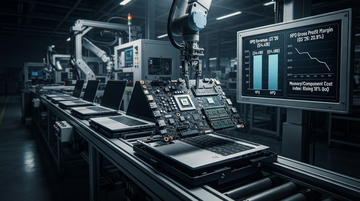
The AI-PC narrative lives or dies on one early datapoint: do customers actually buy more units when the new chip+memory configuration lands? In HP’s most recent reporting, revenue strength paired with weaker PC shipment trends raises a difficult question for the AI refresh cycle: is the market paying up for functionality, or is the industry still constrained by higher component bills.
This matters for the entire supply chain. If the AI-PC refresh is not translating into higher unit volumes, then memory makers can still see pricing support—but PC OEM margins can compress until supply and demand re-balance.
Earnings takeaway, read through the unit-vs-price lens
Revenue can grow while unit demand weakens—HP’s print revenue didn’t have to carry the day
HPQ consolidated revenue (latest reported quarter in this dataset)
$14.41B
Q2 FY2026, reported May 28, 2026
HPQ revenue (prior quarter for context)
$14.08B
Q1 FY2026, reported Feb 25, 2026
HPQ gross profit margin (gross profit / revenue)
20.9%
Q2 FY2026, using Q2 gross profit and Q2 revenue
In the financial statement data available here, HP’s revenue increased quarter-to-quarter across Q1 FY2026 to Q2 FY2026, and gross profit stayed positive. That kind of revenue/margin stability is what can mask an underlying shipment problem—especially when the mix shifts toward higher-cost configurations.
The industry implication is that investors should not treat “AI-PC mix” language as unit growth until shipment-level disclosures (or clear segment shipment drivers) confirm the demand side.
What the market is really pricing
If the AI-PC upgrade cycle stalls on units, elevated memory costs become the margin tax
Even if AI PCs take share within HP’s PC mix, unit volume still drives: (1) production absorption (factory utilization), (2) inventory turns, and (3) how much of the BOM inflation HP can negotiate or pass through.
When unit shipments fall, OEMs can end up with the worst of both worlds: fewer units to spread fixed costs, and higher per-unit memory/component cost pressure. That is why “memory cost” is not just a DRAM story—it’s the margin lever that determines whether the AI-PC upgrade becomes profitable growth or just a pricing battle.
Supply chain map, end-to-end
Memory-cost pressure transmits from DRAM to PC OEMs to printing margins through demand timing
- If DRAM prices rise, HP’s PC bill of materials rises per unit even when revenue mix improves.
- When PC shipments weaken, HP’s ability to spread those higher costs across volume falls before any full-cycle cost relief appears.
- Printing demand can look steadier, but PC weakness still pressures consolidated operating leverage through less PC inventory turn and higher working-capital drag.
This is a supply-chain timing problem more than a product capability problem. Memory and other DRAM-attached components are purchased and built into systems before the market confirms whether customers will upgrade.
So the “unit momentum” signal matters for everyone: memory suppliers want stable demand signals, while CPU/platform and module supply wants consistent unit pull from OEMs.
What to watch next (short horizon) vs. what matters (1–3 years)
The next catalyst is unit disclosure and margin guidance—then the AI-PC mix can become investable
| What to verify | Why it matters | Bear case if it fails | Bull case if it holds |
|---|---|---|---|
| PC shipment/unit drivers and trend | Separates refresh-volume from mix-only improvement | Revenue/mix holds while volume declines | Units stabilize and mix-up grows alongside volumes |
| Gross margin and segment margin commentary | Tests whether pricing offsets elevated memory costs | Memory/component cost bill rises faster than selling price | Margins hold as mix shifts toward AI configurations |
| Working capital and inventory trends | Shows whether demand softness is hitting the balance sheet | Inventory/turn pressure increases | Inventory turns improve with sustained unit flow |
Over the next 1–3 years, the investable question becomes structural: does HP (and the broader PC market) convert AI-PC specs into a recurring upgrade rhythm, or does the PC market simply cycle through replacement needs while customers delay because memory/component costs remain elevated.
A durable upgrade cycle would show up as steadier shipment growth and less margin volatility despite DRAM price swings.
Investor translation
HP’s equity reaction should hinge on margin capacity, not on AI feature marketing
When revenue holds up but shipments soften, the market is effectively asking: “Will the higher-cost AI configuration pay back in volume?” If the answer is delayed, the memory cost bill becomes a near-term headwind and could dominate the narrative.
In that setup, investors should treat HP’s stock as a high-sensitivity proxy for the OEM margin path through the memory/component cycle—not just for AI-PC adoption.
Listed supply-chain and demand proxies tied to this AI-PC unit-versus-cost dynamic
- HP’s revenue can still rise while the PC unit trend weakens until operating leverage turns positive again.
- Elevated memory/component costs can cap gross margin upside if unit volumes don’t recover in time.
- Next-quarter guidance should confirm whether HP can pass through BOM inflation without shipment loss.
- If PC OEMs don’t expand unit volumes, Micron may still benefit from pricing but demand growth may lag.
- Memory-cycle volatility should show up in earnings power timing if PC shipments remain pressured.
- A stabilization in PC refresh units would improve the demand-to-price balance for DRAM.
- AI-PC mix helps DRAM content per PC, but if units stall then volume elasticity weakens for the cycle.
- Margin outcomes depend on whether ASP support lasts through OEM shipment softness.
- Any evidence of unit pickup would tighten the forward demand outlook for HBM/DRAM exposure.
- Samsung’s memory revenue can stay supported by pricing even when OEM unit growth lags.
- If PC shipments keep declining, upside becomes more constrained to mix/ASP than volume.
- A confirmed AI-PC unit refresh would improve the volume side of the memory cycle.