%22%2F%3E%0A%20%20%3Ccircle%20cx%3D%22220%22%20cy%3D%22150%22%20r%3D%22180%22%20fill%3D%22%2322d3ee%22%20fill-opacity%3D%220.12%22%2F%3E%0A%20%20%3Ccircle%20cx%3D%221010%22%20cy%3D%22130%22%20r%3D%22220%22%20fill%3D%22%2338bdf8%22%20fill-opacity%3D%220.08%22%2F%3E%0A%20%20%3Ccircle%20cx%3D%22920%22%20cy%3D%22520%22%20r%3D%22170%22%20fill%3D%22%2322d3ee%22%20fill-opacity%3D%220.06%22%2F%3E%0A%20%20%3Cpath%20d%3D%22M140%20430h920%22%20stroke%3D%22url(%23line)%22%20stroke-width%3D%2212%22%20stroke-linecap%3D%22round%22%2F%3E%0A%20%20%3Cpath%20d%3D%22M220%20360c120-150%20260-220%20380-220s260%2070%20380%20220%22%20fill%3D%22none%22%20stroke%3D%22%2367e8f9%22%20stroke-opacity%3D%220.5%22%20stroke-width%3D%2216%22%20stroke-linecap%3D%22round%22%20stroke-linejoin%3D%22round%22%2F%3E%0A%20%20%3Cpath%20d%3D%22M300%20398h600%22%20stroke%3D%22%2394a3b8%22%20stroke-opacity%3D%220.24%22%20stroke-width%3D%228%22%20stroke-linecap%3D%22round%22%2F%3E%0A%20%20%3Ctext%20x%3D%22220%22%20y%3D%22510%22%20fill%3D%22%23e2e8f0%22%20fill-opacity%3D%220.7%22%20font-family%3D%22Arial%2C%20Helvetica%2C%20sans-serif%22%20font-size%3D%2238%22%20letter-spacing%3D%228%22%3EINSIGHTS%3C%2Ftext%3E%0A%3C%2Fsvg%3E)
Energy / Europe gas security
The winter story isn’t “gas is tight”—it’s that storage starts too low
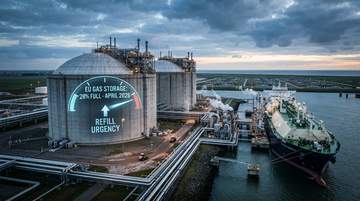
Europe’s pre-winter buffer is already impaired. At the start of the gas summer season on 1 April 2026, average EU gas storage was 28% of capacity, and that starting point was below the levels recorded at the start of the previous three summer seasons.
That matters because winter gas pricing and LNG demand are not driven only by total annual balance—they’re driven by how quickly inventories can be refilled and how much storage drawdown remains “available” when the weather turns. When the starting level is structurally low, the market has less room to absorb shocks before forward prices demand a higher risk premium.
Verified storage anchor (what we can prove from primary reporting)
EU gas storage at start of summer (1 April 2026)
28% capacity
ACER news release citing summer-season starting inventory.
Transmission mechanism
Why depleted storage boosts Atlantic arbitrage (and why US LNG is the swing seat)
With low storage, European system operators and traders have stronger incentives to refill through the summer and early autumn, buying molecules ahead of time instead of waiting. That pulls on LNG import demand, and LNG cargoes then respond to the marginal value of gas at destination.
At a high level, the “swing-supplier” role emerges because US LNG supply economics are tied to Henry Hub-linked feedgas costs, while buyers are tied to hub-based destination pricing (TTF in Europe). When Europe’s storage situation worsens, the value of molecules at European delivery rises relative to the cost of producing and shipping them—creating a wider spread that can increase the volume/value of cargoes routed toward Europe.
- Low storage raises the probability that winter drawdowns are underwritten by higher priced forward contracts rather than spot smoothing.
- LNG purchase timing shifts earlier, which can increase how much of the next quarter’s cargo schedule is “pulled forward.”
- When Europe is the marginal buyer, the LNG pricing chain increasingly reflects the Europe hub (TTF) instead of a global average.
A key nuance for investors: this is not the same setup as “a higher Henry Hub scenario.” The starting constraint is Europe’s inventory position, which can create an asymmetric outcome—US Henry Hub may not need to spike for the Atlantic arb to widen because the destination side can move first.
Where the money likely shows up (upstream → midstream → downstream)
Supply chain exposure: LNG liquefaction and shipping get the first repricing; European gas users get the second
If refill urgency rises, the first balance-sheet impacts tend to land with the players that can convert additional LNG demand into volumes (liquefaction and regasification capacity) and those who hold the ability to reallocate cargoes to where spot and forward spreads justify it.
On the demand side, European gas-intensive businesses and utility-like users are exposed to higher TTF and volatility, which can compress margins and increase working-capital pressure. The swing margin is therefore not evenly distributed: it tends to concentrate in the LNG value chain rather than the wider European gas user base.
| Layer | Who is affected | What changes first | Why it changes |
|---|---|---|---|
| Upstream gas (feedstock economics) | US gas producers and processing | Relative competitiveness vs. destination value | Destination pricing can rise faster than feedgas costs |
| Midstream (liquefaction + marketing + shipping exposure) | US LNG exporters and Atlantic traders | Cargo economics and utilization incentives | Higher destination marginal value improves spreads |
| Downstream (Europe gas price + volumes) | European gas consumers and any Europe-exposed industrials | Fuel cost and volatility risk | Higher TTF and faster repricing increase cost of compliance |
Investor take
What to watch: whether “low storage” turns into a swing contract and routing premium
EU storage starting point for the 2026 refill season
28%
At the start of the gas summer season (1 April 2026), company/market guidance via ACER.
Short-term signals that the market is pricing this risk into LNG routing include: (1) stronger European front-month and winter term curves relative to Henry Hub-linked supply costs; (2) evidence of earlier summer/early autumn refill buying; and (3) changes in how much of the LNG schedule is sold forward vs. spot.
Longer-term, the question becomes whether new LNG capacity and shipping lead times keep up with Europe’s storage buffer needs. If not, storage scarcity can become a recurring structural feature, sustaining a higher volatility premium in Atlantic gas markets.
Listed companies to monitor for storage-driven LNG swing exposure
- Cheniere’s LNG volumes are positioned to benefit if Europe pulls forward LNG refill buying during periods of low storage.
- Higher Europe risk can raise realized cargo economics for liquefaction operators with Atlantic delivery linkage in the winter window.
- If spreads widen, Cheniere can shift market focus from base-case contracts to swing valuation.
- A Europe-led LNG arb can increase the value of US gas feedstock consumed for exports in tight winter setups.
- However, EQT’s earnings sensitivity depends on realized gas prices and hedging—not only Europe’s storage level.
- In a true storage-driven swing, EQT can see support to pricing in near quarters, but margin durability is uncertain.
- Shell’s trading and LNG participation can capture spread expansion when TTF risk lifts destination value.
- At the same time, volatility can increase balance-sheet and risk-management friction around timing and hedges.
- If the swing extends into winter, Shell can benefit in 1–3 year market-cycle outcomes via tradeable optionality.
- TotalEnergies’ integrated LNG activities are positioned to gain when Europe requires higher LNG refill into winter.
- But higher gas prices can pressure parts of the downstream portfolio depending on the contract structure.
- Over 1–3 years, if low-storage winters persist, TotalEnergies can support cash generation with value-chain coverage.
- BP can benefit if storage-driven LNG demand raises trade flows and gas market profitability.
- Yet BP’s exposure is broader than LNG; storage risk can rotate value away from certain segments depending on timing.
- Watch for management commentary on gas trading/portfolio mix—near-quarter results reveal whether the swing shows up.