%22%2F%3E%0A%20%20%3Ccircle%20cx%3D%22220%22%20cy%3D%22150%22%20r%3D%22180%22%20fill%3D%22%2322d3ee%22%20fill-opacity%3D%220.12%22%2F%3E%0A%20%20%3Ccircle%20cx%3D%221010%22%20cy%3D%22130%22%20r%3D%22220%22%20fill%3D%22%2338bdf8%22%20fill-opacity%3D%220.08%22%2F%3E%0A%20%20%3Ccircle%20cx%3D%22920%22%20cy%3D%22520%22%20r%3D%22170%22%20fill%3D%22%2322d3ee%22%20fill-opacity%3D%220.06%22%2F%3E%0A%20%20%3Cpath%20d%3D%22M140%20430h920%22%20stroke%3D%22url(%23line)%22%20stroke-width%3D%2212%22%20stroke-linecap%3D%22round%22%2F%3E%0A%20%20%3Cpath%20d%3D%22M220%20360c120-150%20260-220%20380-220s260%2070%20380%20220%22%20fill%3D%22none%22%20stroke%3D%22%2367e8f9%22%20stroke-opacity%3D%220.5%22%20stroke-width%3D%2216%22%20stroke-linecap%3D%22round%22%20stroke-linejoin%3D%22round%22%2F%3E%0A%20%20%3Cpath%20d%3D%22M300%20398h600%22%20stroke%3D%22%2394a3b8%22%20stroke-opacity%3D%220.24%22%20stroke-width%3D%228%22%20stroke-linecap%3D%22round%22%2F%3E%0A%20%20%3Ctext%20x%3D%22220%22%20y%3D%22510%22%20fill%3D%22%23e2e8f0%22%20fill-opacity%3D%220.7%22%20font-family%3D%22Arial%2C%20Helvetica%2C%20sans-serif%22%20font-size%3D%2238%22%20letter-spacing%3D%228%22%3EINSIGHTS%3C%2Ftext%3E%0A%3C%2Fsvg%3E)
Verified hyperscaler commitment hits right after Nvidia’s growth framing
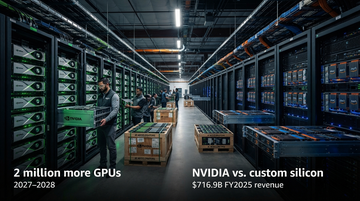
Amazon didn’t just place another AI order—it added 2 million more Nvidia GPUs for 2027–2028
Amazon and NVIDIA expanded their partnership in a way that is directly measurable in unit terms. The companies said the deal adds another 2 million NVIDIA GPU chips for AWS data centers, spanning 2027 and 2028, and covering Blackwell Ultra, Rubin, and Rubin Ultra.
| Disclosure element | Stated in coverage |
|---|---|
| Incremental GPU chips | Adds another 2 million NVIDIA GPU chips |
| Delivery window | AWS data centers in 2027 and 2028 |
| GPU families named | Blackwell Ultra, Rubin, and Rubin Ultra |
Two details matter for investors who track supply chain capacity rather than just headline “AI demand.” First, Amazon is not merely extending legacy Blackwell—it is explicitly naming Rubin generations, which increases confidence that the order book is forward-looking rather than a catch-up purchase of already-shipped platforms. Second, the inclusion of multiple generations in one incremental bundle raises the probability that suppliers will see sustained wafer/HBM/package loading rather than a short, single-product spike.
Growth-rate alignment, not just hype
Why this is the first “hard” hyperscaler yes to the ~70% FY2028 growth framing
Nvidia’s AI growth story has often been discussed in terms of visibility and supply constraints. Reuters reported that Nvidia forecast 70% revenue growth next fiscal year (with the market implication being that the cycle still has runway), and that framing was circulating right around the same time as Amazon’s expanded 2 million GPU commitment for 2027–2028.
The key analytical move is to treat this as a constraint-driven supply-chain indicator. If hyperscalers are willing to lock incremental volumes into 2027–2028, then suppliers downstream of Nvidia are more likely to receive orders that must be scheduled around capacity limits (packaging, HBM sourcing, and rack integration). That tends to improve leverage for the constrained links, at least on timing, even if the eventual margin outcome depends on pricing and mix.
Supply chain mechanics: what a 3x-like commitment typically stresses
A larger GPU order usually tightens CoWoS/HBM and can re-price the memory bottleneck
A unit increase of this magnitude is rarely “GPU-only” economically. For each incremental Nvidia accelerator deployed at AWS scale, the supply chain must also deliver enough high-bandwidth memory capacity and packaging throughput to meet rack-level system targets. That means a hyperscaler upsizing its Nvidia GPU allocation tends to increase demand pressure for the links that schedule on HBM availability and advanced packaging capacity (the parts of the stack that often behave like the real bottleneck, not the bare chip fab).
- Amazon’s added 2M GPUs pulls forward system-level demand for HBM and advanced packaging needed to assemble deployable training/inference racks in 2027–2028.
- If memory supply tightens relative to schedules, the next round of pricing power usually accrues to the constrained memory suppliers rather than to the hyperscaler at the margin line.
- Naming both Rubin and Rubin Ultra implies multi-generation memory planning, which can smooth capacity utilization for suppliers that qualify new HBM/package combinations.
Important caveat: this chain-of-custody behavior is an inference from how AI infrastructure is built, not a direct disclosure of CoWoS or HBM unit quantities in the sources we opened for this story. The article below therefore treats the bottleneck channels as the most likely transmission mechanisms, while the only hard, quoted numbers remain the GPU-unit expansion and Nvidia’s disclosed growth framing.
Tension: Nvidia GPUs up, custom silicon scaling too
The caveat: AWS’s Trainium scaling means Amazon can grow compute demand without making it “Nvidia-only”
Amazon is simultaneously scaling its own custom AI accelerator portfolio. AWS describes Trainium as a purpose-built AI chip and positions it as delivering “the best economics” for training and inference at scale. The operational implication is simple: when a hyperscaler invests in custom silicon, it can moderate the rate at which incremental tokens and workloads translate into incremental Nvidia-GPU purchases—even while total AI compute spend continues to rise.
This is why the order book should be read as “share-of-wallet confirmation” rather than a blanket replacement of custom silicon. Amazon’s disclosed deal increment is a strong Nvidia tailwind; AWS’s Trainium positioning is the reminder that Amazon will still optimize cost-per-token and availability by routing workloads across accelerators.
Fundamentals context: what Amazon’s recent cash behavior implies for capex stamina
Amazon’s capex stamina matters because the deal is explicitly back-half loaded
FY2024 revenue
$637.9B
FY2024, reported in Amazon filings; fiscal year ended Dec 31, 2024
FY2025 revenue
$716.9B
FY2025, reported in Amazon filings; fiscal year ended Dec 31, 2025
FY2025 free cash flow
$7.7B
FY2025, reported in Amazon filings; fiscal year ended Dec 31, 2025
FY2025 operating cash flow
$139.5B
FY2025, reported in Amazon filings; fiscal year ended Dec 31, 2025
The reason this matters for the Nvidia order signal is timing. Amazon’s expanded Nvidia GPU commitment points to deployments in 2027–2028. That makes the question less “does Amazon have AI demand?” and more “can it keep funding data center expansion through the back half of the cycle?” Amazon’s FY2025 filings show strong operating cash generation, but free cash flow compressed as capital expenditures stayed heavy.
What to watch next: where the bottleneck shows up first
Near-term vs. 1–3 year implications: markets should watch pricing and qualification, not just unit headlines
- In the next days-to-quarters, the first impact should show up in Nvidia-related supply confidence (order visibility, guide confidence, and commentary around fulfillment).
- Over 1–3 years, the bigger tell will be whether memory pricing holds into 2027–2028 deployment windows—because multi-generation GPU commitments stress the HBM + packaging calendar.
- If Trainium and other custom accelerators keep capturing more workload share, the “GPU share” tailwind can moderate even when AI infrastructure spend grows—a reason to watch AWS instance mix and customer-level routing disclosures when available.
Amazon’s revenue rose while FY2025 free cash flow compressed (capex intensity context)
Fiscal years ended Dec 31; free cash flow is calculated as operating cash flow minus capex per the cash flow statement figures.
Unit: $
FY2024 Operating cash flow
115,877,000,000
FY2024 Free cash flow
32,878,000,000
FY2025 Operating cash flow
139,514,000,000
FY2025 Free cash flow
7,695,000,000
Listed stocks most directly touched by the transmission mechanism
- Amazon’s added 2M GPU chips supports Nvidia’s forward hardware revenue mix through the 2027–2028 window named in the deal.
- Nvidia’s disclosed ~70% FY2028 revenue growth framing gets a hyperscaler “yes” confirmation that can strengthen near-term guide confidence.
- If fulfillment stays supply-constrained, Nvidia’s gross margin trajectory can remain resilient versus a demand-only slowdown scenario.
- GPU deployment pressure increases demand for DRAM/HBM-class memory capacity into the 2027–2028 buildout window.
- If supply remains tight into the deployment calendar, Micron’s memory pricing can hold up better than broad IT memory demand assumptions.
- Expanded AI capex by hyperscalers improves utilization expectations for advanced-node manufacturing equipment that depends on the wafer ramp cadence.
- The timing risk is that advanced logic scaling may lag GPU demand if node transitions slip—watch for order and backlog commentary tied to AI.
- Multi-generation Nvidia GPU commitments raise the probability of sustained HBM demand into 2027–2028 deployments.
- If HBM supply stays constrained, SK Hynix’s pricing power is more likely to persist versus a scenario where AI capex cools.
- AI infrastructure expansion supports the networking and accelerates-feeding ecosystem (switches/cables) that Broadcom participates in indirectly.
- But if workload routing shifts toward custom silicon at the hyperscaler edge, the GPU-adjacent spend mix could redistribute, making results less linear than pure GPU-unit growth.