Latest
The day's market news, with the argument attached
New notes every trading day on earnings, policy and market structure. Each one opens with the conclusion, then the evidence, then the companies it hits.
2026-08-31
%22%2F%3E%0A%20%20%3Ccircle%20cx%3D%22220%22%20cy%3D%22150%22%20r%3D%22180%22%20fill%3D%22%2322d3ee%22%20fill-opacity%3D%220.12%22%2F%3E%0A%20%20%3Ccircle%20cx%3D%221010%22%20cy%3D%22130%22%20r%3D%22220%22%20fill%3D%22%2338bdf8%22%20fill-opacity%3D%220.08%22%2F%3E%0A%20%20%3Ccircle%20cx%3D%22920%22%20cy%3D%22520%22%20r%3D%22170%22%20fill%3D%22%2322d3ee%22%20fill-opacity%3D%220.06%22%2F%3E%0A%20%20%3Cpath%20d%3D%22M140%20430h920%22%20stroke%3D%22url(%23line)%22%20stroke-width%3D%2212%22%20stroke-linecap%3D%22round%22%2F%3E%0A%20%20%3Cpath%20d%3D%22M220%20360c120-150%20260-220%20380-220s260%2070%20380%20220%22%20fill%3D%22none%22%20stroke%3D%22%2367e8f9%22%20stroke-opacity%3D%220.5%22%20stroke-width%3D%2216%22%20stroke-linecap%3D%22round%22%20stroke-linejoin%3D%22round%22%2F%3E%0A%20%20%3Cpath%20d%3D%22M300%20398h600%22%20stroke%3D%22%2394a3b8%22%20stroke-opacity%3D%220.24%22%20stroke-width%3D%228%22%20stroke-linecap%3D%22round%22%2F%3E%0A%20%20%3Ctext%20x%3D%22220%22%20y%3D%22510%22%20fill%3D%22%23e2e8f0%22%20fill-opacity%3D%220.7%22%20font-family%3D%22Arial%2C%20Helvetica%2C%20sans-serif%22%20font-size%3D%2238%22%20letter-spacing%3D%228%22%3EINSIGHTS%3C%2Ftext%3E%0A%3C%2Fsvg%3E)

Ciena's order book is the missing systems-level proof for AI networking demand — but it comes with a demand-vs-supply timing squeeze
Ciena’s latest reported results show strong growth alongside a large backlog, but the most decision-relevant question—whether AI demand is showing up at the optical-systems layer rather than only upstream modules—can’t be answered from the primary sources available in this research run. The numbers we can verify support a real order-book-backed cycle expansion, while key “webscale/AI” backlog breakdowns and “optical systems” attribution were not disclosed in the pages that loaded successfully.

Clipto’s $250M price tag tests whether “search over terabytes of video” is an investable data moat—or just another retrieval app
Clipto’s latest private round values the company at $250M post-money after raising $15M in an all-equity deal, with the firm claiming $15M ARR and net-income profitability. The bigger signal for investors is not only the valuation—it’s Clipto’s pitch that the indexing layer for unstructured video belongs on-device, under user authorization, which could change who owns the retrieval infrastructure in the AI stack.

Dell’s AI-server growth proves demand—but margin still has to clear the “dollars per rack” test
Dell’s guidance jump implies AI-optimized servers can scale fast, with Q1 FY27 showing $16.1B of AI server revenue on 18.1% gross margin. The investable question is whether that gross-mix improvement holds through the next quarters, because Dell’s core franchise still carries the burden of lower-quality earnings and weak operating momentum outside AI.

Oil back above $90 after a fresh strike on Iran—yet stocks barely blink: the market is pricing “duration,” not direction
A U.S. strike on Iran’s Larak Island helped lift Brent crude back above $90, but equity risk gauges stayed subdued and traders leaned toward a September hike odds shifting rather than a full-blown recession shock. The key difference is that the market appears to be treating the latest escalation as a near-term supply “headline” while assuming the Fed’s path (and risk appetite) won’t reprice materially unless disruption looks prolonged.

France’s near-2008 OAT stress is testing the eurozone duration channel—and the US rate pass-through is the risk investors can quantify
France’s borrowing pressure in OATs—driven by auction/term-structure supply mechanics—has moved closer to crisis-era yield territory, and that matters because eurozone duration repricing can spill into global rates. The spill-through is not “headline contagion”; it is the market repricing of long-dated funding and collateral, which can steepen US curves into late-year Fed decisions—while hurting European banks and supporting institutions with trading/hedging capacity.

GameStop's cash-first store shrink turns the earnings story from “meme” to “milking leases”
GameStop’s latest update frames a weaker near-term quarterly sales outlook alongside continued store portfolio optimization and the completed exit of France operations via divestiture accounting. The investor takeaway is not just lower top-line—it's that the market is now valuing execution of cost/lease rationalization and capital preservation over any retail-speculation multiple.

The gas-turbine order book is turning hyperscaler power into a timing bet—OEM slots beat permits by 2027
GE Vernova and Siemens Energy are sitting on huge gas-turbine backlogs while AI-era demand is colliding with unusually tight delivery slots. But the binding constraint for getting megawatts online by 2027 is turning from turbine manufacturing capacity into emissions/permitting sequencing—where delays can strand already-ordered equipment and shift revenue capture toward OEMs with the longest order visibility.

GoPro's creator-owner moment tests whether reach can substitute for a hardware turnaround
Mark Fischbach (Markiplier) disclosed a passive 8.5% stake in GoPro, giving a consumer-hardware turnaround story a new kind of capital: creator distribution plus potential relevance. But GoPro is still burning cash (TTM operating cash flow of -$19.6M) and has deteriorating profitability, so the real question for investors is whether creator-driven demand can beat the product and margin math.

When helium scarcity meets crypto mania: the HNT weekend jump looks less like supply-chain repricing and more like liquidity-driven narrative trading
China’s temporary helium export ban (announced July 10, 2026) is a real physical supply shock for helium-dependent sectors, but it does not translate into a clear, near-term earnings shock for listed helium suppliers. Instead, the reported HNT weekend surge reads more like cross-asset reflexivity—crypto liquidity hunting for “scarcity” story momentum—than a clean reprice of helium gas fundamentals.

Honda–Nissan’s SDV software deal turns a shelved merger into a 2029 consolidation playbook
Honda and Nissan are moving from merger talks to a joint vehicle-software effort, targeting a shared operating system and onboard computer for fiscal 2029. For investors, the bigger signal isn’t “cooperation” — it’s that Japanese OEMs are consolidating software and control-unit supply chains to compress time-to-market and reduce integration cost, tightening the competitive space around Tesla’s software-first approach.

Nvidia’s $3.5B MediaTek bet reframes “hyperscaler ASICs” into Nvidia-routed, rack-scale custom chips—raising the odds it slows the GPU exodus
Nvidia’s $3.5B investment in MediaTek is more than capital—it’s an ecosystem play: MediaTek will adopt Nvidia’s NVLink Fusion platform to help customers field custom XPUs inside Nvidia-connected AI racks. If hyperscalers increasingly buy “integration-ready” custom accelerators instead of building their own end-to-end stack, Nvidia can keep participating in training/inference demand even as silicon becomes more customized.

Offerpad’s Nasdaq relisting is a “housing bottom” test for iBuyers: Q2 liquidity economics show Cash Offer can scale—but still needs a rate-friendly resale window
Offerpad’s OPAD transfer to Nasdaq on Aug. 31, 2026 is not an iBuyer comeback by itself, but it gives the market a fresh price discovery moment for whether instant-cash offers can sustain margins in a still-stiff mortgage-rate environment. In its latest reported quarter, Cash Offer generated most of revenue while the company’s overall gross profit stayed thin and operating cash flow swung negative—so the iBuyer model’s next phase depends more on resale velocity than on the “cash” headline.

OpenAI’s $1B annualized ad run-rate turns a free-tier experiment into a new P&L line—and tightens the squeeze on Google’s ad fortress
OpenAI says its ChatGPT Ads business has reached a $1 billion annualized revenue run rate after roughly 200 days, following a U.S. pilot that crossed $100 million annualized revenue within six weeks. The implication isn’t just “ads are real”—it’s that OpenAI is building a scalable acquisition channel on top of free usage, pressuring Alphabet’s ad duopoly economics while creating a fresh battleground for advertiser budgets.

Palo Alto Networks's platform leap only works if NGS can outgrow firewall drag—its latest ARR + RPO trajectory says “maybe,” but the attach-rate story is still the missing piece
Palo Alto Networks’ latest results show Next-Generation Security (NGS) ARR accelerating and guidance implying continued NGS momentum, alongside a fast-growing RPO backlog. The unanswered question for investors is whether AI-driven “normalize the stack” buying can lift platform attach faster than legacy firewall cycles dilute growth, especially as Microsoft pushes agentic security workflows that may pressure bundling economics.

Shelter re-accelerated: the rent CPI input that can turn September from a jobs story into an inflation test
A fresh shelter/rent read can re-ignite the “sticky disinflation” debate because rents flow into CPI with a built-in lag. When that lag turns back upward, the market’s September-rate path that was leaning on labor-only evidence gets stress-tested by a second inflation channel.

SAIC’s pre-market print can’t yet prove “federal AI” is cashing into margin—its latest filings still show a services-heavy earnings engine
SAIC is set to report its next pre-market quarter on Aug. 31, 2026, but the core investor question—whether federal-AI/software budgets are converting into backlog and higher-margin billable capacity—cannot be validated from the sources available so far. What the latest publicly accessible financials do support is that SAIC’s earnings engine remains consistent with large-scale services delivery rather than a fast shift to higher-margin software economics.

Sellas' GPS Just Needs 2 More Deaths — Why a 2% Pre-Market Bump Is Hiding a One-Day Repricing Event for Sellas Life Sciences
Sellas Life Sciences climbed 2% in pre-market trading on Aug 30, 2026 after LinkedIn comments from AstraZeneca and Johnson & Johnson sales executives called its Phase 3 AML drug 'game changers' — but the real story is the binary trigger sitting two deaths away. With 78 of the 80 events recorded in REGAL, an 80th death hands Sellas a same-day catalyst that can halve or double the stock on a single survival readout, while 28% of the float is already short.

Trump’s bulk-power emergency turns Tesla’s energy stack into the “grid-flexibility” policy floor—Megapack deployments and VPP dispatch rules matter more than Solar Roof tiles
Executive Order 14420 targets national-security risk in U.S. bulk-power equipment (including backup generators) and directs the Department of Energy to implement rules to secure reliability and cyber resilience. Combined with Tesla’s Solar Roof exit from new tile sales, the policy shift increases the market relevance of Tesla’s Megapack and dispatchable flexibility—especially where virtual power plant (VPP) programs convert reliability needs into contracted, dispatch-triggered value.
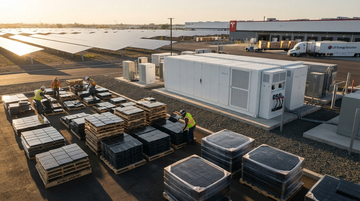
Tesla's Solar Roof exit is a confession, not a setback — it killed 0.17% of US residential solar to free up the energy segment that actually scales
After a decade and roughly 3,000 installed systems, Tesla quietly told certified installers in mid-August 2026 it will stop supplying Solar Roof tiles and only sell conventional panels going forward. The retreat is small in unit terms but huge as a signal: Tesla's energy segment — now a $12.77B business at a 29.8% gross margin in FY2025 — is Megapack-led, not roof-tile-led, and the $240M Q2 warranty true-up shows what custom-manufactured products cost when they don't scale. The move tightens the moat around utility-scale storage, validates Enphase and SolarEdge as the inverter standard for the rest of residential solar, and hands roof-replacement economics back to traditional players like Sunrun and the legacy installer base — while LG Energy Solution collects a $4.3B tailwind from the Megapack cell deal.

Trump’s Teva and Astellas “most-favored-nation” deals shift drug-price risk toward manufacturers—and toward PBMs’ net-price math
Trump’s administration announced a new round of bilateral “most-favored-nation” style pricing agreements that include Teva and Astellas Pharma, tied to state Medicaid access and foreign-price parity. Unlike the IRA negotiation framework, this voluntary approach can change net-price expectations across generics and branded portfolios—and force PBMs and manufacturers to re-cut incentives around list-to-net spreads.
What to expect
Evidence-first notes with a visible point of view.
This section collects sharp takes on earnings, shareholder meetings, and market structure. Each new piece should make the thesis, the facts, and the implications obvious within the first few screens.
Expect direct analysis, not generic commentary.
Expect the data to be explicit and the argument to be easy to follow.
Plutux is not an investment adviser. Market data and AI-generated analysis are for information and education only, not investment advice. Disclaimer