%22%2F%3E%0A%20%20%3Ccircle%20cx%3D%22220%22%20cy%3D%22150%22%20r%3D%22180%22%20fill%3D%22%2322d3ee%22%20fill-opacity%3D%220.12%22%2F%3E%0A%20%20%3Ccircle%20cx%3D%221010%22%20cy%3D%22130%22%20r%3D%22220%22%20fill%3D%22%2338bdf8%22%20fill-opacity%3D%220.08%22%2F%3E%0A%20%20%3Ccircle%20cx%3D%22920%22%20cy%3D%22520%22%20r%3D%22170%22%20fill%3D%22%2322d3ee%22%20fill-opacity%3D%220.06%22%2F%3E%0A%20%20%3Cpath%20d%3D%22M140%20430h920%22%20stroke%3D%22url(%23line)%22%20stroke-width%3D%2212%22%20stroke-linecap%3D%22round%22%2F%3E%0A%20%20%3Cpath%20d%3D%22M220%20360c120-150%20260-220%20380-220s260%2070%20380%20220%22%20fill%3D%22none%22%20stroke%3D%22%2367e8f9%22%20stroke-opacity%3D%220.5%22%20stroke-width%3D%2216%22%20stroke-linecap%3D%22round%22%20stroke-linejoin%3D%22round%22%2F%3E%0A%20%20%3Cpath%20d%3D%22M300%20398h600%22%20stroke%3D%22%2394a3b8%22%20stroke-opacity%3D%220.24%22%20stroke-width%3D%228%22%20stroke-linecap%3D%22round%22%2F%3E%0A%20%20%3Ctext%20x%3D%22220%22%20y%3D%22510%22%20fill%3D%22%23e2e8f0%22%20fill-opacity%3D%220.7%22%20font-family%3D%22Arial%2C%20Helvetica%2C%20sans-serif%22%20font-size%3D%2238%22%20letter-spacing%3D%228%22%3EINSIGHTS%3C%2Ftext%3E%0A%3C%2Fsvg%3E)
Creator-economy capital meets consumer hardware stress
Markiplier’s stake is real—but it’s structurally passive, so the only lever is demand and messaging, not control
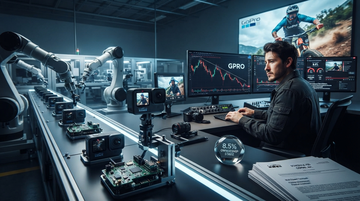
Mark Fischbach—known online as Markiplier—filed a Schedule 13G disclosing 13.5 million shares of GoPro Class A common stock, equal to 8.5% of the class.
The same filing states sole voting power of 13.5 million shares and passive/no-control intent: the securities were not acquired “for the purpose of or with the effect of changing or influencing control of the issuer.”
Passive ownership disclosed
13.5M shares
Schedule 13G, disclosed Aug 20, 2026 (Mark Edward Fischbach)
Stated ownership of the class
8.5%
Schedule 13G, disclosed Aug 20, 2026 (Class A common stock)
Control intent
Not intended
Schedule 13G states no acquisition/effect to change or influence control
Voting posture in filing
Sole voting power
Schedule 13G lists sole voting power; no shared voting power disclosed
Hardware turnaround reality check
GoPro’s financial condition still depends on margin and cash generation—creator hype can’t paper over that
GoPro remains loss-making on an earnings and cash basis. On a trailing twelve-month basis, GoPro reported revenue of $568.6M, gross profit of $157.3M, and net loss of $162.2M.
Cash flow is the constraint for any “customer demand fix” idea: trailing twelve-month net cash used in operating activities was -$19.6M, with free cash flow of -$23.3M.
| Period | Revenue | Gross profit | Net income (loss) | Operating cash flow | Free cash flow |
|---|---|---|---|---|---|
| TTM through Jun 30, 2026 (reported as FY2026 TTM) | $568.6M | $157.3M | -$162.2M | -$19.6M | -$23.3M |
| FY2025 | $651.5M | $219.2M | -$93.5M | -$20.7M | -$24.0M |
| FY2024 | $801.5M | $271.3M | -$432.3M | -$125.1M | -$129.2M |
Full supply-chain lens: where creator-driven demand could actually help
If creator reach changes anything, it has to show up at the margin layer: slower inventory aging, better sell-through, and fewer clearance cycles
Creator-driven demand usually works through faster awareness and higher conversion—not directly through procurement terms. For a consumer hardware company like GoPro, the operational translation is: improved sell-through reduces the need for markdowns and stabilizes inventory levels.
On the balance sheet, GoPro still holds substantial inventory ($86.7M on the latest TTM balance sheet basis). The key investor question is whether any demand boost reduces inventory risk quickly enough to preserve gross margin and cash flow.
Latest inventory (balance sheet)
$86.7M
TTM balance sheet, reported with Aug 10, 2026 filing
Cash and equivalents
$27.3M
TTM balance sheet, reported with Aug 10, 2026 filing
Total current assets
$229.1M
TTM balance sheet, reported with Aug 10, 2026 filing
Total current liabilities
$404.9M
TTM balance sheet, reported with Aug 10, 2026 filing
Causality: what has to be true for the turnaround thesis to work
Reach → conversion → repeat usage is the only chain that can plausibly reduce financial drag
- Reach needs to convert into sell-through (higher sell-through should show up in inventory reductions and fewer markdown effects).
- Conversion needs to stick into repeat usage (repeat behavior supports accessory attach and reduces churn-driven demand swings).
- Repeat usage needs to protect gross margin (margin protection is what stops revenue volatility from turning into cash burn).
- Gross margin protection needs to flow into operating cash flow (cash generation is the real constraint given TTM operating cash flow is -$19.6M).
Why this is the right causal chain for investors: GoPro’s scale is not enough to “buy” a turnaround with marketing alone, and the company is already showing persistent operating cash strain. That means the creator stake only matters if it changes conversion economics, not just attention.
What to watch next (short-term vs. 1–3 year horizon)
The near-term signal is retail demand quality; the long-term signal is whether GoPro can fund product relevance without perpetual dilution or cash stress
GoPro’s revenue and net loss trajectory still suggests a turnaround with heavy execution risk
Reported revenue and net income (loss) from the latest annual history and trailing twelve-month view
Unit: $
Revenue
TTM through Jun 30, 2026 (shown as FY2026 TTM)
568,590,000
Net loss
TTM through Jun 30, 2026 (shown as FY2026 TTM)
-162,181,000
Revenue (FY2025)
FY2025
651,542,000
Net loss (FY2025)
FY2025
-93,487,000
- Short-term (next reported quarter): watch for inventory and cash flow stabilization consistent with improved sell-through.
- Short-term: watch for whether the stake is accompanied by any measurable commercial activity (distribution, bundled offerings, or product-channel alignment)—not just sentiment.
- 1–3 years: the thesis survives only if GoPro can convert creator-led attention into enduring gross margin and operating cash improvement.
Investor synthesis
This isn’t a meme-flow hedge—it's a test of whether creator distribution can fix the economics of a cash-constrained hardware brand
The core verified fact is straightforward: Markiplier disclosed an 8.5% Class A stake in GoPro, with the filing describing passive intent (no control change). The financial reality is equally clear: GoPro is still losing money and using cash, with TTM operating cash flow of -$19.6M.
So the real investor question is not “will social media like it?” but whether creator reach can change the sell-through and margin equation fast enough to reduce cash stress. Until that shows up in quarterly statements, the ownership angle is mostly a narrative catalyst—not an earnings catalyst.
Who else is exposed to a creator-to-consumer conversion shift (and who’s not)
- Owning attention doesn’t remove operating cash risk—TTM operating cash flow remains -$19.6M, so execution still decides the stock.
- If creator-led pull improves sell-through, inventory volatility should fall—latest inventory is $86.7M.
- If the demand bump is real, gross margin recovery should precede cash improvement given the current net loss of -$162.2M (TTM).
- If it’s mostly sentiment, the stock will likely fade with revenue pressure—TTM revenue is $568.6M.