Semiconductors
Chips, from the fab floor to the income statement
Foundry capacity, HBM supply, packaging bottlenecks and export rules — traced through to the companies whose quarters they decide.
2026-08-04
%22%2F%3E%0A%20%20%3Ccircle%20cx%3D%22220%22%20cy%3D%22150%22%20r%3D%22180%22%20fill%3D%22%2322d3ee%22%20fill-opacity%3D%220.12%22%2F%3E%0A%20%20%3Ccircle%20cx%3D%221010%22%20cy%3D%22130%22%20r%3D%22220%22%20fill%3D%22%2338bdf8%22%20fill-opacity%3D%220.08%22%2F%3E%0A%20%20%3Ccircle%20cx%3D%22920%22%20cy%3D%22520%22%20r%3D%22170%22%20fill%3D%22%2322d3ee%22%20fill-opacity%3D%220.06%22%2F%3E%0A%20%20%3Cpath%20d%3D%22M140%20430h920%22%20stroke%3D%22url(%23line)%22%20stroke-width%3D%2212%22%20stroke-linecap%3D%22round%22%2F%3E%0A%20%20%3Cpath%20d%3D%22M220%20360c120-150%20260-220%20380-220s260%2070%20380%20220%22%20fill%3D%22none%22%20stroke%3D%22%2367e8f9%22%20stroke-opacity%3D%220.5%22%20stroke-width%3D%2216%22%20stroke-linecap%3D%22round%22%20stroke-linejoin%3D%22round%22%2F%3E%0A%20%20%3Cpath%20d%3D%22M300%20398h600%22%20stroke%3D%22%2394a3b8%22%20stroke-opacity%3D%220.24%22%20stroke-width%3D%228%22%20stroke-linecap%3D%22round%22%2F%3E%0A%20%20%3Ctext%20x%3D%22220%22%20y%3D%22510%22%20fill%3D%22%23e2e8f0%22%20fill-opacity%3D%220.7%22%20font-family%3D%22Arial%2C%20Helvetica%2C%20sans-serif%22%20font-size%3D%2238%22%20letter-spacing%3D%228%22%3EINSIGHTS%3C%2Ftext%3E%0A%3C%2Fsvg%3E)

AI diplomacy is repricing US chips: China’s Mythos anxiety turns the next frontier-model release into a Trump–Xi bargaining input
U.S. policy is building a voluntary, federally benchmarked “covered frontier model” review process for advanced AI with cyber risk, ahead of a Trump–Xi summit sequence. If China is truly focusing on Anthropic’s Mythos-class cyber capabilities as an “offensive weapon” concern, then the next frontier-model decision window is effectively being priced into the same trade corridor that governs advanced AI chip access—making NVIDIA, Broadcom, AMD, and Micron sensitive to diplomacy headlines.

onsemi's guided-up AI data-center demand is shifting the “power bottleneck” from GPUs to SiC and power-silicon
In its latest quarter and outlook, onsemi guided to faster AI data-center momentum, with silicon-carbide and power-silicon demand framed as scaling alongside broader power architectures. The practical investor read: when hyperscalers add AI racks, the spend doesn’t only show up in GPUs/HBM—it increasingly pulls forward discrete power devices, SiC, and server-power capacity, tightening the link between AI capex and onsemi’s growth.
2026-08-03
AMD's $11.2B Quarter Is the Easy Print — Helios, the Anthropic 2GW Deal, and a 64x Forward P/E Decide Whether This Rally Has a Second Half
Advanced Micro Devices reports Q2 2026 on Aug 4 with $11.2B revenue and ~$1.61 non-GAAP EPS already in the guide, but the real test sits in the data-center mix and gross margin trajectory now that the $5B/Anthropic 2GW MI450 deal (Jul 22), Helios rack-scale launch (Jul 23) and $14B/Core Scientific 2.5GW data-center pact (Jul 28) have reset the 2027–2028 setup. Stock has run +120–160% YTD to ~$476 against a 64x forward P/E — almost 3x NVIDIA's 22x — so the print must validate that MI450 ramp economics can absorb Blackwell-style gross-margin compression rather than replicate it.

Copper Foil Is the New US IPO “Test of Trust” for China’s AI Compute Supply Chain
Londian Wason [FOIL] is using a US listing to formalize access to Western capital for a bottleneck material: electrolytic copper foil that feeds both LiB and PCB-grade conductors used in high-performance computing. In its F-1, it frames AI/high-speed computing PCBs as requiring lower-roughness foil (RTF/HVLP) and highlights a scale where PCB-grade remains far smaller than LiB—so investors should watch whether the market can re-rate the PCBs growth story before certification and customer concentration risks show up.
OpenAI’s “abundant intelligence” is a capex doctrine—and the bill routes through Nvidia, Oracle, and the AI power grid
OpenAI’s Jul 31 “Building abundant intelligence” framing reads less like a product roadmap and more like a compute-scale-out discipline: plan infrastructure years ahead, measure success by useful work per cost, and keep pushing the capability-per-dollar frontier. When you combine that with OpenAI’s explicit GPT-5.6 cost cuts and its Nvidia partnership commitment to deploy at least 10 GW starting in 2H’26, the likely winners are the suppliers who monetize GPU scale, cloud capacity, and (most underpriced) reliable power.
2026-08-02
Amazon Just Admitted AI Capex Now Outruns Its Own Cash Engine — A $220B Verdict on Hyperscaler Survival
Amazon raised 2026 capex to $220B and posted a -$7.6B TTM free cash flow on July 30, joining Oracle in negative territory and following Alphabet's -$5.85B Q2 print, even as AWS grew 37% and operating income hit $27.5B. The capex bump is fully memory-driven, the $496B AWS backlog shows demand outstrips supply through 2027, and the $53.4B non-cash Anthropic gain is doing the work that operations no longer can. The read-through to Microsoft, Meta, and NVIDIA: AI capex has moved from 'growth-justified' to 'survival-justified,' and the supply chain — SK Hynix, Samsung, Micron, Broadcom, AMD — collects the toll.
MiniMax's H3 Is a Quotation Mark for Alibaba — China's Video-Gen Race Just Reset the AI Investment Cycle
On July 31, 2026, MiniMax shipped H3 — a 15-second, 2K, omni-modal video model priced at less than one-third of mainstream rivals and built to run on Chinese chips — then open-sourced the weights. The release collapses the price floor for frontier video generation in China and forces Alibaba, which both holds a MiniMax stake AND sells it cloud AND competes with it via HappyHorse, into a single sharp decision. The second-order trade is harder: H3's deliberate compatibility with Cambricon and Huawei Ascend silicon signals that Chinese inference is decoupling from Nvidia, even as Tencent ramps capex above 36 billion yuan for 2026.
2026-08-01

Apple's $500B wipe says the memory crunch broke consumer pricing power
On July 30, 2026, Tim Cook's last report beat on revenue and EPS, then guided 9–11% growth and 47–48% margins — wiping ~$500B from Apple's market cap in a day. The reason: supply constraints on memory and processors now visibly throttle the iPhone ramp, while DRAM/NAND inflation compresses gross margins. Samsung Mobile, HP, Dell, and Sony face the same shock; Micron, SK Hynix, and Samsung memory are the visible winners.
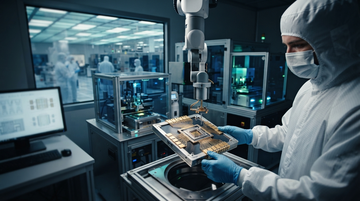
IonQ's $1.8B SkyWater Buy Isn't a Foundry Deal — It's a Statement That Quantum's Moat Has Moved From Algorithms to Atoms
The FTC cleared IonQ's acquisition of SkyWater Technology on July 31, 2026, creating the only U.S. quantum platform with a Trusted-accredited fab under one roof. The $1.8 billion price tag — a 38% premium to SKYT's pre-deal VWAP — buys IonQ a 4.5× acceleration in chip iteration time and captive capacity for 200,000-qubit roadmaps, but it also leaves IonQ holding $1.8B of cash burn against $187M of trailing revenue and pushes competitors like D-Wave Quantum, Rigetti Computing and PsiQuantum onto a supplier they no longer fully control. The structural read: vertical integration is becoming the prerequisite for fault-tolerant quantum, just as it became for AI accelerators — and the listed foundry comps (Intel, TSMC) are the closest read on the multiple investors should pay for that bet.
2026-07-31

MediaTek's $5B Authorization Is a Capacity Option, Not a Capital Raise—and That Matters More for Broadcom Than NVIDIA
MediaTek has authority to issue as much as $5 billion of bonds, but it has not yet raised the money. The strategic signal is still strong: securing foundry, packaging and HBM capacity can turn a $2 billion 2026 ASIC ramp into a credible custom-silicon alternative. That pressures Broadcom's turnkey position first; NVIDIA's 74.9% gross margin remains protected by a much larger $119 billion supply commitment and its full-stack platform.

Sony Group Raises FY26 Profit Guidance, but PlayStation’s Hardware Mix Reveals the Memory-Cost Test
Sony Group reported its FY2026 first-quarter results on July 31, 2026, with operating profit rising sharply and full-year operating-profit guidance raised to ¥1.72 trillion. The more important signal is inside gaming: software and network revenue is growing faster than PS5 hardware, allowing the group to improve earnings even as memory costs remain a direct risk to console economics. That makes the result positive for Sony’s digital mix, but a warning that hardware demand alone may not absorb higher DRAM and NAND prices.
2026-07-30
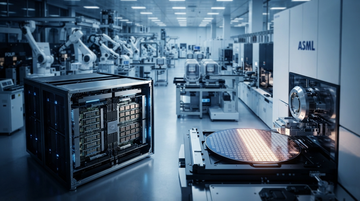
The headline +94% semiconductor forecast is really a memory-and-accelerator story—so your winners may not be who you expect
Omdia’s raised 2026 semiconductor revenue forecast (+94.1% YoY) is being driven by AI-concentrated segments like DRAM/NAND (including HBM) and “Computing & Data Storage,” not by broad-based end-market recovery. That creates a two-speed market: companies with direct AI supply-chain leverage can re-rate fast, while non-AI-sensitive revenue can lag until pricing normalizes and capacity catches up.
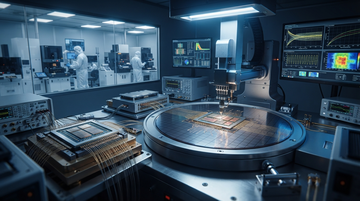
Eliyan’s $145M/ $1B chiplet-memory bet turns NVLink into a testable “standard,” not a monopoly
Eliyan’s $145M Series C at a $1B valuation funds an electro-optical die-to-die/die-to-memory interconnect platform aimed at removing AI chip data bottlenecks. Because Eliyan positions NuLink as standards-compatible (UCIe/BoW) and targets bandwidth efficiency for chiplet-to-memory traffic, it pressures the idea that Nvidia’s NVLink is the only path to coherent “big memory” scale.
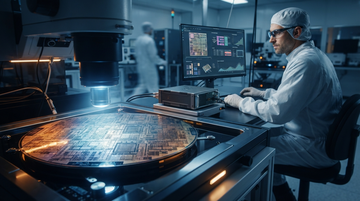
Intel’s foundry playbook shifts from “process sales” to “warm pipeline” as Intel technology routes through Lip-Bu Tan’s co-investor startup
A Reuters-exclusive arrangement described as Intel shipping proprietary 14A/18A-related chip technology to RosaicLabs—linked to a Lip-Bu Tan co-investor—looks like the first time Tan’s private venture network has become a foundry customer funnel. For investors, the key signal isn’t just another “customer”—it’s a new go-to-market mechanism that could compress the time from PDK/tool readiness to design-win commitments.

Meta’s capex jump buys AI time—but it risks starving FCF while Microsoft turns spend into service-margin growth
Meta and Microsoft printed a near-simultaneous capex signal, but the market’s read-through is likely less about AI demand and more about how each firm funds it. Meta’s latest reported cash flows show a large capex drain versus free cash flow, while Microsoft’s cash engine supports an even heavier buildout, implying power/cooling & connectivity vendors get paid sooner than advertising/consumer-internet margin holders.
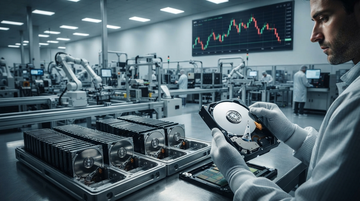
Seagate didn’t “miss”—it proved the HAMR profit engine… and the market still priced in the harder margin math next
Seagate’s fiscal Q4 blowout (revenue and adjusted EPS both beating expectations) triggered a sell-the-news move that makes the next test less about “more TB shipped” and more about whether HAMR mass-capacity economics hold across the drive build-and-supply chain. For investors, the stock’s reaction matters because it shifts attention from die-count/technology headlines to tray/component margin durability—where suppliers and competing drive OEMs can win or lose first.
2026-07-29

AI hardware is pulling air cargo capacity toward data-center “just-in-time”—and operators with scheduling power are the gatekeepers
In 2025, air cargo transported more than two-thirds of global AI-related goods, making aircraft utilization and slot allocation a strategic bottleneck rather than a background logistics variable. The air-freight scarcity that e-commerce previously dominated is shifting to dense, time-sensitive AI hardware lanes, where the margin moves from shipping volume to capacity control.
Arm’s AI forecast beat indicates the “architecture royalty” flywheel can scale faster than chip unit demand
Arm’s latest guidance/outlook strength can be read as a demand signal that hyperscalers are prioritizing Arm-based AI infrastructure designs—not just buying more chips. The royalty model works only if energy-efficient adoption drives durable Neoverse (data-center) design-in and custom-silicon programs that keep royalty revenue compounding even when hardware supply constraints shift the timing of shipments.

ChipAgents’ $60M funding bets AI agents can speed chip design—without breaking the EDA tollbooth
ChipAgents’ new $60M infusion extends an “agentic” approach to chip design and verification, aiming to compress the bug-finding and iteration loop that makes EDA such a sticky spend category. The key investor question isn’t whether AI reduces engineering time, but whether it routes more cycles into EDA workflows (verification runs grow) or starts to replace parts of the workload (tool seats and services get displaced). For incumbents like Cadence and Synopsys, near-term impact hinges on integration and workflow attachment rather than abstract AI throughput claims.
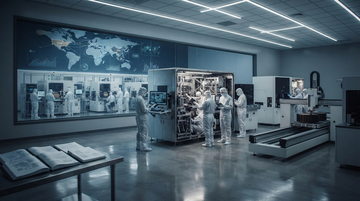
China’s DUV mass-production pressures Congress: MATCH Act’s servicing ban timing will decide whether Lam Research, Applied Materials, and KLA harvest China growth in 2H26 or lose it to license “latency”
China’s July 27, 2026 shift to mass-producing homegrown immersion DUV tools increases the probability of near-term fab ramp—exactly when the MATCH Act must clear Congress if it’s meant to restrict not just exports, but servicing/maintenance. For the US semicap trio, the key risk is that a servicing ban applies a licensing policy of denial, which can delay tool upkeep and directly disrupt backlog/revenue conversion even if some equipment already sits in-country.
What to expect
Evidence-first notes with a visible point of view.
This section collects sharp takes on earnings, shareholder meetings, and market structure. Each new piece should make the thesis, the facts, and the implications obvious within the first few screens.
Expect direct analysis, not generic commentary.
Expect the data to be explicit and the argument to be easy to follow.
Plutux is not an investment adviser. Market data and AI-generated analysis are for information and education only, not investment advice. Disclaimer