Semiconductors
Chips, from the fab floor to the income statement
Foundry capacity, HBM supply, packaging bottlenecks and export rules — traced through to the companies whose quarters they decide.
2026-07-26
%22%2F%3E%0A%20%20%3Ccircle%20cx%3D%22220%22%20cy%3D%22150%22%20r%3D%22180%22%20fill%3D%22%2322d3ee%22%20fill-opacity%3D%220.12%22%2F%3E%0A%20%20%3Ccircle%20cx%3D%221010%22%20cy%3D%22130%22%20r%3D%22220%22%20fill%3D%22%2338bdf8%22%20fill-opacity%3D%220.08%22%2F%3E%0A%20%20%3Ccircle%20cx%3D%22920%22%20cy%3D%22520%22%20r%3D%22170%22%20fill%3D%22%2322d3ee%22%20fill-opacity%3D%220.06%22%2F%3E%0A%20%20%3Cpath%20d%3D%22M140%20430h920%22%20stroke%3D%22url(%23line)%22%20stroke-width%3D%2212%22%20stroke-linecap%3D%22round%22%2F%3E%0A%20%20%3Cpath%20d%3D%22M220%20360c120-150%20260-220%20380-220s260%2070%20380%20220%22%20fill%3D%22none%22%20stroke%3D%22%2367e8f9%22%20stroke-opacity%3D%220.5%22%20stroke-width%3D%2216%22%20stroke-linecap%3D%22round%22%20stroke-linejoin%3D%22round%22%2F%3E%0A%20%20%3Cpath%20d%3D%22M300%20398h600%22%20stroke%3D%22%2394a3b8%22%20stroke-opacity%3D%220.24%22%20stroke-width%3D%228%22%20stroke-linecap%3D%22round%22%2F%3E%0A%20%20%3Ctext%20x%3D%22220%22%20y%3D%22510%22%20fill%3D%22%23e2e8f0%22%20fill-opacity%3D%220.7%22%20font-family%3D%22Arial%2C%20Helvetica%2C%20sans-serif%22%20font-size%3D%2238%22%20letter-spacing%3D%228%22%3EINSIGHTS%3C%2Ftext%3E%0A%3C%2Fsvg%3E)

CoreWeave just proved hyperscaler build beats pure-play certainty — but Nvidia locking still sets the floor
CoreWeave disclosed that Meta committed to pay about $21B for AI cloud capacity running through December 2032, lifting the relationship toward a ~$35B multi-year total. The stock’s selloff after Meta’s competing cloud push signals a new market reality: tier-1 compute gets owned by self-build hyperscalers, while pure-play neoclouds face utilization and churn risk even when contract headlines look “secure.”

Nasdaq’s Pre‑Earnings “Capex Confession” Sell Signal Hits Semis First—Because Hyperscaler Guidance Can Break the Math
On the tape, the Nasdaq can reprice AI exposure before hyperscalers even print, when investors treat guidance tone as a proxy for whether $300B+ of planned infrastructure spend stays intact. For semiconductors, the key risk isn’t “AI demand exists or not”—it’s whether hyperscaler capex cadence and margin narratives soften fast enough to pull forward a downgrade cycle through the supply chain.
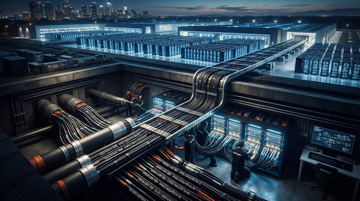
Nvidia’s SK Hynix $500B-style memory lock-up reframes HBM as a contracted utility—tightening the HBM choke point for every other AI GPU maker
Public reporting confirms Nvidia has secured advanced AI memory supply from SK hynix via a multiyear technology partnership announced June 7, 2026. The key market impact is structural: when the “input bottleneck” gets prepaid and custom-developed, HBM behaves less like a commodity and more like a utility with allocation power—compressing upside for Micron and Samsung and making AMD- and Broadcom-adjacent supply strategies more substitute-constrained.

NVIDIA's Vera Rubin entering full production turns the 2026 AI demand debate into a supply-chain scheduling problem
Jensen Huang’s explicit confirmation that Vera Rubin is “in full production” removes the biggest uncertainty from the AI cycle: whether the post-Blackwell ramp is on schedule. For investors, the reframing is immediate—2026–27 hyperscaler capex and TSMC advanced packaging allocations now map more directly to HBM4 and CoWoS throughput timing, not just product positioning.
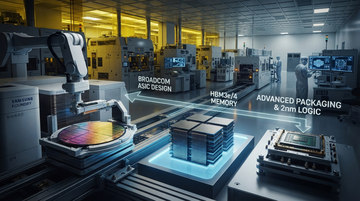
Samsung Electronics turns a $200B Broadcom AI supply deal into foundry + ASIC leverage
Samsung’s MOU with Broadcom is not just more HBM/2nm capacity—it explicitly bundles memory, sub-2nm manufacturing, and advanced packaging through 2030, with Broadcom’s ASIC/communications designs manufactured at Samsung. That changes how investors should think about Samsung’s margin mix: it becomes a quota-share-style “compute perimeter” supplier at a time when advanced-node pricing power at TSMC is rising and alternative logic nodes are still proving out.
2026-07-25
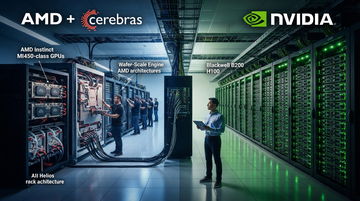
AMD's Cerebras deal proves inference disaggregation sells—yet it also confirms why NVIDIA still controls the full-stack narrative
AMD and Cerebras publicly position a split-infrastructure inference workflow—AMD Helios plus Cerebras Wafer-Scale Engine—aimed at ultra-low-latency throughput, first via Cerebras Cloud in 2H26. The more interesting signal for investors: AMD’s own SEC disclosure already shows Meta tying up to 6 GW of MI450-class GPUs, so this partnership looks less like a wedge against NVIDIA’s end-to-end moat and more like AMD buying “AI inference credibility” while the real scale still flows through NVIDIA’s platform dynamics.

UAE gets license-free access to “advanced computing” under EAR—potentially repricing the compliance premium across chip and server supply chains
The U.S. reclassified the UAE under the EAR to Country Group A:5 and expanded license-free/STA eligibility for “advanced computing items,” including AI chips and servers, effective July 10, 2026. For investors, the key question isn’t whether demand rises—it’s whether compliance friction drops fast enough to shorten lead times, shift inventory risk, and compress the “safe routing” discount that sellers used to price into contracts.
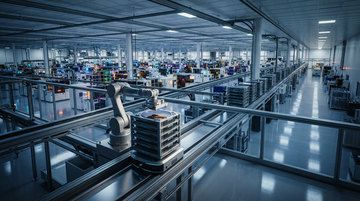
Micron’s 2H26 signal suggests AI-memory may be shifting from “scarce bottleneck” toward “managed surplus”
Micron’s latest guidance ties a still-tight DRAM/NAND backdrop to slowing the rate of price increases, which is the first “loosening” hint investors can underwrite against AI infrastructure demand. Using Micron’s own inventory-tightness and pricing-change disclosures, the article frames how upstream (wafer-capacity + HBM/DRAM packaging) and downstream (server memory build cycles) transmit from pricing into capex and margins over 2H26 and beyond.
2026-07-24
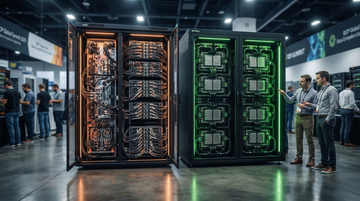
AMD’s Helios Is the First Rack-Scale Bet That Can Let AMD Win More Than GPU Share
With Helios, AMD moves from selling accelerators to selling a complete, double-wide rack-scale AI platform built on open rack standards—meant to compete in the same “one-rack is the system” category as NVIDIA’s NVIDIA NVL72. The decisive investor question is whether hyperscalers treat rack-scale as a compute-ops platform decision (favoring Helios’s open, Ethernet-based scale-up/scale-out) or as an NVIDIA-software-and-interconnect moat that AMD still can’t dislodge.
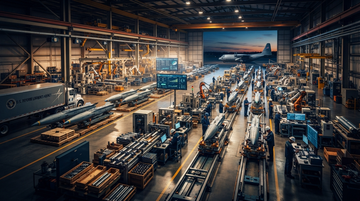
Etched’s $10.3B Valuation Is a Bet Against “One-Model-to-Fill-a-GPU” — and It’s Powered by a Two-Stage Prefill/Decode Memory Architecture
Etched’s reported $300M Series C at a $10.3B valuation validates venture appetite for vertical inference specialization—not horizontal “GPU duopoly” scaling. The company’s own framing (prefill-first compute at low voltage + decode-side shared “cluster-scale memory” over a proprietary interconnect) suggests the market is paying for systems throughput and latency, not just raw FLOPs.

Intel Just Proved the AI-Server Demand Link—But the Real Test Is Whether It Holds When TSMC Capex Normalizes
Intel’s Q2 2026 forecast guidance beat—first flagged as “above estimates”—is the clearest, data-backed sign so far that the company is participating in AI server CPU demand rather than only narrating an 18A foundry transition. The key question for investors is whether Intel’s DCAI/server momentum can persist alongside TSMC’s AI-driven capex regime ($60–$64B 2026 guidance) or is merely riding the same cycle.
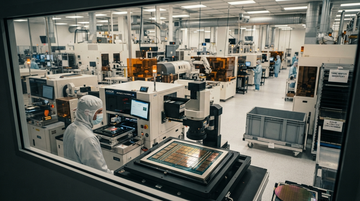
Advanced Packaging Is Escaping CoWoS Scarcity—But Nvidia’s “$1.5B to Amkor” Deal Is Not Verified in Primary Sources Yet
The premise—Nvidia entering a $1.5B, multi-year advanced-packaging agreement with Amkor that routes AI production around TSMC’s CoWoS bottleneck—is not confirmed by any primary source retrieved in this research session. What is verifiable here: Nvidia contracts out assembly/testing/packaging rather than performing it in-house, and Amkor is a leading OSAT providing advanced packaging services; but the specific $1.5B figure and contract scope remain “not disclosed / unverified” due to tool and source-access failures.
2026-07-23
2026-07-22

Super Micro’s Q4 2026 Gross-Margin Jump (15%–17% vs 8.2%–8.4%) Is Real—but the Risk Is “Backlog Quality,” Not Demand
Super Micro Computer SMCI signaled a preliminary fiscal Q4 gross margin of 15%–17%, nearly doubling prior guidance to ~8.2%–8.4%, alongside a record $60B+ new-orders backlog. The setup looks like genuine AI infrastructure operating leverage, but the stock move will ultimately hinge on whether that margin expansion converts into repeatable revenue mix and cash (not just accounting timing) as production ramps and shipments catch up.
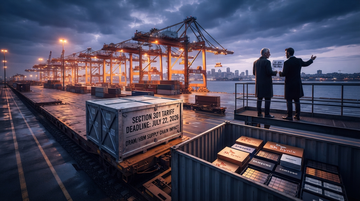
South Korea’s 301 Tariff Deadline Puts Samsung Electronics and SK hynix in the Crosshairs—Here’s the Supply-Chain Math
A mid/late-July 2026 Section 301 forced-labor probe is pressuring South Korea toward a potentially higher-than-expected U.S. tariff rate, with Seoul scrambling to cap the impact. Because Samsung Electronics and SK hynix sell memory and electronics into U.S.-linked demand chains, even a “single-digit-to-mid-teens” tariff can ripple into pricing, contract timing, and working-capital swings well before volumes adjust. The investor takeaway: this is less about whether memory demand collapses immediately—and more about how quickly firms can shift pricing, mix, and inventory risk while U.S. buyers re-source.

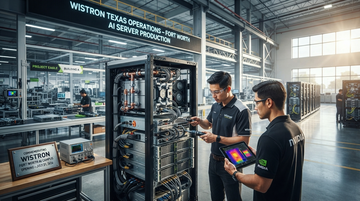
Wistron's $761M Fort Worth AI-Server Factory Is a “Domestic Scale” Test—Here’s What Could Still Break in Mid-2026
Wistron is building two Fort Worth AI supercomputer manufacturing sites totaling $761M, with the facilities expected to be operational by early 2026 and ramping mass production over the following 12–15 months. The deal is heavily structured around delivery/performance triggers (including minimum investment, jobs, and salary floors), turning execution capacity—not just demand—into the primary risk. The operational bottlenecks to watch aren’t only factory construction; they’re supply of server components, quality ramp, and the ability to sustain output once “pilot” becomes “production.”
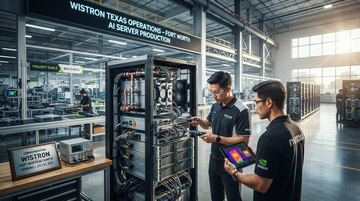
Wistron's $700M Texas AI-Server Factory Is the “Domestic Scaling” Test for NVIDIA’s Supercomputer Supply Chain
Wistron opened a $700M, 324,000-square-foot AI-server assembly-and-test facility in Fort Worth on July 21, 2026, built to support NVIDIA’s next wave of AI systems. The U.S. move matters less because it changes the chip source—and more because it stress-tests integration, yield, thermal/liquid-cooling readiness, and speed-to-ramp for high-volume Blackwell Ultra and Vera Rubin “system” production. For investors, the key question is whether domestic manufacturing reduces latency and risk enough to win sustained orders without permanently worsening Wistron’s working-capital and cash-flow profile.

Zhongji Innolight's $7B Hong Kong IPO Is a Real-Time Demand Test for AI Optical Interconnect
Zhongji Innolight’s Hong Kong listing approval (expected to raise about $7B) is more than a capital-markets milestone—it’s a market verdict on whether AI data-center buildouts will keep translating into high-margin optical transceiver demand. The company’s disclosed growth profile (Q1/3M 2026 revenue and gross margin acceleration) plus its supply-chain scaling plans are the core reason this IPO can be used as a near-term benchmark for AI optical infrastructure capex intensity.
2026-07-21
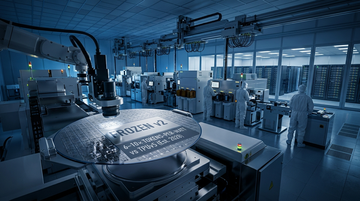
Google’s “Frozen v2” (Gemini-aware) chip targets 6–10× better tokens-per-watt by 2028—reshaping the AI inference hardware stack
Reuters/The Information reports Google is developing an internally named “Frozen v2” server chip that bakes Gemini model elements into hardware, targeted for as early as 2028 deployment. The chip is expected to deliver 6–10× more AI tokens per unit of power than Google’s latest custom silicon and is intended to complement (not replace) Google’s existing TPU roadmap—aiming to relieve compute bottlenecks as AI capex rises. For investors, the key question isn’t only whether the chip works, but whether Google can turn improved tokens-per-watt into measurable inference cost leverage versus competitors’ GPUs/accelerators, with TSMC likely central to the advanced packaging and manufacturing ramp.
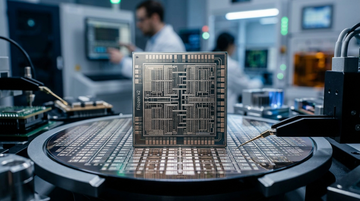
Google Develops 'Frozen v2' Chip With Gemini Baked Into Silicon — A 6-10x Efficiency Play for 2028
Reuters reported on July 20, 2026 that Google is developing a new server chip codenamed 'Frozen v2' that embeds elements of its Gemini model directly into the hardware. The chip is projected to be 6–10x more efficient than current custom Google AI silicon (measured by tokens served per watt) and is targeted for deployment as early as 2028. The 'Frozen' program runs alongside but does not replace Google's existing TPU roadmap (TPU 8t/8i announced at Cloud Next '26) and signals an architectural shift toward model-silicon co-design, putting further pressure on the GPU-centric AI compute stack.
What to expect
Evidence-first notes with a visible point of view.
This section collects sharp takes on earnings, shareholder meetings, and market structure. Each new piece should make the thesis, the facts, and the implications obvious within the first few screens.
Expect direct analysis, not generic commentary.
Expect the data to be explicit and the argument to be easy to follow.
Plutux is not an investment adviser. Market data and AI-generated analysis are for information and education only, not investment advice. Disclaimer