%22%2F%3E%0A%20%20%3Ccircle%20cx%3D%22220%22%20cy%3D%22150%22%20r%3D%22180%22%20fill%3D%22%2322d3ee%22%20fill-opacity%3D%220.12%22%2F%3E%0A%20%20%3Ccircle%20cx%3D%221010%22%20cy%3D%22130%22%20r%3D%22220%22%20fill%3D%22%2338bdf8%22%20fill-opacity%3D%220.08%22%2F%3E%0A%20%20%3Ccircle%20cx%3D%22920%22%20cy%3D%22520%22%20r%3D%22170%22%20fill%3D%22%2322d3ee%22%20fill-opacity%3D%220.06%22%2F%3E%0A%20%20%3Cpath%20d%3D%22M140%20430h920%22%20stroke%3D%22url(%23line)%22%20stroke-width%3D%2212%22%20stroke-linecap%3D%22round%22%2F%3E%0A%20%20%3Cpath%20d%3D%22M220%20360c120-150%20260-220%20380-220s260%2070%20380%20220%22%20fill%3D%22none%22%20stroke%3D%22%2367e8f9%22%20stroke-opacity%3D%220.5%22%20stroke-width%3D%2216%22%20stroke-linecap%3D%22round%22%20stroke-linejoin%3D%22round%22%2F%3E%0A%20%20%3Cpath%20d%3D%22M300%20398h600%22%20stroke%3D%22%2394a3b8%22%20stroke-opacity%3D%220.24%22%20stroke-width%3D%228%22%20stroke-linecap%3D%22round%22%2F%3E%0A%20%20%3Ctext%20x%3D%22220%22%20y%3D%22510%22%20fill%3D%22%23e2e8f0%22%20fill-opacity%3D%220.7%22%20font-family%3D%22Arial%2C%20Helvetica%2C%20sans-serif%22%20font-size%3D%2238%22%20letter-spacing%3D%228%22%3EINSIGHTS%3C%2Ftext%3E%0A%3C%2Fsvg%3E)
The verified event: AMD’s first rack-scale system
Helios is AMD’s first concrete answer to “NVL72-class” rack-scale AI—with a full rack architecture, not a bare GPU offering
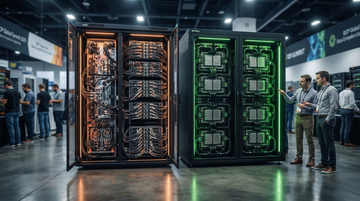
Helios is AMD’s rack-scale AI platform showcased publicly at the OCP Global Summit 2025, positioned as a deployable “open-based AI reference platform” for OEM/ODM and hyperscalers. The key shift is that Helios is designed as an entire rack solution—integrating GPUs, CPUs, and networking—so customers buy and standardize an AI “factory building block,” not just accelerators.
Public showcase (primary source)
2025-10-14
AMD press release date for Helios showcased at OCP Global Summit 2025
AMD’s Helios rack footprint
Double-wide
Helios is built on open rack guidance (ORW) aimed at high-density AI and serviceability
Helios role
Reference design → OEM/ODM systems
Framed as an open rack-scale blueprint to speed adoption/customization
What makes Helios “rack-scale” (and investor-relevant)
System boundary
A complete rack platform
Designed as a rack-scale system architecture, not a single-chip product
Integration target
GPU + CPU + networking + open fabrics
Helios ties together compute and rack-level interconnect/ethernet fabric choices
Strategy lever
Platform revenue opportunity
Rack-scale can convert accelerator demand into broader system/solutions influence
Competitive mapping: define the category
NVL72 is the rack-scale “system” baseline—and Helios explicitly targets the same buying behavior
NVIDIA’s NVL72 category is defined by a “single massive rack” design that binds CPUs, GPUs, liquid cooling, and high-bandwidth NVLink switching into one operational unit. For AMD, Helios is the first time its data-center AI pitch is shaped like a rack-scale product category competitor—so the comparison isn’t just performance per GPU, but whether the rack interconnect and scaling model are “good enough” for frontier training and large inference deployments.
| Company | Rack-scale system | GPU count / rack | Memory / rack | Interconnect / scaling headline |
|---|---|---|---|---|
| AMD | Helios rack-scale solution | 72 × MI455X GPUs | 31 TB HBM4 | Up to 260 TB/s scale-up and up to 43 TB/s scale-out bandwidth |
| NVIDIA | GB200 NVL72 | 72 × Blackwell GPUs | 13.4 TB HBM3E (GPU memory) | NVLink domain / NVLink switching; liquid-cooled rack-scale design |
Evidence block: what Helios actually contains
Helios is more than a GPU count—AMD quantifies rack-level bandwidth, memory, and Ethernet-based scaling
On AMD’s Helios product page, the platform is specified with quantified rack-scale characteristics: 72 AMD Instinct MI455X GPUs, 31 TB of HBM4 per rack, and explicit bandwidth numbers for scale-up and scale-out. This is important because rack-scale performance is often limited by interconnect and serviceability/ops friction—areas where “just port the GPU” isn’t sufficient.
Helios rack-level interconnect targets (AMD-stated)
Scale-up and scale-out bandwidth are stated in the Helios product materials (primary source).
Unit: TB/s
Scale-up bandwidth
260
Scale-out bandwidth
43
Compute performance (AMD-stated)
2.9 EF FP4
Helios highlights for rack-level compute
Compute performance (AMD-stated)
1.4 EF FP8
Same rack-level compute highlights
Memory capacity (AMD-stated)
31 TB HBM4
Per rack memory capacity
Memory bandwidth headline (AMD-stated)
23.3 TB/s
Per GPU memory bandwidth
Supply-chain / ecosystem: where platform revenue can show up
Helios’s “open rack” approach attacks platform lock-in—shifting value from silicon-only to systems + fabrics + services
Helios is built around open rack standards (OCP / ORW) and ties into open interconnect and Ethernet-based scale-out concepts (via Pensando and UALink/UALoE guidance on AMD’s pages). In a supply-chain view, this matters because rack-scale deployments are constrained by (1) procurement standardization, (2) operations and serviceability, and (3) whether the system can scale across many racks reliably.
- Upstream silicon: AMD supplies GPUs, CPUs, and networking silicon building blocks inside Helios (rather than only exporting a GPU SKU).
- System integrators/OEMs: Helios is framed as a reference design enabling OEM/ODM to build branded rack-scale systems faster (so AMD can influence platform acceptance even if a third party sells the chassis).
- Networking/fabric layer: AMD quantifies scale-up and scale-out bandwidth targets and points to Ethernet-based scale-out guidance—reducing the need for “one vendor’s entire interconnect stack” to get respectable scaling.
- Downstream deployment: rack-scale systems are purchased as operational units; the open rack approach is aimed at lowering integration friction and enabling multi-source system building blocks.
Downstream adoption signals: where the rack-scale bet could land first
The earliest credible Helios momentum is likely to come through OEM/ODM rack builders and cloud platform procurement cycles
Helios’s path to revenue is mediated through system makers and hyperscalers. While AMD’s own pages emphasize reference design adoption, OEM and platform builders can be a faster channel to rack-scale deployments—because they control chassis, cooling, and rack integration workflows.
| Upstream platform | Downstream entity | What the downstream entity confirms | Why it matters for rack-scale revenue |
|---|---|---|---|
| AMD | Super Micro Computer | Supermicro states it is expanding rack-scale AI leadership with the AMD Helios platform; Helios is described as 72-GPU double-width rack-scale built with MI455X/EPYC/Pensando and shown on a Computex timeline | Supermicro is a rack-system builder; its involvement increases the probability Helios becomes a shippable rack SKU, not just a blueprint |
| AMD | Hewlett Packard Enterprise | HPE’s rack-scale portfolio includes “NVIDIA GB200 NVL72 by HPE,” and HPE states services and liquid-cooling-oriented rack-scale delivery framing | This is a “competitive downstream” signal: the NVL72 rack platform channel is proven with major OEMs; Helios must win the same procurement attention from customers and services teams |
Fundamentals as context: can AMD afford a platform transition?
AMD’s financial trajectory gives it runway—but rack-scale platform revenue is still an execution bet, not a guaranteed line item
A platform transition is capital-light for AMD at the silicon level, but it increases pressure on software readiness, integration support, and supply-chain delivery timing. Financially, AMD has sustained high growth in recent annual revenue and strong profitability metrics in key ratio snapshots, which supports the capability to fund a rack-scale go-to-market push.
AMD revenue (FY 2024)
$25.8B
Annual revenue from company income statement data
AMD revenue (FY 2025)
$34.6B
Annual revenue from company income statement data
AMD gross margin (TTM snapshot)
50.3%
From company overview TTM gross profit margin
AMD operating margin (TTM snapshot)
11.7%
From company overview TTM operating profit margin
AMD annual revenue trend (latest two fiscal years in dataset)
Revenue growth matters because rack-scale adoption requires sustained silicon supply and supporting platform GTM resources.
Unit: USD billions
FY 2024
25.8
FY 2025
34.6
Causal chain: why this could (or could not) work
The Helios win condition isn’t “benchmark wins”—it’s whether Ethernet-based rack scaling becomes operationally acceptable at hyperscale
- Mechanism: rack-scale purchasing centralizes risk in the system integrator + cloud operator; Helios’s open rack approach aims to reduce integration time and multi-path resiliency friction (as framed in AMD’s open rack/ORW messaging).
- Competition dynamic: NVL72’s advantage is a tightly bound NVIDIA rack ecosystem (compute + interconnect + liquid-cooled “single massive rack” design). Helios must persuade buyers that its scale-up/scale-out bandwidth and Ethernet-based scaling are reliable enough end-to-end.
- Execution risk: without published end-to-end training/inference throughput parity, buyers may keep a “NVIDIA-native” default while experimenting with AMD racks on workloads where software/data-center ops constraints are less strict.
What to watch next (short-term and long-term)
Short-term: design wins and workload references. Long-term: whether rack-scale becomes AMD’s platform revenue engine
| Horizon | What to verify | Why it matters | Leading indicators |
|---|---|---|---|
| Next 1–2 quarters | Public workload benchmarks (end-to-end training/inference) using Helios-class racks | Spec-sheet bandwidth doesn’t guarantee job throughput under real scheduling and multi-rack conditions | Press/technical papers from OEMs and/or cloud deployments referencing Helios racks |
| Next 2–6 quarters | More system-builder announcements for Helios-based rack SKUs | Rack-scale revenue depends on shippable products and repeatable deployments | OEM/ODM press releases and product pages showing Helios configs moving to volume |
| Next 12–36 months | Evidence that platform-level procurement includes AMD in the “default rack” choices for AI factories | This would imply a shift from accelerator-only revenue toward platform/solutions influence | Broader pipeline of hyperscaler multi-rack deployments and lasting contract visibility |
Bottom line: Helios is a credible strategic move because it matches the category definition of NVL72—one rack as a system. But the investor edge comes from trackable proof: end-to-end throughput, reliability/ops data, and repeatable OEM/cloud deployments.