%22%2F%3E%0A%20%20%3Ccircle%20cx%3D%22220%22%20cy%3D%22150%22%20r%3D%22180%22%20fill%3D%22%2322d3ee%22%20fill-opacity%3D%220.12%22%2F%3E%0A%20%20%3Ccircle%20cx%3D%221010%22%20cy%3D%22130%22%20r%3D%22220%22%20fill%3D%22%2338bdf8%22%20fill-opacity%3D%220.08%22%2F%3E%0A%20%20%3Ccircle%20cx%3D%22920%22%20cy%3D%22520%22%20r%3D%22170%22%20fill%3D%22%2322d3ee%22%20fill-opacity%3D%220.06%22%2F%3E%0A%20%20%3Cpath%20d%3D%22M140%20430h920%22%20stroke%3D%22url(%23line)%22%20stroke-width%3D%2212%22%20stroke-linecap%3D%22round%22%2F%3E%0A%20%20%3Cpath%20d%3D%22M220%20360c120-150%20260-220%20380-220s260%2070%20380%20220%22%20fill%3D%22none%22%20stroke%3D%22%2367e8f9%22%20stroke-opacity%3D%220.5%22%20stroke-width%3D%2216%22%20stroke-linecap%3D%22round%22%20stroke-linejoin%3D%22round%22%2F%3E%0A%20%20%3Cpath%20d%3D%22M300%20398h600%22%20stroke%3D%22%2394a3b8%22%20stroke-opacity%3D%220.24%22%20stroke-width%3D%228%22%20stroke-linecap%3D%22round%22%2F%3E%0A%20%20%3Ctext%20x%3D%22220%22%20y%3D%22510%22%20fill%3D%22%23e2e8f0%22%20fill-opacity%3D%220.7%22%20font-family%3D%22Arial%2C%20Helvetica%2C%20sans-serif%22%20font-size%3D%2238%22%20letter-spacing%3D%228%22%3EINSIGHTS%3C%2Ftext%3E%0A%3C%2Fsvg%3E)
Verified event + what it actually does
AMD and Cerebras are selling a “single disaggregated inference workflow,” not a competing platform
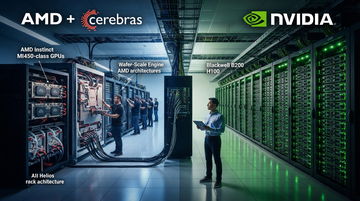
On July 23, 2026, AMD and Cerebras Systems Inc. (Cerebras) announced an ultra-low-latency, high-throughput AI inference solution that pairs AMD’s Helios rack-scale infrastructure with Cerebras’ Wafer-Scale Engine (WSE). Their stated positioning is that the two compute engines will “operate as a single disaggregated inference workflow,” with a workload split between high-performance prompt prefill and ultra-fast token generation.
Announcement date
2026-07-23
AMD press release date (AMD IR)
First availability channel
Cerebras Cloud
Initial GTM channel named by both companies
Initial availability window
2H 2026
“expected to be available first… in the second half of 2026”
Performance claim
Up to 5×
“tokens per second per watt (T/s/W)”
Load-bearing technical numbers from primary sources
The only hard “load-bearing” metric is efficiency (T/s/W), so the wedge must be operational—not ideological
The AMD/Cerebras announcement’s central quantified claim is efficiency: the combined solution is expected to deliver up to 5× higher tokens per second per watt (T/s/W). Importantly, that metric is about how much inference work you can push per unit energy, which aligns directly with the inference market’s near-term pain point: customers want lower latency without exploding power and rack power density.
The announced performance lever is inference efficiency (T/s/W), not raw peak tokens
Single quantified metric in primary sources; other performance details were not fully enumerated in the accessible chunks.
Unit: x
Announced upside
Up to 5× higher tokens per second per watt (T/s/W)
5
- If efficiency drives the buyer’s ROI, the sales motion is likely capacity-constrained: “more tokens per kilowatt” under strict latency SLOs.
- Because the metric is ratio-based (per watt), NVIDIA’s usual dominance via software stack may be harder to defend if customers can measure $/token and latency together.
- But an efficiency ratio does not automatically create a full replacement; it can still live as a “specialized path” inside a customer’s broader inference ecosystem.
Supply-chain + architectural linkage map
Full supply chain: CPUs/GPUs/cluster racks are the “prompt engine,” while WSE becomes the “token engine”
The announcement implies a workload partition inside a single workflow: AMD Helios is framed as the foundation for high-throughput and rack-scale efficiency for prompts and large context windows, while Cerebras WSE is framed as the ultra-fast token generation engine. Even without a full bill-of-materials disclosure, that partition is a supply-chain story: the request path must traverse (1) AMD’s rack-scale infrastructure layer and (2) Cerebras’ wafer-scale compute layer, then rejoin into a unified inference workflow.
| Stack layer | What the customer experiences | Which vendor is positioned as the core enabler | Why it matters for competition |
|---|---|---|---|
| Prompt prefill / context handling | Fast processing of long inputs before generation | AMD Helios throughput engine (rack-scale efficiency) | Controls time-to-first-token without needing to move everything to wafer-scale |
| Token generation | Low-latency output generation at high throughput | Cerebras Wafer-Scale Engine (WSE) | Targets the exact latency pain point that users feel during interactive inference |
| Orchestration / unified workflow | Appears as “single disaggregated inference workflow” | Integration across both compute fabrics | If orchestration is robust, it reduces switching cost; if brittle, it becomes a niche |
| Go-to-market + initial deployments | Where buyers start purchasing/consuming | Cerebras Cloud in 2H 2026 | Starts inside Cerebras’ distribution rather than replacing NVIDIA’s ecosystem entry points |
Why this matters vs NVIDIA
This partnership reads like an inference credibility play—while NVIDIA keeps the full-stack default
The brief’s premise is that “Helios alone can’t win” versus NVIDIA’s full-stack grip. What the primary sources support more directly is narrower: AMD and Cerebras are offering a disaggregated workflow whose initial GTM is via Cerebras Cloud. That is consistent with a hedge: AMD gains a differentiated story in inference efficiency/latency, but it does not eliminate NVIDIA’s system-level advantage because customers still need an end-to-end platform for training, inference orchestration, and developer tooling.
A second, more investor-relevant signal is scale planning inside AMD’s own SEC disclosures. In AMD’s 10‑Q for the quarter ended March 28, 2026, AMD disclosed that in February 2026 it amended a master purchase agreement with Meta under which Meta agreed to deploy up to 6 gigawatts of AMD GPUs, with the first gigawatt powered by custom AMD Instinct MI450-based GPU and 6th Gen AMD EPYC CPUs. That means AMD already has “large deployment credibility” with a major cloud buyer; the Cerebras tie-up likely strengthens the inference narrative rather than swapping out the dominant full-stack supplier relationship.
Five data-backed research angles for investors
Five angles you should track after the announcement
- Track whether the announced “up to 5× T/s/W” claim survives independent benchmark replication in real serving workloads (not just lab kernels).
- Watch for whether Cerebras Cloud becomes a de facto channel for Helios adoption, because the partnership’s initial availability is explicitly tied to Cerebras Cloud in 2H 2026.
- Measure AMD inference share indirectly by counting how often customers describe hybrid disaggregated workflows in procurement language (RFPs and deployment announcements), rather than by headline GPU orders.
- Correlate with AMD’s already-disclosed large deployment pipeline: AMD told investors about Meta up to 6 GW of MI450-based GPU deployments, so new inference platforms must compete for “who supplies the GPUs” inside that scale envelope.
- Benchmark whether NVIDIA’s full-stack stickiness is weakened specifically for interactive workloads (where latency is felt) versus background batch inference (where efficiency still matters but SLOs are looser).
What’s NOT disclosed (and therefore not safe to claim)
6 GW joint deployment figure
Not confirmed in primary-source chunks opened
The accessible AMD/Cerebras primary pages did not contain a 6 GW joint deployment statement.
Customer name list for deployments
Limited in opened chunks
Cerebras risk/disclosure language was mentioned in one web chunk, but specific deployment commitments beyond Cerebras Cloud planning were not fully verified in primary pages opened here.
Exact mix of prompt vs token hardware allocation
Not enumerated
The press release text describes the roles (prompt engine vs token engine) but does not quantify split ratios in the opened excerpts.
Fundamentals overlay
AMD’s financial “room” for inference differentiation is real—but it still won’t be a near-term revenue story
AMD FY2025 revenue
$34.64B
From income statement dataset (FY ended 2025-12-27).
AMD FY2025 net income
$4.33B
From income statement dataset (FY ended 2025-12-27).
NVIDIA TTM operating margin
0.656
Company overview metrics (TTM).
AMD is already operating at scale in revenue terms, but inference disaggregation partnerships tend to monetize on a system integration + deployment timeline, not instantly. In contrast, NVIDIA currently shows exceptionally strong profitability metrics in the dataset (high margins), which supports the idea that a wedge in efficiency/latency may pressure procurement—but it takes time to convert that into share loss and margin compression.
Horizons
Short-term: integration credibility. Long-term: whether inference workflows standardize around disaggregation
Short-term (days–quarters after 2H 2026 availability): the first test is whether Cerebras Cloud deployments can consistently meet tail-latency targets while delivering the advertised efficiency. If the “single disaggregated workflow” falls back to higher variance latency, buyers will treat it as a specialized accelerator rather than a default alternative to NVIDIA-based full-stack inference.
Long-term (1–3 years): disaggregation wins if it becomes a standard architectural option with repeatable integration and measurable total cost-of-ownership (latency + tokens/watt + developer overhead). NVIDIA’s advantage is not just hardware; it is the ecosystem default path for developers and operators—so AMD’s best case is that customers create hybrid paths rather than switching off NVIDIA entirely.
Synthesis verdict
AMD’s Cerebras pact is a smart inference wedge, but not a knockout against NVIDIA’s full-stack default
So the investing question shifts from “does AMD beat NVIDIA?” to “where does the procurement checklist change first?” In the 2H 2026 window, the most actionable signal will be whether customers start specifying disaggregated inference workflows with Cerebras Cloud as the integration path, and whether AMD can attach meaningful incremental GPU volume (beyond its already-disclosed large MI450-class deployment pipeline) to this inference story.
Investable linkage (listed comps only)
- Cerebras integration creates an inference efficiency narrative that can pull AMD into more latency-focused deployment RFPs by 2H 2026
- AMD already disclosed Meta up to 6 GW of MI450-class GPU deployment authority, which supports capacity to scale inference partnerships
- If the partnership proves repeatable, AMD can strengthen data-center margin durability against GPU-cycle volatility
- If customers validate disaggregated workflows delivering up to 5× T/s/W in serving, NVIDIA’s “full-stack default” pricing power faces a measurable efficiency challenge
- Over 1–3 years, repeated disaggregation wins would cap NVIDIA’s inference differentiation moat even without full ecosystem replacement
- Near-term (2H 2026), NVIDIA may still benefit from overall GPU demand, but loses some share in the lowest-latency procurements if results replicate
- If AWS participates through multi-cloud inference rollouts, it could accelerate hybrid inference deployments in 2H 2026 as Cerebras Cloud becomes operational
- However, no AWS-specific deployment commitment was confirmed in the opened primary-source chunks, so this remains a channel-read-through catalyst to monitor
- If disaggregated inference standardizes, Intel can re-enter rack-scale inference contests in 1–3 years via alternative accelerators
- But the announcement does not name Intel, so any effect is indirect benchmarking pressure rather than an immediate win