%22%2F%3E%0A%20%20%3Ccircle%20cx%3D%22220%22%20cy%3D%22150%22%20r%3D%22180%22%20fill%3D%22%2322d3ee%22%20fill-opacity%3D%220.12%22%2F%3E%0A%20%20%3Ccircle%20cx%3D%221010%22%20cy%3D%22130%22%20r%3D%22220%22%20fill%3D%22%2338bdf8%22%20fill-opacity%3D%220.08%22%2F%3E%0A%20%20%3Ccircle%20cx%3D%22920%22%20cy%3D%22520%22%20r%3D%22170%22%20fill%3D%22%2322d3ee%22%20fill-opacity%3D%220.06%22%2F%3E%0A%20%20%3Cpath%20d%3D%22M140%20430h920%22%20stroke%3D%22url(%23line)%22%20stroke-width%3D%2212%22%20stroke-linecap%3D%22round%22%2F%3E%0A%20%20%3Cpath%20d%3D%22M220%20360c120-150%20260-220%20380-220s260%2070%20380%20220%22%20fill%3D%22none%22%20stroke%3D%22%2367e8f9%22%20stroke-opacity%3D%220.5%22%20stroke-width%3D%2216%22%20stroke-linecap%3D%22round%22%20stroke-linejoin%3D%22round%22%2F%3E%0A%20%20%3Cpath%20d%3D%22M300%20398h600%22%20stroke%3D%22%2394a3b8%22%20stroke-opacity%3D%220.24%22%20stroke-width%3D%228%22%20stroke-linecap%3D%22round%22%2F%3E%0A%20%20%3Ctext%20x%3D%22220%22%20y%3D%22510%22%20fill%3D%22%23e2e8f0%22%20fill-opacity%3D%220.7%22%20font-family%3D%22Arial%2C%20Helvetica%2C%20sans-serif%22%20font-size%3D%2238%22%20letter-spacing%3D%228%22%3EINSIGHTS%3C%2Ftext%3E%0A%3C%2Fsvg%3E)
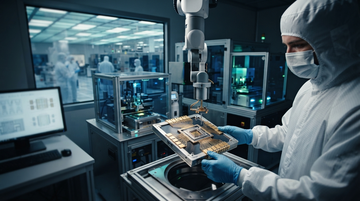
IonQ announced the SkyWater Technology acquisition on January 26, 2026 and closed it on July 31, 2026, after the Federal Trade Commission cleared the transaction on a 1-1 commissioner split. Chairman Andrew Ferguson had proposed requiring IonQ to guarantee fair foundry access to rival quantum customers, but Commissioner Mark Meador disagreed that the merger would lessen competition, and the deadlock let the deal close without conditions. FTC Chairman Ferguson's preferred remedy — a behavioral order restricting how IonQ could prioritize its own chip production over customers like D-Wave Quantum and PsiQuantum — never made it into a settlement.
Deal value
$1.8B
$35.00/share — 38% premium to 30-day VWAP
Mix
$15 cash + $20 stock
0.4883 IONQ shares per SKYT share, with collar
Closing date
July 31, 2026
FTC cleared by 1-1 split, no conditions
Vertical play
First of its kind
Only U.S. quantum platform with a Trusted foundry under one roof
Why a Foundry — And Why Now
IonQ ended Q1 2026 with $2.03B of cash and short-term investments but just $187M of trailing twelve-month revenue. It was spending at a rate that made its $1.8B acquisition price almost the entire war chest — yet the company is choosing to deploy that capital into physical fab assets rather than into additional algorithmic IP or cloud distribution deals. The reason is buried in IonQ's own roadmap: 200,000 physical qubits supporting 8,000 logical qubits by 2028, and 2,000,000 physical / 80,000 logical qubits by 2030. Iteration speed, not qubit fidelity, is now the binding constraint — and iteration speed is set by who owns the fab line.
The acquisition also gives IonQ access to SkyWater Technology's $93M Fab 25 — a 200mm foundry in Austin, Texas, closed by SkyWater in June 2025 with ~400,000 wafer starts per year of incremental capacity — plus its Bloomington, Minnesota facility and Kissimmee, Florida Advanced Packaging Center. All three are DMEA Category 1A Trusted, meaning they are cleared to manufacture chips for the U.S. Department of Defense. That accreditation is the single hardest thing to replicate in U.S. semiconductor manufacturing, and it is the structural reason D-Wave Quantum, PsiQuantum, EeroQ and Silicon Quantum Computing have all been lining up to run their qubit processes through SkyWater.
The Supply Chain Just Got Rewired — For Everyone
Here is the part the press releases skip. As of Q1 2026, SkyWater Technology reported eight commercial Advanced Technology Services engagements with quantum computing customers, with quantum-related ATS revenue growing over 30% year-over-year and reaching $175.6M of wafer services revenue in the second half of 2025 alone. Those customers included D-Wave Quantum, PsiQuantum, EeroQ and Silicon Quantum Computing — companies that are now, structurally, buying capacity from a subsidiary of their direct competitor. IonQ has publicly committed to keeping SkyWater operating as a merchant foundry, with firewalls and IP compartmentalization. The FTC Chairman did not believe that promise was enforceable and wanted it written into a consent order; he lost that vote.
The supply-chain spillover runs both ways. Upstream, SkyWater Technology sources 200mm silicon wafers and process tooling from a tightly concentrated base of equipment vendors, and IonQ inherits those relationships. Downstream, IonQ's trapped-ion architecture — historically manufactured via bespoke lab processes and the Oxford Ionics 'trap-on-a-chip' technology it acquired in September 2025 for ~$1.075B — now has a U.S. foundry path for photonic interconnects, atomic clocks and superconducting ICs that SkyWater already runs for other customers. That is the literal definition of vertical integration: one company owning the qubits, the photonic interconnects, the packaging and the fab line that produces them.
The Comparable: AI Foundries Already Priced This In
The clearest listed-company read-across is the AI foundry race. TSMC trades at 14× sales and a $2.1T market cap because it owns the world's most advanced fab capacity; Intel trades at 8× sales and has spent over $100B building Intel Foundry precisely because it failed to control its own chip production during the AI accelerator build-out. IonQ's enterprise value of $13.1B against $187M of trailing revenue is 70× sales — a multiple that, applied to SkyWater Technology's $542M of trailing revenue, would imply an embedded foundry value of roughly $38B inside IonQ. That is a generous way of saying the market is already paying for vertical integration in the equity, and the closing of the deal simply converts narrative into balance sheet.
| Company | Ticker | Market cap | TTM revenue | EV / Sales | Strategic role |
|---|---|---|---|---|---|
| IonQ | IONQ | $13.6B | $187M | 70.2x | Acquirer; quantum platform + foundry under one roof |
| SkyWater Technology | SKYT | $1.6B | $542M | 3.3x | Subsidiary; Trusted U.S. foundry (delisting Aug 3, 2026) |
| D-Wave Quantum | QBTS | $5.95B | $12M | 510x | Rival quantum co.; former SkyWater customer |
| Rigetti Computing | RGTI | $4.97B | $10M | 492x | Rival superconducting quantum co. |
| Intel | INTC | $466B | $57.0B | 8.8x | Intel Foundry — CHIPS-Act backed U.S. competitor |
| TSMC | TSM | $2,105B | $4,440B | 13.7x | Taiwan-domiciled foundry; TSMC Arizona U.S. fab |
The second comparable is closer to home. GlobalFoundries launched its own Quantum Technology Solutions business in May 2026, explicitly positioning itself as a U.S. quantum foundry with trusted accreditation across its U.S. footprint. PsiQuantum — which also runs photonic chip development at GlobalFoundries in New York — is the one quantum company hedging its foundry exposure across two suppliers. After this deal, every other quantum pure-play has only one of those two as an independent option, and that option is now IonQ's subsidiary.
What This Means For IonQ's Own Math
IonQ closed FY2025 with $130.0M of revenue, up from $43.1M in FY2024 — a 201% year-over-year jump driven by commercial customers accounting for over 60% of sales, distributed through AWS Braket, Microsoft Azure Quantum and Google Cloud Marketplace. Q1 2026 revenue hit $64.7M, implying a run rate north of $250M annualized. Against that trajectory, the $1.8B acquisition price equals roughly seven years of current revenue. The dilution math is also material: 0.4883 IonQ shares per SkyWater share, multiplied by SkyWater's ~49.2M shares outstanding, equals ~24M new IonQ shares — a ~6.7% increase on the 358.8M Q1 2026 weighted share count.
IonQ revenue trajectory — $187M TTM and accelerating
Trailing twelve-month revenue, USD millions
Unit: USD millions
FY2023
$22.0M
22
FY2024
$43.1M (+95% YoY)
43.1
FY2025
$130.0M (+202% YoY)
130
Q1 2026
$64.7M in single quarter
64.7
TTM (Aug 2026)
$187.1M
187.1
The trailing TTM numbers also expose the cash-burn reality. IonQ's trailing operating loss is $830M against $2.03B of liquid resources. Closing the SkyWater Technology deal uses up roughly 89% of that liquidity in cash, plus 24M shares of equity. Investors are now funding the foundry thesis primarily with IonQ stock, not with the post-deal cash flow it would generate. That is why the multiple looks like a foundry multiple but the cash flow looks like an early-stage quantum company: the foundry is the optionality, not the cash machine, and the next 12 months of dilution and integration risk are the price of converting that optionality into a captive physical asset.
Short-Term Catalysts (Days to Quarters)
- The combined company reports Q2 2026 earnings on August 5, 2026 and holds an investor day on September 8, 2026 — the first opportunity for IonQ to disclose SkyWater Technology segment economics and reaffirm or revise the 200,000-qubit 2028 roadmap with concrete fab milestones.
- D-Wave Quantum, EeroQ, Silicon Quantum Computing and PsiQuantum must now negotiate renewal or expansion of their existing SkyWater ATS contracts knowing IonQ is the parent — a contracting event that will compress customer margins if the firewalls fail.
- SkyWater Technology common stock is suspended effective August 3, 2026 after deal closing; SKYT holders who did not tender receive the $35.00 cash-and-stock consideration and exit the listing, removing the cleanest US-pure-play foundry from the public tape.
- First iteration-time comparison: IonQ claimed 256-qubit chip cycles move from 9 months to 2 months in-house. The first tape-out under the new structure, expected in late 2026, will be the falsification test for that 4.5× acceleration claim.
Long-Term Implications (1–3 Years)
- If IonQ reaches its 2028 target of 200,000 physical qubits and 8,000 logical qubits, it will be the first U.S. quantum company with Trusted-accredited, vertically integrated U.S. manufacturing at scale — a position that becomes a structural moat against both Chinese quantum hardware and U.S. rivals that still rent foundry capacity.
- Rigetti Computing and D-Wave Quantum face a strategic choice: keep buying from an IonQ subsidiary under firewall protections, build or buy their own foundry exposure (D-Wave already uses SkyWater for its annealing qubits; Rigetti runs at an independent fab), or accept that their manufacturing roadmap will be paced by a competitor's board.
- The deal re-prices every other U.S. quantum foundry M&A scenario. With IonQ having taken the only DMEA Category 1A Trusted quantum-relevant U.S. foundry off the public market, GlobalFoundries' May 2026 launch of a Quantum Technology Solutions unit looks less like a defensive move and more like the only remaining independent option for U.S. quantum hardware customers — which is a multiple-expansion catalyst for GFS if the integration runs into friction.
- The AI-foundry comp suggests the next 24 months are about execution, not algorithms. Intel has spent $100B+ and still trades at 8× sales because its foundry business is unproven; TSMC earns 14× sales and a $2.1T market cap because it owns the world's most advanced node. IonQ is now betting that its qubit node becomes as differentiated as TSMC's 3nm — and the equity multiple will move with proof, not with promises.
The Thesis, In One Line
IonQ paid $1.8B for SkyWater Technology — a 38% premium, 89% of its cash, plus 24M new shares — to convert a rented-fab business model into a captive, Trusted-accredited, U.S.-domestic manufacturing platform that no other pure-play quantum company can match before 2028. The thesis works if iteration speed, not qubit fidelity, is what separates the first commercially useful fault-tolerant quantum computer from the rest; the thesis breaks if D-Wave Quantum, PsiQuantum and others either negotiate around IonQ's control or defect to GlobalFoundries, leaving the captive fab underutilized. IonQ is now priced like a foundry and operating like a quantum startup — and the next 12 months of tape-outs will determine which multiple survives.
Where the deal lands across the supply chain
- Pays ~89% of its $2.03B cash plus ~24M new shares for SkyWater Technology; 4.5× chip iteration speed-up is the structural bet against 6.7% dilution and ongoing operating losses of ~$830M TTM.
- Claims a 200,000-physical-qubit / 8,000-logical-quubit roadmap for 2028 with captive Trusted U.S. capacity — execution on Q2 2026 earnings (Aug 5) and September 8 investor day sets the near-term tape.
- Becomes both the largest quantum customer and the largest competitor to D-Wave Quantum, Rigetti Computing and PsiQuantum on the foundry side; multiple compresses if firewalls fail, expands if customer renewals stay clean.
- Was one of eight named commercial quantum ATS customers of SkyWater Technology; now buying fab capacity from IonQ's subsidiary under disclosed firewall commitments, not a regulator-enforced order.
- SkyWater produced the qubits behind D-Wave's March 2025 quantum supremacy demonstration — losing independent access to that specific fab line raises D-Wave's manufacturing risk premium into 2027.
- At 510× EV/Sales with $12M of TTM revenue, D-Wave's valuation is uniquely exposed if IonQ's foundry integration accelerates a rival 200,000-quubit roadmap first.
- Does not use SkyWater Technology as its primary foundry, so it avoids the immediate customer-versus-competitor conflict — but it loses the optionality of buying from a now-IonQ-controlled U.S. Trusted foundry.
- At 492× EV/Sales on $10M of TTM revenue, Rigetti's multiple is the most exposed to relative execution speed between itself and IonQ's 2028 qubit-count target.
- A clean path to GlobalFoundries' new Quantum Technology Solutions unit (launched May 2026) is the clearest structural hedge against the new IonQ-SkyWater monopoly on Trusted U.S. quantum fab capacity.
- Intel Foundry is the most direct U.S. foundry comp; IonQ's captive-foundry bet implies Intel's $100B+ foundry investment thesis gains validation if iteration speed and Trusted accreditation start to dominate qubit-quality competition.
- At 8.8× EV/Sales with $57B of TTM revenue, Intel is the structural low-end of the U.S. foundry multiple range — a comparison anchor if IonQ's multiple compresses post-deal as dilution and integration costs hit.
- Intel's 18A node at Chandler, Arizona is in high-volume production; if IonQ signs any future-generation qubit capacity as an Intel Foundry customer, it would materially de-risk the standalone SkyWater thesis.
- TSMC is the high-end U.S. foundry comp at 13.7× EV/Sales and a $2.1T market cap — the implicit ceiling on what a Trusted-accredited U.S. foundry could be worth if IonQ executes on its 2028 qubit roadmap.
- TSMC Arizona ($165B pledged) is the only serious U.S.-domestic alternative to SkyWater Technology for high-volume advanced packaging; any IonQ move toward TSMC packaging in 2027–2028 would dilute the strategic value of the SkyWater acquisition.
- As a foundry reference price, TSMC lets investors triangulate whether IonQ's post-deal ~70× EV/Sales is foundry-priced (defensible) or quantum-startup-priced (compresses on dilution).