%22%2F%3E%0A%20%20%3Ccircle%20cx%3D%22220%22%20cy%3D%22150%22%20r%3D%22180%22%20fill%3D%22%2322d3ee%22%20fill-opacity%3D%220.12%22%2F%3E%0A%20%20%3Ccircle%20cx%3D%221010%22%20cy%3D%22130%22%20r%3D%22220%22%20fill%3D%22%2338bdf8%22%20fill-opacity%3D%220.08%22%2F%3E%0A%20%20%3Ccircle%20cx%3D%22920%22%20cy%3D%22520%22%20r%3D%22170%22%20fill%3D%22%2322d3ee%22%20fill-opacity%3D%220.06%22%2F%3E%0A%20%20%3Cpath%20d%3D%22M140%20430h920%22%20stroke%3D%22url(%23line)%22%20stroke-width%3D%2212%22%20stroke-linecap%3D%22round%22%2F%3E%0A%20%20%3Cpath%20d%3D%22M220%20360c120-150%20260-220%20380-220s260%2070%20380%20220%22%20fill%3D%22none%22%20stroke%3D%22%2367e8f9%22%20stroke-opacity%3D%220.5%22%20stroke-width%3D%2216%22%20stroke-linecap%3D%22round%22%20stroke-linejoin%3D%22round%22%2F%3E%0A%20%20%3Cpath%20d%3D%22M300%20398h600%22%20stroke%3D%22%2394a3b8%22%20stroke-opacity%3D%220.24%22%20stroke-width%3D%228%22%20stroke-linecap%3D%22round%22%2F%3E%0A%20%20%3Ctext%20x%3D%22220%22%20y%3D%22510%22%20fill%3D%22%23e2e8f0%22%20fill-opacity%3D%220.7%22%20font-family%3D%22Arial%2C%20Helvetica%2C%20sans-serif%22%20font-size%3D%2238%22%20letter-spacing%3D%228%22%3EINSIGHTS%3C%2Ftext%3E%0A%3C%2Fsvg%3E)
Event date
2026-07-20
CFO Wendell Huang interview (CNBC)
Arizona investment pipeline
$265B
Total investment pipeline now includes an additional $100B commitment
Incremental Arizona commitment
$100B
Described as additional commitment to expand U.S. footprint
2026 capex guidance
$60–64B
Raised from prior $52–56B
Arizona Phase 1 node
4nm
Phase 1 already running on 4nm
U.S. fab build cost premium
4–5x
US fab construction costs vs. Taiwan levels (CFO statement)
What happened
TSMC’s Arizona acceleration is no longer “risk diversification”—it’s now a quantified US capex program built around AI supply demand
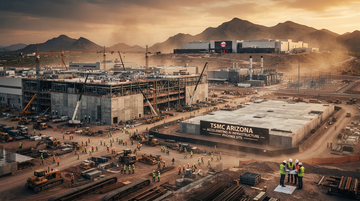
On July 20, 2026, TSMC’s CFO Wendell Huang told CNBC the company is accelerating its Arizona fab buildout to capitalize on AI-driven demand, and he attached new hard numbers: the Arizona investment pipeline is now $265B (with an additional $100B commitment), and 2026 capex guidance was lifted to $60–64B. He also confirmed that Arizona Phase 1 is already running on 4nm and that advanced packaging is being built on-site.
Load-bearing facts disclosed by TSMC (via CNBC CFO interview)
Arizona investment pipeline
$265B
Total now includes incremental $100B commitment
Incremental Arizona commitment
$100B
Described as additional to expand the U.S. footprint
2026 capex guidance
$60–64B
Raised from prior $52–56B
Arizona Phase 1
Running on 4nm
CFO stated Phase 1 is in production on 4nm
Advanced packaging
Built on-site
CFO tied packaging investment to the $100B
US fab construction cost premium
4–5x Taiwan
CFO cited higher US build costs as a key datapoint
Data & cross-checks
The headline numbers are consistent across coverage—and they point to front-end + advanced packaging co-location as the real build logic
| Fact | Value | Where disclosed | Why it matters |
|---|---|---|---|
| Arizona investment pipeline (total) | $265B | CNBC (CFO Wendell Huang interview) | Defines the scale of the US buildout program |
| Incremental commitment | $100B | CNBC + echoed in additional coverage | Signals acceleration rather than a static plan |
| 2026 capex guidance | $60–64B | CNBC | Provides a near-term tracking metric for the market |
| Arizona Phase 1 node status | 4nm in production | CNBC | Reduces “future” uncertainty: volume ramp can start earlier |
| Advanced packaging on-site | Included as part of Arizona build | CNBC | Indicates TSMC is bundling wafer capacity + packaging throughput to serve AI demand |
| US fab construction cost premium | 4–5x Taiwan | CNBC | Is the key economic variable for US foundry expansion |
Two important interpretive details sit inside the CNBC framing. First, TSMC didn’t describe Arizona as only wafer capacity—it tied the $100B commitment to both front-end fabs and advanced packaging built on-site. Second, Huang highlighted the US cost premium (4–5x Taiwan construction), which makes this acceleration a bet on economics improving via scale, utilization, and downstream packaging bottleneck relief—not just policy-driven geography.
Fundamentals baseline
TSMC has the cash generation to fund a $60–64B capex year—but the margin question shifts to whether AI-era utilization can offset 4–5x US build costs
Revenue (TTM snapshot in tool)
$4.45T (TWD-based reporting in tools)
Tool snapshot: revenue 4,450,378,591,000 (reported currency TWD)
Gross profit (TTM)
$2.86T (TWD-based reporting in tools)
Tool snapshot: gross profit 2,858,297,926,000 (TWD)
Net income (TTM)
$2.32T (TWD-based reporting in tools)
Tool snapshot: net income 2,321,070,276,000 (TWD)
Operating cash flow (TTM)
$2.68T (TWD-based reporting in tools)
Tool snapshot: operating cash flow 2,683,421,026,000 (TWD)
Capex (TTM)
$1.49T (TWD-based reporting in tools)
Tool snapshot: investments in PP&E -1,491,410,317,000 (TWD)
Free cash flow (TTM)
$1.19T (TWD-based reporting in tools)
Tool snapshot: free cash flow 1,192,023,588,000 (TWD)
TSMC profitability and cash generation backdrop (tool snapshot: TTM)
Used only to show baseline scale and funding capacity; not a forecast for Arizona economics.
Unit: TWD (as reported by tool)
TTM Revenue (reported currency TWD)
4,450,378,591,000
TTM Gross Profit (TWD)
2,858,297,926,000
TTM Operating Cash Flow (TWD)
2,683,421,026,000
TTM Free Cash Flow (TWD)
1,192,023,588,000
Causal chain
Why the Arizona capex hike likely “needs” the advanced packaging build: AI demand is not just wafer starts—it’s a system bottleneck around heterogeneous packaging
The acceleration story has an important mechanism implied by the disclosure: if AI customers are “racing” for advanced capacity, wafer output alone can be insufficient when packages and integration steps are the limiting throughput. Huang’s statement that the $100B covers both wafer fabs and advanced packaging on-site suggests TSMC is trying to remove a downstream chokepoint that would otherwise strand wafer supply.
- Event: CFO accelerates Arizona build and raises 2026 capex to $60–64B while noting US build cost premium (4–5x Taiwan).
- Mechanism: Co-locating advanced packaging with front-end wafer fabs reduces transfer/lead-time risks and increases end-to-end “AI-ready” throughput.
- Structural driver: AI product roadmaps increasingly rely on heterogeneous components (compute + memory + networking + accelerators), so packaging/integration steps can become capacity ceilings even when wafer capacity expands.
- Economic implication: If packaging is a bottleneck, utilization of the expensive US fab capacity can stay higher for longer—improving the chance to offset 4–5x build costs via volume and better absorbed fixed costs.
Supply chain map
The Arizona acceleration turns the US AI chip supply chain into a multi-quarter capex wave (equipment, construction, utilities), not a one-time fab story
- Upstream (inputs to build): semiconductor manufacturing equipment, cleanroom construction/MEP (mechanical/electrical/plumbing), specialty gases, and materials (e.g., high-purity chemicals) become demand magnets as fab build schedules compress.
- Upstream (site enablement): power generation/distribution, high-capacity substations, and water/chemical handling systems matter because fabs are utility intensive—US build cost premium (4–5x Taiwan construction) implicitly includes these categories.
- Downstream (how the chips get used): cloud and enterprise AI customers demand packaged, system-ready accelerators; if advanced packaging is built on-site, the downstream “time-to-integrated-chip” improves and can stabilize customer orders.
- Industry spillover: the US foundry and packaging expansion can pull capacity investments across the heterogeneous packaging ecosystem, tightening the link between wafer supply and final assembly throughput.
| Link | Entity (example) | Type | Evidence status in this session | What to verify next (if you want a deeper chain) |
|---|---|---|---|---|
| Fab construction cost drivers | US construction/cleanroom contractors (not named in opened sources) | Upstream (construction) | Unverified (no entity named in the CNBC extract captured here) | Open additional primary pages or SEC/IR materials that name EPCs or major construction packages |
| Semiconductor manufacturing equipment | ASML / Applied Materials / Lam Research (not opened in this session) | Upstream (capex equipment) | Unverified in this session | Pull capex commentary or order/backlog signals for 2026–2027 and tie to Arizona/fab equipment categories |
| Packaging equipment and services | Teradyne / ASMPT / other packaging equipment players (not opened in this session) | Upstream (packaging) | Unverified in this session | Link packaging tool deliveries/backlog to TSMC advanced packaging ramp |
| Customers/outsized demand | AI hyperscalers and accelerator OEMs (e.g., NVIDIA ecosystem) | Downstream (demand) | Referenced conceptually in the topic brief, but not evidenced with opened primary customer statements here | Open TSMC customer-order commentary via IR/earnings releases or supplier/customer disclosures |
Competitive positioning
TSMC is repositioning Arizona as a capacity product—meaning the real competition is utilization, not geography
A pure “strategic redundancy” build would justify geography and policy support but would not naturally demand a capex guide bump alongside a quantified cost premium. Here, TSMC raised 2026 capex to $60–64B while explicitly stating the US construction costs are 4–5x Taiwan. That combination reads like: the company believes it can secure enough AI customer commitments to run the facilities at high enough utilization to make the economics work.
| Question | Evidence we have | Inference supported by that evidence | Remaining uncertainty |
|---|---|---|---|
| Is Arizona being treated as a serious revenue engine? | CFO raised capex guidance and confirmed 4nm Phase 1 is running + advanced packaging built on-site. | Yes: the build is operational now and tied to end-to-end manufacturing output, not only long-dated option value. | We still need Arizona-specific financial contribution or yield/utilization metrics to prove margin outcomes. |
| Does the cost premium threaten the thesis? | CFO stated US fab construction costs are 4–5x Taiwan. | It would be a thesis breaker without AI volumes; therefore, the accelerated build likely assumes sustained order flow and utilization. | We need evidence on customer commitments, ramp curves, and whether US production commands pricing/mix advantages. |
| Is TSMC’s edge wafer or packaging? | Advanced packaging being built on-site was tied to the $100B investment. | Packaging is part of the differentiator; end-to-end capacity reduces integration bottlenecks for AI systems. | Need packaging capacity numbers (substrate/test/assembly throughput) to quantify this advantage. |
Valuation-style framing (without making up multiples)
The market will reprice TSMC’s US capex as “AI-enabled capacity,” but the risk is that AI demand is peaky while US costs are not
Capex step-change implied by the guidance raise (tracking metric)
Guidance range change shown numerically from the prior range cited in CNBC coverage.
Unit: USD billions
Prior 2026 capex guidance (lower end)
52
Prior 2026 capex guidance (upper end)
56
New 2026 capex guidance (lower end)
60
New 2026 capex guidance (upper end)
64
- Upside case: AI-driven orders sustain utilization and packaging bottlenecks are truly relieved by co-located advanced packaging, turning capex into revenue faster.
- Downside case: if AI demand softens or ramps slower than expected, 4–5x US build costs become a fixed-cost burden with limited near-term absorption.
- What to watch next (operational milestones): Arizona 4nm ramp rate in production quarters; packaging tool installation completion; utilization/lead-time improvements reported by TSMC earnings updates.
- What to watch next (financial signals): whether gross margin holds while capex rises, and whether capex-to-depreciation or cash conversion weakens.
Long-term view
If TSMC can industrialize US AI manufacturing economics, the CHIPS-era story shifts from subsidies to unit economics
Over the next 1–3 years, the Arizona acceleration becomes a unit-economics experiment under extreme cost conditions: US construction at 4–5x Taiwan. If utilization and end-to-end throughput (wafer + on-site advanced packaging) convert into stable revenue, it effectively reframes the CHIPS-era narrative from “policy-driven capacity” to “manufacturing scale that earns its cost of capital.”
- Milestone 1: Sustained 4nm production scaling in Arizona Phase 1 across subsequent quarters (beyond “running”).
- Milestone 2: Advanced packaging capacity availability at the point that it removes a real customer integration bottleneck (reflected in customer lead times).
- Milestone 3: Updated capex guidance for 2027/2028 and whether it remains elevated or tapers with ramp.
- Risk 1: Construction/utility ramp delays in the US that push yield or throughput later than the market expects.
- Risk 2: AI demand concentration risk still exists—just now it’s demand volatility rather than geography.
Synthesis
TSMC’s $60–64B 2026 capex and $265B Arizona pipeline imply AI is now underwriting US foundry economics—even with 4–5x build costs
This event matters because it forces a structural reframing: the US expansion is not just about de-risking supply chains; it is about funding a large, high-cost manufacturing footprint that must be utilized to make sense. TSMC’s own CFO linked the acceleration to AI demand and emphasized both the higher US build costs (4–5x) and the co-location of advanced packaging, implying an operational strategy to monetize AI chip bottlenecks.
| Category | What we know as a fact | What we infer |
|---|---|---|
| Scale | Arizona pipeline is $265B and includes an additional $100B commitment; 2026 capex is raised to $60–64B. | TSMC is increasing the probability of meeting customer demand with physical capacity rather than relying on Taiwan-only supply. |
| Execution | Arizona Phase 1 is running on 4nm; advanced packaging is being built on-site. | TSMC is treating end-to-end throughput (wafer + packaging) as essential to capturing AI demand. |
| Economics | US fab construction costs are 4–5x Taiwan. | The capex acceleration likely assumes sufficient AI volumes to keep US facilities utilized long enough to absorb the cost premium. |