%22%2F%3E%0A%20%20%3Ccircle%20cx%3D%22220%22%20cy%3D%22150%22%20r%3D%22180%22%20fill%3D%22%2322d3ee%22%20fill-opacity%3D%220.12%22%2F%3E%0A%20%20%3Ccircle%20cx%3D%221010%22%20cy%3D%22130%22%20r%3D%22220%22%20fill%3D%22%2338bdf8%22%20fill-opacity%3D%220.08%22%2F%3E%0A%20%20%3Ccircle%20cx%3D%22920%22%20cy%3D%22520%22%20r%3D%22170%22%20fill%3D%22%2322d3ee%22%20fill-opacity%3D%220.06%22%2F%3E%0A%20%20%3Cpath%20d%3D%22M140%20430h920%22%20stroke%3D%22url(%23line)%22%20stroke-width%3D%2212%22%20stroke-linecap%3D%22round%22%2F%3E%0A%20%20%3Cpath%20d%3D%22M220%20360c120-150%20260-220%20380-220s260%2070%20380%20220%22%20fill%3D%22none%22%20stroke%3D%22%2367e8f9%22%20stroke-opacity%3D%220.5%22%20stroke-width%3D%2216%22%20stroke-linecap%3D%22round%22%20stroke-linejoin%3D%22round%22%2F%3E%0A%20%20%3Cpath%20d%3D%22M300%20398h600%22%20stroke%3D%22%2394a3b8%22%20stroke-opacity%3D%220.24%22%20stroke-width%3D%228%22%20stroke-linecap%3D%22round%22%2F%3E%0A%20%20%3Ctext%20x%3D%22220%22%20y%3D%22510%22%20fill%3D%22%23e2e8f0%22%20fill-opacity%3D%220.7%22%20font-family%3D%22Arial%2C%20Helvetica%2C%20sans-serif%22%20font-size%3D%2238%22%20letter-spacing%3D%228%22%3EINSIGHTS%3C%2Ftext%3E%0A%3C%2Fsvg%3E)
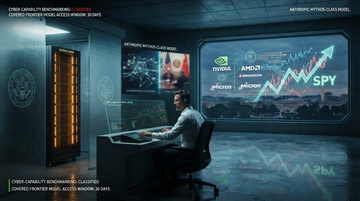
Verdict first: the trade isn’t just chips—it’s frontier-model release timing
The “Mythos anxiety” frame matters because it ties AI release mechanics to US–China deal flow
Bloomberg reports Beijing is “getting more anxious” about Anthropic’s Mythos-class frontier AI ahead of a planned Trump–Xi summit, with officials focused on its cyber capabilities and the political signal of why China isn’t granted “normal” access. That matters for markets because the U.S. has simultaneously moved to operationalize AI pre-release safety review for models that could meet a “covered frontier model” threshold.
In other words: the next frontier-model release decision is not only a lab milestone—it can become a diplomatic input that shifts the probability distribution of export-control enforcement, licensing behavior, and therefore advanced compute spend. Investors who trade only on “AI demand” are missing the mechanism: policy review timing can reprice chip-access expectations.
Primary-source anchors used for the causal chain
U.S. voluntary frontier-model review framework (cyber-focused, before release)
Executive Order 14409 (Jun 2, 2026)
Describes classified benchmarking + voluntary developer access up to 30 days before release.
China’s Mythos concern framing + cyber capability focus
Bloomberg (Aug 3, 2026 reporting; lead referenced in Aug 4 coverage)
Reports Beijing officials worried about cyber capabilities and why Anthropic denies China access.
- China’s worry is about cyber capability weaponization risk, not generic AI competitiveness.
- U.S. policy creates a measurable pre-release review window for covered frontier models (classified benchmarking; voluntary access up to 30 days).
- Trade impact is indirect: diplomacy changes chip licensing probability, which changes near-term orders and capex pacing.
Step 1: verify the AI-policy mechanism that could intersect diplomacy
What the U.S. actually put in place: a classified “covered frontier model” benchmark + voluntary access before release
The U.S. policy backdrop is not vague AI regulation—it’s an operational review process. Executive Order 14409 (“Promoting Advanced Artificial Intelligence Innovation and Security,” dated Jun 2, 2026) requires development and maintenance of a classified benchmarking process to assess advanced AI’s cyber capabilities and determine whether a model is a “covered frontier model.”
Crucially for timing: the voluntary framework is designed so developers can provide the federal government access to covered frontier models for up to 30 days before they release the models to other trusted partners. The order also clarifies that the authorization does not by itself create a mandatory licensing / permitting regime for development or release.
So if diplomacy later decides how “trusted partners” are defined (or how rigorously the review is enforced/communicated), the release window can become a lever that changes what gets shipped, to whom, and when. That is the exact bridge from “Mythos anxiety” to “chip repricing.”
Cyber-capability benchmarking
Classified
Built to determine “covered frontier model” threshold based on cyber capabilities.
Developer access window
Up to 30 days
Federal government access to covered frontier models before release to other trusted partners.
Step 2: connect China’s Mythos concern to frontier-model cyber risk
Mythos is being framed as an offensive cyber capability signal—and Beijing is questioning Anthropic’s access posture
Bloomberg’s lead describes Beijing officials growing anxious about Anthropic’s Mythos before Trump meets Xi, emphasizing cyber capabilities. It reports officials see potential for models like Mythos to be used as offensive weapons and notes China is questioning why Anthropic is denying China access to the systems “for normal purposes.”
A key market-relevant implication is what China appears to be treating Mythos as: not just a frontier-language model, but a frontier cyber capability that could shift how much risk the U.S. believes should be tolerated in cross-border AI technology pathways.
When policymakers treat the cyber side as the decisive risk dimension, export-control behavior and “trusted partner” definitions can become more conservative—and that directly affects demand timing for AI compute stacks.
| Link | What the sources say | Market transmission channel |
|---|---|---|
| Risk dimension | Beijing focuses on Mythos’s cyber capabilities (offensive weapon concern). | Diplomacy weighs cyber-enabled misuse risk more than generic AI performance. |
| Policy step | U.S. has classified benchmarking for “covered frontier models,” with voluntary federal access up to 30 days pre-release. | Timing window becomes a lever that can change what gets released/partnered and when. |
| Trade corridor | If “trusted partner” access is politically constrained, advanced AI supply/capacity commitments can slip. | Chip orders and accelerator deployment pacing move with licensing and enforcement expectations. |
Step 3: quantify why the chip corridor is sensitive (use fundamentals + exposure)
Why this repricing lands hardest on advanced compute: the incumbents have massive revenue sensitivity to AI data-center capex
NVIDIA’s revenue acceleration creates leverage to policy-driven order timing
Annual revenue (reported) used to show how rapidly revenue scales with AI spend cycles.
Unit: USD
FY 2025
Baseline year in the dataset.
130,497,000,000
FY 2026
Steeper AI-related demand ramp.
215,938,000,000
TTM (as of 2026-08-04)
Current run-rate.
253,491,000,000
- When diplomacy shifts expected licensing of advanced accelerators, AI data-center deployments slip first (orders move before models even ship broadly).
- Companies with the sharpest AI-related revenue scaling can see near-term earnings revisions from order-timing deltas, even without a change in long-run AI adoption.
This is where your chip list makes sense as a “pricing into diplomacy” basket. NVIDIA, Broadcom, AMD, and Micron are all tightly coupled to the full stack: accelerators, high-speed interconnect/networking, compute platforms, and memory bandwidth/capacity.
The key is not that Mythos magically increases model training demand overnight. The key is that the probability of immediate China-facing AI deployment (and therefore near-term advanced compute orders) can change if diplomacy treats Mythos-class cyber risk as a bargaining chip.
That’s why the same summit headline can propagate into chip curves—the market path is order timing → supply planning → reported revenue timing.
Step 4: supply-chain aware impacts (upstream → chips → downstream deployment)
Full supply-chain view: from cyber-risk framing to memory/loading and networking bottlenecks
- Upstream (AI models & safety gating): the voluntary “covered frontier model” review window can affect which systems are cleared/communicated to partners and when.
- Midstream (compute + networking): accelerator and interconnect demand is sensitive to whether China-facing AI builds are assumed to proceed on-schedule.
- Downstream (deployment bottlenecks): memory capacity/bandwidth and datacenter system integration determine how fast new accelerator fleets translate into production workloads.
Horizons: what moves first vs what matters later
Short-term (days–quarters): “release window + summit” headlines drive chip expectations; long-term (1–3 years): stack durability depends on whether AI safety becomes a recurring trade mechanism
Short-term, markets don’t need a new regulation to reprice—only a credible shift in expected enforcement and licensing behavior around advanced AI stacks. That shift can happen via (1) how quickly the voluntary review framework is operationalized in communications, and (2) whether Beijing treats Mythos as a justification for tougher constraints on access.
Over 1–3 years, the bigger question is whether AI safety and cyber capability governance become a recurring bargaining channel (model releases ↔ partner access ↔ compute availability). If yes, then the “winner” among semis will be the ecosystem player best positioned to absorb policy-induced timing variance—via diversified customer bases, inventory/supply flexibility, and platform breadth.
Practically: the next frontier-model decision window functions like a macro input to AI capex pacing, which is exactly why chip equities can move even when fundamentals look stable.
Investor checklist: the “what to watch” signals
What would confirm or falsify the thesis (and therefore directionally impact the chip basket)
- Watch for language changes around “trusted partners” or early access timelines for frontier models after the policy review window—timing clarity reduces dispersion in chip demand expectations.
- Watch for any sign that China’s “normal-purpose access” question triggers tighter practical pathways—access friction raises near-term China build caution.
- Watch datacenter build guidance and memory/compute supply planning references to export/licensing uncertainty—direct references validate policy-to-orders causality.
Listed stocks most exposed to “Mythos → diplomacy → chip orders” timing
- If Summit-driven licensing uncertainty delays China-facing AI deployments, NVIDIA faces near-term revenue timing risk within one to two quarters.
- Because NVIDIA monetizes accelerator platforms and networking broadly, a policy-driven shift can change mix without stopping total AI spend over 1–3 years.
- Its current run-rate revenue scale implies that even modest order pacing changes can move earnings expectations quickly.
- If US firms are allowed to sell under stricter cyber-risk constraints, AMD can gain share where platform compatibility matters as customers reconfigure stacks.
- Over 1–3 years, any “trusted-partner” segmentation that favors additional vendor diversity can support AMD’s platform demand durability.
- If accelerator builds continue but face timing uncertainty, memory is still required; Micron can benefit from bandwidth/capacity catch-up demand after policy windows clarify.
- Because memory demand is tied to sustained workloads, a clearance-based diplomacy mechanism can front-load rebuilds into the next 1–3 years if releases broaden.
- If diplomacy changes export-control rigor for AI-related manufacturing, ASML is a second-order beneficiary/loser; watch for guidance shifts linked to China fabrication investment assumptions.
- Over 1–3 years, any sustained tightening/loosening can reprice capex cycles in lithography—but near-term linkage is not disclosed in the sources.