%22%2F%3E%0A%20%20%3Ccircle%20cx%3D%22220%22%20cy%3D%22150%22%20r%3D%22180%22%20fill%3D%22%2322d3ee%22%20fill-opacity%3D%220.12%22%2F%3E%0A%20%20%3Ccircle%20cx%3D%221010%22%20cy%3D%22130%22%20r%3D%22220%22%20fill%3D%22%2338bdf8%22%20fill-opacity%3D%220.08%22%2F%3E%0A%20%20%3Ccircle%20cx%3D%22920%22%20cy%3D%22520%22%20r%3D%22170%22%20fill%3D%22%2322d3ee%22%20fill-opacity%3D%220.06%22%2F%3E%0A%20%20%3Cpath%20d%3D%22M140%20430h920%22%20stroke%3D%22url(%23line)%22%20stroke-width%3D%2212%22%20stroke-linecap%3D%22round%22%2F%3E%0A%20%20%3Cpath%20d%3D%22M220%20360c120-150%20260-220%20380-220s260%2070%20380%20220%22%20fill%3D%22none%22%20stroke%3D%22%2367e8f9%22%20stroke-opacity%3D%220.5%22%20stroke-width%3D%2216%22%20stroke-linecap%3D%22round%22%20stroke-linejoin%3D%22round%22%2F%3E%0A%20%20%3Cpath%20d%3D%22M300%20398h600%22%20stroke%3D%22%2394a3b8%22%20stroke-opacity%3D%220.24%22%20stroke-width%3D%228%22%20stroke-linecap%3D%22round%22%2F%3E%0A%20%20%3Ctext%20x%3D%22220%22%20y%3D%22510%22%20fill%3D%22%23e2e8f0%22%20fill-opacity%3D%220.7%22%20font-family%3D%22Arial%2C%20Helvetica%2C%20sans-serif%22%20font-size%3D%2238%22%20letter-spacing%3D%228%22%3EINSIGHTS%3C%2Ftext%3E%0A%3C%2Fsvg%3E)
Bottom line
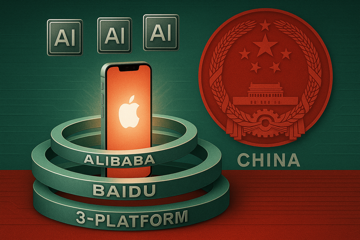
The CAAC approval turned China's AI race into a 3-platform contest - and Baidu's Kunlunxin $50B IPO is now the cleanest cross-border AI chip test of the cycle.
CNBC's Justina Lee reported on July 16, 2026 that Hong Kong-listed shares of Alibaba rose 5% and Baidu rose 4% after the Cyberspace Administration of China included Apple Intelligence on a list of seven approved AI service providers for iPhone users in China, alongside Huawei and homegrown AI models. The approval also clears the path for Baidu's AI chip unit Kunlunxin, which is targeting a Hong Kong IPO that could value the affiliate at $50 billion. The combined signal is that China's AI race is now a 3-platform contest - Alibaba (cloud + Qwen), Baidu (search + Ernie + Kunlunxin chips), and Huawei (Pangu + Ascend AI chips) - and the cross-border AI infrastructure trade is now anchored in the iPhone ecosystem.
The reason the timing matters more than a normal China-AI news cycle is that the CAAC approval is the first concrete regulatory greenlight for a U.S. consumer-tech company (Apple) to operate a U.S.-developed AI service (Apple Intelligence) in China. The approval is the first time a major U.S. tech company has cleared the CAAC regulatory bar for AI services, and the read-through is direct for every other U.S. consumer-tech company trying to re-enter the China market. The CAAC approval also means the China AI race is now a 3-platform contest with explicit regulatory backing - which means the cohort has institutional support that is independent of the U.S.-China policy swings.
For Apple, Baidu, Alibaba, Tencent, Huawei, and the broader China AI cohort, the read-through is direct. Apple gets a clean re-entry into the China market with a credible AI experience. Baidu gets the cleanest IPO catalyst of the year for its Kunlunxin AI chip unit. Alibaba gets the validation of the Qwen open-source strategy. Tencent is the natural next participant in the Apple Intelligence partnership. And Huawei gets the institutional backing of the CAAC approval for its Pangu AI and Ascend AI chip stack.
The trade that broke
The 'China AI is isolated from the iPhone stack' trade is being split into 'Alibaba is in, Baidu is in, Huawei is in' and 'the China-AI cohort is now a 3-platform race with regulatory backing'.
For most of 2024 and 2025, the playbook for China AI was that the cohort was isolated from the iPhone stack and the U.S. consumer-tech ecosystem. The CAAC regulatory bar was the binding constraint on Apple AI services, and the U.S. export-control regime was the binding constraint on Chinese AI chips. The CAAC approval breaks that framework: the Chinese AI race is now a 3-platform contest with explicit regulatory backing, and the read-through is direct for the entire China-AI cohort.
The first piece of the new framing is 'Alibaba is in, Baidu is in, Huawei is in.' The CAAC approval is explicit: Apple Intelligence, Huawei Pangu, and five other homegrown AI services are now on the approved list. Alibaba Qwen is the first Chinese AI model to land in the iPhone stack; Baidu is the next confirmed Apple partner; Huawei is the institutional backstop. The China-AI cohort is now structurally inside the iPhone ecosystem, and the read-through is direct for Tencent (the natural next partner) and every other Chinese AI company.
The second piece is 'the China-AI cohort is now a 3-platform race with regulatory backing.' The 3-platform structure is: Alibaba (cloud + Qwen + Apple partnership), Baidu (search + Ernie + Kunlunxin chips + Apple partnership), and Huawei (Pangu + Ascend AI chips + CAAC backing). Each platform has a distinct competitive moat: Alibaba has the cloud infrastructure and the open-source Qwen distribution; Baidu has the search distribution and the chip stack; Huawei has the chip infrastructure and the institutional backing. The 3-platform structure is the new regulatory floor for China AI - and the Baidu Kunlunxin $50B IPO is the cleanest single test of whether the regulatory floor translates to public-market valuation.
| Name | Ticker | CAAC 3-platform race read-through |
|---|---|---|
| Apple | AAPL | Reference: Apple Intelligence on the approved list; first U.S. consumer AI in China |
| Alibaba | BABA | Direct: Qwen in Apple Intelligence; HK +5% on the news |
| Baidu | BIDU | Direct: Apple partner; Kunlunxin $50B Hong Kong IPO target |
| Huawei | private | Direct: Pangu + Ascend on the approved list; institutional backstop |
| Tencent | 0700.HK | Indirect: natural next Apple Intelligence partner; Hunyuan model |
| Baidu Kunlunxin | private | Direct: $50B Hong Kong IPO target; AI chip unit of Baidu |
| Apple Intelligence | private | Reference: CAAC-approved; first U.S. consumer AI in China |
What the numbers say
BABA +5% HK, BIDU +4.28% HK, Kunlunxin $50B IPO target - the 3-platform China AI race is the cleanest cross-border infrastructure trade of the cycle.
Alibaba's Hong Kong-listed shares closed up 5% to HKD 119.30 on July 16, 2026 - the cleanest single signal that the Qwen-Apple Intelligence partnership is priced as a real revenue opportunity. The U.S.-listed ADR had already closed at $117.69 (+4.78%) the prior session, which means the marginal buyer was not fading the news into the close. The 5% HK move on the next session is a clean signal that the cross-border AI infrastructure trade is being repriced in real time.
Baidu's Hong Kong-listed shares rose 4.28% to HKD 112.10 on the news - the cleanest single read on the China-AI partnership template. The market is pricing Baidu's role in the Apple Intelligence partnership as a multi-year revenue opportunity, and the Kunlunxin IPO catalyst is layered on top. Kunlunxin is the AI chip unit of Baidu, and the Hong Kong IPO target of $50B is the cleanest single test of whether the China-AI-chip private-mark pricing holds in the public market.
The CAAC approval is the regulatory floor for the 3-platform race. The seven approved services - Apple Intelligence, Huawei Pangu, and five homegrown AI services - are the institutional anchors for the next phase of China AI development. The approval is also a clean signal that the Chinese government is willing to allow U.S. consumer-tech AI services to operate in China, which is the cleanest single read on the U.S.-China AI de-coupling thesis. The trade is no longer 'China AI is isolated'; it is 'China AI is a 3-platform race with regulatory backing and a $50B IPO catalyst.'
China AI 3-platform race: BABA, BIDU, and Huawei
Reference points from CNBC reporting on the July 16, 2026 CAAC approval and the Apple Intelligence partnership. The chart documents the HK moves, the IPO target, and the structural framework.
Unit: HKD / percent / USD billions
BABA HK close (HKD)
Up 5% on the CAAC approval; Qwen in Apple Intelligence
119.3
BABA HK move (%)
Cleanest single signal of cross-border AI infrastructure trade
5.2
BIDU HK close (HKD)
Up 4.28% on the Apple partnership news
112.1
BIDU HK move (%)
Multi-year revenue opportunity priced in
4.3
Kunlunxin IPO target ($B)
Baidu's AI chip unit; Hong Kong listing target
50
CAAC-approved services
7 smartphone-based AI services including Apple Intelligence
7
Why it matters
If Kunlunxin clears the $50B Hong Kong IPO, the China AI chip sector is the cleanest cross-border infrastructure trade - and the 3-platform race is the new regulatory floor.
The macro question underneath the CAAC approval is whether the 3-platform China AI race is the new institutional floor for the China-AI cohort. The post-2022 trade was that China AI was a structurally isolated sector; the CAAC approval breaks that framework. The 3-platform structure is now the institutional architecture: Alibaba for cloud + Qwen + Apple partnership, Baidu for search + Ernie + Kunlunxin chips, and Huawei for Pangu + Ascend AI chips. Each platform has distinct competitive moats and each has explicit regulatory backing. The 2028 Kunlunxin IPO is the cleanest single test of whether the regulatory floor translates to public-market valuation.
For Apple, the CAAC approval is the cleanest single read on the China re-entry. Apple's China revenue has been under pressure for several quarters; the Apple Intelligence partnership with Alibaba and Baidu is the path back into the China market with a credible AI experience. The deal also gives Apple a regulatory template for future China-AI partnerships - if the Qwen deal clears, the next round of Apple-China-AI deals is structurally easier.
For the broader market, the read-through is that the cross-border AI infrastructure trade is now anchored in the iPhone ecosystem. The Baidu Kunlunxin $50B IPO is the cleanest single test of whether the China-AI-chip private-mark pricing holds in the public market. A clean IPO at premium valuations validates the 3-platform structure; a discounted listing would reprice the entire China-AI-chip cohort. The 2026-2028 calendar is the binding window for the 3-platform race thesis.
- BABA HK +5%, BIDU HK +4.28% on July 16, 2026 after the CAAC approved Apple Intelligence for China users.
- CAAC approved 7 smartphone-based AI services including Apple Intelligence, Huawei Pangu, and 5 homegrown services.
- Baidu's AI chip unit Kunlunxin is targeting a Hong Kong IPO at $50B - the cleanest cross-border AI chip test of the cycle.
- 3-platform structure: Alibaba (cloud+Qwen+Apple), Baidu (search+Ernie+Kunlunxin), Huawei (Pangu+Ascend).
- Read-through: AAPL China re-entry; BIDU Kunlunxin IPO; BABA Qwen validation; Tencent next Apple partner.
What to watch
Watch the Kunlunxin IPO timing, Apple's China revenue next quarter, the Tencent follow-on, and the Huawei Ascend production.
The first tell is the Kunlunxin IPO timing. Baidu's AI chip unit is targeting a Hong Kong IPO at $50B; the timing of the S-1 filing is the first clean signal of the listing calendar. A 2027 S-1 means a 2027-2028 listing; a 2026 S-1 means an accelerated 2027 listing. Watch the corporate-governance steps (board structure, audit committee, financial reporting) as the first signal of the IPO preparation.
The second tell is Apple's China revenue in the next earnings release. The Qwen integration is a clean revenue uplift on a per-device basis; the next quarter's China segment will show whether the deal is converting to actual sales. A clean beat on China revenue is a re-rating catalyst; a flat print is a one-time PR event.
The third tell is the Tencent follow-on. If Tencent announces a similar Apple partnership within 60 days, the Qwen deal was the first of a cohort, not a one-time event. Tencent's Hunyuan model is the natural next Apple Intelligence partner. The fourth tell is the Huawei Ascend AI chip production cadence. Ascend is the institutional backstop for the China-AI-chip cohort; production milestones are the cleanest read on whether the institutional backing translates to commercial deployment.