%22%2F%3E%0A%20%20%3Ccircle%20cx%3D%22220%22%20cy%3D%22150%22%20r%3D%22180%22%20fill%3D%22%2322d3ee%22%20fill-opacity%3D%220.12%22%2F%3E%0A%20%20%3Ccircle%20cx%3D%221010%22%20cy%3D%22130%22%20r%3D%22220%22%20fill%3D%22%2338bdf8%22%20fill-opacity%3D%220.08%22%2F%3E%0A%20%20%3Ccircle%20cx%3D%22920%22%20cy%3D%22520%22%20r%3D%22170%22%20fill%3D%22%2322d3ee%22%20fill-opacity%3D%220.06%22%2F%3E%0A%20%20%3Cpath%20d%3D%22M140%20430h920%22%20stroke%3D%22url(%23line)%22%20stroke-width%3D%2212%22%20stroke-linecap%3D%22round%22%2F%3E%0A%20%20%3Cpath%20d%3D%22M220%20360c120-150%20260-220%20380-220s260%2070%20380%20220%22%20fill%3D%22none%22%20stroke%3D%22%2367e8f9%22%20stroke-opacity%3D%220.5%22%20stroke-width%3D%2216%22%20stroke-linecap%3D%22round%22%20stroke-linejoin%3D%22round%22%2F%3E%0A%20%20%3Cpath%20d%3D%22M300%20398h600%22%20stroke%3D%22%2394a3b8%22%20stroke-opacity%3D%220.24%22%20stroke-width%3D%228%22%20stroke-linecap%3D%22round%22%2F%3E%0A%20%20%3Ctext%20x%3D%22220%22%20y%3D%22510%22%20fill%3D%22%23e2e8f0%22%20fill-opacity%3D%220.7%22%20font-family%3D%22Arial%2C%20Helvetica%2C%20sans-serif%22%20font-size%3D%2238%22%20letter-spacing%3D%228%22%3EINSIGHTS%3C%2Ftext%3E%0A%3C%2Fsvg%3E)
Policy-to-market transmission
The meeting is less about safety, more about who gets first access to frontier model evaluation
The load-bearing fact is not that the White House wants “AI safety testing.” It’s who they brought in, and under what structure.
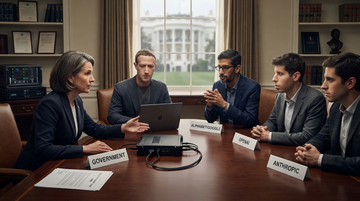
Reuters reports the Trump administration invited Meta, Anthropic, Google, and OpenAI to meet with White House officials to discuss “voluntary government safety testing.” The initiative is being operationalized via a June 2 executive order that explicitly contemplates a model-access window of up to 30 days before release to other trusted partners.
What the primary sources actually establish
Meeting participants (reported by Reuters)
Meta, Anthropic, OpenAI, Google
Invited to discuss voluntary government safety testing
Policy mechanism (from EO 14409)
Voluntary framework + access window
Up to 30 days of government access for “covered frontier models”
Test focus (from EO 14409)
AI cybersecurity capability benchmarking
A classified process to designate “covered frontier models”
Causal chain: policy design → incentives → market structure
Why this quietly “re-prices the frontier”: testing becomes a bargaining table over confidentiality
Frontier labs (like OpenAI and Anthropic) compete on capability and on what they keep proprietary. Incumbent public-platform firms (like Meta and Google) can tolerate disclosures better because their monetization is already distributed across huge deployment surfaces (ads, cloud, distribution).
The June 2 executive order is explicit that the government can receive access to covered models under confidentiality/IP/insider-risk protections and nondisclosure/use requirements for a period of up to 30 days. The White House sit-down—by directly coordinating the biggest model developers—raises the probability that “voluntary” testing evolves into a de-facto gate for speed-to-market, creating a new trade-off: faster access may cost optionality on disclosure.
- Voluntary testing shifts the first-mover advantage to the labs that can supply models under government terms without losing strategic secrecy.
- The confidentiality language in the EO reduces—but does not eliminate—disclosure risk; the remaining risk is about what gets compared, scored, and benchmarked.
- A classified “covered frontier model” threshold means results can concentrate decision power inside government benchmarking workflows, not public rulebooks.
Supply chain view: where economics can change first
A cyber-testing framework changes the procurement channel, not just the AI lab workflow
Even though this is framed as AI safety/cyber capability testing, the executive order is written as a whole-of-government cyber capability accelerator: DHS/CISA guidance, a Treasury-led “AI cybersecurity clearinghouse,” and a classified benchmarking process.
That matters for the AI supply chain because once government agencies start sharing vulnerability findings, prioritizing remediation, and coordinating patch distribution, downstream demand can tilt toward providers with the quickest integration path into those institutional processes—especially for defensive tools and evaluation pipelines. Put differently: testing governance can re-route near-term spending toward integration-ready vendors.
Frontier-facing platforms have large financial capacity to absorb compliance friction
Illustrative capacity: 2025 revenue scale for selected public platforms touched by the meeting (numbers from data tools).
Unit: USD
NVIDIA (proxy for AI infrastructure cycle)
Revenue in FY2025 (data-tool extraction)
130,497,000,000
Revenue in FY2025 (data-tool extraction)
200,966,000,000
Revenue in FY2025 (data-tool extraction)
402,963,000,000
Microsoft (baseline enterprise/cloud integrator)
Not tied to EO scope; included as a baseline integrator for enterprise compliance absorption (data-tool extraction was annual FY2025, but ensure consistency in a full model run)
200,966,000,000
Investor lens: who likely wins/loses from “voluntary but structured” testing
The winners aren’t necessarily the safest models—they’re the ones that can get evaluated without getting exposed
| Policy element | What it implies operationally | Transmission into company incentives |
|---|---|---|
| Voluntary framework with government access (up to 30 days) | Developers must negotiate access terms, timing, and handling rules | Frontier labs face a disclosure/optionality trade-off; incumbents can spread risk across product lines |
| Classified benchmarking process for AI cyber capabilities | A hidden threshold can determine “covered frontier model” status | Speed-to-market may depend on readiness for benchmarking workflows, not public-facing safety claims |
| DHS/CISA + Treasury “AI cybersecurity clearinghouse” coordination | Results can feed remediation prioritization and patch distribution | Defensive integration ecosystems become more valuable than purely generative model marketing |
Company fundamentals check (publicly listed channels)
Public platforms’ scale gives them compliance leverage—frontier labs must pay a different kind of cost
This is the core financial implication: public-platform economics can absorb compliance and coordination costs without jeopardizing quarterly runway, which makes them more likely to treat government testing as a negotiated process rather than a survivability constraint.
For private frontier labs, the cost function is different: time spent proving model safety can collide with their core strategic objective—keeping model internals and capability comparisons private. The mechanism is why a “safety” meeting can still re-price relative access and optionality for the frontier.
Horizons: what moves first vs. what changes later
Near-term: process signals; 1–3 years: governance could harden into a de facto gate
- Days–weeks: expect market narrative to focus on model access and benchmarking readiness; early guidance from agencies (DHS/Treasury/clearinghouse) can move sentiment on “who will comply fastest.” Speed-to-evaluation becomes a near-term catalyst.
- Quarters: pricing impact likely comes through customer-facing platforms (cloud/chat/agents) aligning releases with testing cycles rather than pure product iteration.
- 1–3 years: the hidden “covered frontier model” threshold can institutionalize government-mediated model gates, raising the bargaining power of the labs that can supply models with maximal confidentiality.
Research gaps (explicit)
What we could not verify from accessible primary sources in this run
Reuters access control prevented opening a Reuters litigation-hosted page for additional details. As a result, this article does not claim specifics on test metrics, reporting format, or whether any test results will be published.
Those items may exist in the operational guidance described by the executive order (binding operational directives/guidance), but they were not fully extractable here.
Listed stock takeaways from a frontier-testing governance shock
- Incumbent compliance advantage: can spread process costs over a $200.97B FY2025 revenue base (capacity to negotiate testing terms).
- If “voluntary” testing becomes a release gate, Meta’s time-to-launch may trade off against confidentiality risk (medium-term execution constraint).
- Downside hedge: public disclosures are already normalized, reducing the marginal effect of government benchmarking on strategic secrecy.
- Large FY2025 scale ($402.96B revenue) supports absorption of testing-driven coordination without near-term liquidity stress.
- If benchmarking defines “covered frontier” thresholds, Alphabet’s frontier access could become more cyclical (release timing tied to government workflows).
- Upside if confidentiality holds: government cyber validation can reduce friction for enterprise deployments (1–3 year integration benefit).
- Not named in the Reuters invitation in this run, but as an enterprise/cloud integrator, it is likely to be downstream of testing outcomes via customer model access policies (watch near-term rollout alignment).
- Over 1–3 years, cloud compliance stacks may incorporate EO-derived cyber benchmarking artifacts (needs operational guidance confirmation).
- If testing cycles modestly slow frontier releases, AI infrastructure demand could see timing distortions rather than demand destruction (watch quarters; no direct link from sources here).
- If testing accelerates defensive tool adoption, enterprise security workloads may rise, indirectly supporting capex cycles (mechanism is second-order; validate with procurement data).