%22%2F%3E%0A%20%20%3Ccircle%20cx%3D%22220%22%20cy%3D%22150%22%20r%3D%22180%22%20fill%3D%22%2322d3ee%22%20fill-opacity%3D%220.12%22%2F%3E%0A%20%20%3Ccircle%20cx%3D%221010%22%20cy%3D%22130%22%20r%3D%22220%22%20fill%3D%22%2338bdf8%22%20fill-opacity%3D%220.08%22%2F%3E%0A%20%20%3Ccircle%20cx%3D%22920%22%20cy%3D%22520%22%20r%3D%22170%22%20fill%3D%22%2322d3ee%22%20fill-opacity%3D%220.06%22%2F%3E%0A%20%20%3Cpath%20d%3D%22M140%20430h920%22%20stroke%3D%22url(%23line)%22%20stroke-width%3D%2212%22%20stroke-linecap%3D%22round%22%2F%3E%0A%20%20%3Cpath%20d%3D%22M220%20360c120-150%20260-220%20380-220s260%2070%20380%20220%22%20fill%3D%22none%22%20stroke%3D%22%2367e8f9%22%20stroke-opacity%3D%220.5%22%20stroke-width%3D%2216%22%20stroke-linecap%3D%22round%22%20stroke-linejoin%3D%22round%22%2F%3E%0A%20%20%3Cpath%20d%3D%22M300%20398h600%22%20stroke%3D%22%2394a3b8%22%20stroke-opacity%3D%220.24%22%20stroke-width%3D%228%22%20stroke-linecap%3D%22round%22%2F%3E%0A%20%20%3Ctext%20x%3D%22220%22%20y%3D%22510%22%20fill%3D%22%23e2e8f0%22%20fill-opacity%3D%220.7%22%20font-family%3D%22Arial%2C%20Helvetica%2C%20sans-serif%22%20font-size%3D%2238%22%20letter-spacing%3D%228%22%3EINSIGHTS%3C%2Ftext%3E%0A%3C%2Fsvg%3E)
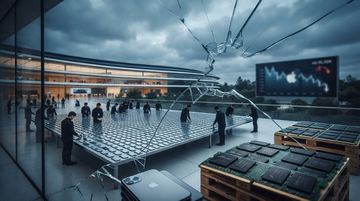
Apple one-day market-cap loss
~$500B
Shares fell ~9.7% intraday on July 31, 2026; worst single day since March 2020 (Reuters, NY Post).
Apple Q3 FY26 iPhone revenue
$54.25B
Record June quarter, up 22% YoY (Apple 10-Q filed Jul 31, 2026).
Apple Q4 FY26 revenue growth guide
9%–11%
Below Wall Street's ~12% consensus; 47%–48% gross margin guide (CNBC live blog).
Apple product gross margin (Q3 FY26)
40.1%
Up from 34.5% YoY but offset partially by memory inflation (Apple 10-Q).
DRAM LPDDR5X contract price (Q2 26)
+89% QoQ
Mobile-segment memory outpacing PC segment, which rose ~50% (TrendForce/Tweaktown).
Samsung MX division Q2 26
-$480M
First-ever operating loss; KRW 700B swing from KRW 2.8T profit in Q2 2025 (Samsung Q2 release).
Event
The first record quarter where memory showed up as a supply shock, not just a cost line
Apple reported fiscal Q3 2026 revenue of $109.4 billion (up 16% YoY) and diluted EPS of $2.02 — both June-quarter records — yet the stock fell as much as 9.7% intraday on July 31, 2026, erasing roughly $475–500 billion of market value in its worst single-day move since the March 2020 pandemic selloff. iPhone revenue hit an all-time June-quarter high of $54.25 billion, up 22% YoY, with China sales jumping 22% to $18.82B. The print was not the problem; the September-quarter guide was. Apple guided 9%–11% growth and 47%–48% gross margin, missing the ~12% consensus, with management explicitly blaming 'supply constraints' and memory costs that 'will continue to increase beyond September.'
Mechanism
Why the memory crunch is a supply shock and a margin shock at the same time
AI data centers now consume ~50% of global DRAM output (vs. ~32% five years ago, per Bloomberg), and HBM wafer-equivalent demand eats capacity that would otherwise flow to LPDDR5X and DDR5. Apple, Samsung Mobile, and PC OEMs sit at the back of that queue. TrendForce tracked LPDDR5X contract prices up 89% QoQ in Q2 2026, with conventional DRAM contract prices set to rise another 13%–18% in Q3. The same supply tightness that lifted Micron gross margin to ~56% and Samsung DS division operating profit to KRW 89.2 trillion is the force compressing consumer-device bill-of-materials — memory alone now runs ~35% of PC BOM versus 15–18% a year ago, per HP's filings.
| Metric | Memory sellers (beneficiaries) | Consumer hardware (victims) |
|---|---|---|
| Gross margin direction | Micron ~56% TTM; Samsung DS op profit KRW 89.2T (+89% QoQ) | Apple product GM held via tariff refund + inventory; Samsung MX posts first-ever operating loss |
| Pricing power | Long-term contracts; SK Hynix removed price cap on LTAs in 2H26 | Apple raised Mac/iPad/Vision Pro $150–$300; Dell raised 15–20% in Dec 2025; Sony PS5 now $649 |
| Volume signal | Sold out of HBM through 2026; consumer DRAM rationed | IDC: PC shipments −10.4%, smartphones −8.4% in 2026; Gartner: sub-$500 laptops 'unviable' |
| Capex posture | Micron $9.3B Idaho fab (output Q3 2028); Samsung/SK expanding HBM4 lines | Dell/Lenovo/HP pulling forward price hikes; Gartner flags further PC contraction |
Apple is now caught between two margins at once: Tim Cook said on the call that he expects 'memory prices will continue to increase beyond September' and that even paying more will not be enough to clear the line. Q3 product gross margin of 40.1% (vs. 34.5% YoY) hides a sequential 230-bp dip that Morningstar attributes to memory inflation; another ~250-bp September-quarter drop is the consensus expectation, with a 200-bp 2027 headwind baked into Wall Street models. The company has absorbed the hit so far with tariff refunds and inventory positioning. That cushion runs out.
Supply chain
Upstream winners and downstream victims — the chain is splitting
On the upstream side, Micron, SK Hynix, and Samsung are extracting pricing power for the first time in a decade. Samsung just posted an all-time-high Memory quarterly revenue and operating profit; Micron's trailing gross margin of ~72.6% and operating margin of ~65.9% reflect HBM-led mix shift. Both are pushing multi-year LTAs and removing pricing caps. The bottleneck at Apple is therefore not just 'higher prices' — it is allocation. Tim Cook's 'hundred-year flood' phrasing, lifted from a pre-call WSJ interview, signals that even Apple's bargaining leverage is being outbid by hyperscaler demand from Nvidia, Microsoft, Amazon, and Meta, who have pre-booked premium capacity through 2026.
On the downstream side, the playbook Apple is following — accept supply rationing, push selective price hikes, defend hardware margin — is now visibly breaking for less-leveraged buyers. Samsung's MX division posted its first-ever operating loss in Q2 2026 (KRW 700B, ~$480M) on Galaxy S26 strength, because it both makes and consumes memory — the chip arm profits, the phone arm loses. HP trimmed the high end of FY26 EPS guidance to $2.90–$3.10 even after a Q2 beat; Dell raised prices 15–20% in December 2025 and saw Q2 FY26 revenue up 19% but PC gross margins compressed. Sony's PS5 has been hiked twice in 2026 to $649; Steam Machine launched at $1,049 (vs. internal $700–800 target) and Xbox Series X jumps to $799.99 on August 1.
- Memory is now ~35% of PC BOM, up from 15–18% a year ago (HP disclosed in Q2 FY26 earnings).
- Conventional DRAM contract prices up 13%–18% QoQ in Q3 2026; NAND contract prices up 10%–15% QoQ (TrendForce).
- 32GB DDR5 kits rose from ~$200 in 2025 to $400+ in mid-2026 on Newegg; LPDDR5X up 89% QoQ in Q2.
- Gartner expects 2026 PC shipments down 10–11%, smartphones down 8–9%; IDC cuts consumer PC forecast to −10.4%.
Fundamentals
Apple's numbers look fine — that is exactly why the guide matters
Strip out the noise and Apple's reported quarter is the strongest June print in its history: total revenue +16% YoY, Services +12% to $30.74B (a record), iPhone +22%, Mac +29%. Net income of $29.79B beat by ~27%. The problem is in the September-quarter setup: revenue growth guided at 9%–11% versus ~12% consensus, gross margin 47%–48% versus prior ~49–50%, with explicit supply-constraint and FX (~2.5pp drag) headwinds. The 'record quarter plus soft guide' combination is what the tape punished — not because earnings are weak, but because the gap between record demand and constrained supply has widened to a point investors no longer assume Apple can will through it with timing and channel fills.
Apple FY26 segment revenue trajectory — iPhone carries the offset while Mac/Mac growth cools
FY24–FY26 from Apple 10-K and 10-Q filings.
Unit: $B
FY24 total
$391.0B
391
FY25 total
$416.2B, +6.5%
416.2
FY26 TTM (Jun)
$466.8B, +12.2%
466.8
Q3 FY26 iPhone
$54.25B, +22% YoY
54.3
Q3 FY26 Mac
$10.35B, +29% YoY
10.4
Q3 FY26 Services
$30.74B, +12% YoY
30.7
Margins are the real story. Q3 product gross margin printed at 40.1% — a ~560 bp YoY gain — but Morningstar's analysis strips out ~230 bp of sequential memory-driven compression and warns of another ~250 bp coming in the September quarter. With Services (the highest-margin line) growing only 12% versus iPhone's 22%, the mix shift toward lower-margin memory-constrained hardware is exactly what Apple's pricing power is supposed to defend against. Apple has, so far. The guide says that defense is running out of ammo.
Horizons
Short-term: who moves on the September print. Long-term: when the flood recedes
Over the next two quarters, the central question is whether Apple breaks ranks on iPhone pricing in September (IDC already expects iPhone 18 Pro hikes above $300) and whether Samsung's MX division can claw back operating profit once memory allocations rebalance. HP's H2 will be the cleanest read on consumer-PC margin compression — its Q3 report lands in late August. Dell's Q2 FY27 print in late August should test whether AI-server strength ($24.4B in Q1 FY27 orders, $51.3B AI backlog) can subsidize the consumer-PC drag, or whether the broader cost push finally cracks server margins too. Watch SK Hynix' Q2 print (July 30 results flagged a miss on estimates despite records) — the market is no longer pricing DRAM sellers as a single trade, and HBM4 share dynamics are starting to bifurcate returns.
Over 1–3 years, the supply side has a path: Micron's Idaho fab adds meaningful output in Q3 2028; Samsung/SK HBM4 lines scale; CXMT and other Chinese DRAM capacity comes online. Kearney's base case is that the shortage persists into 2028 with possible full recovery only by 2030. AMD has publicly flagged DDR5 pricing staying elevated until ~2028. That means consumer-device OEM margins stay structurally pressured through at least FY27, the back half of the replacement cycle is materially distorted, and pricing power on flagship hardware is no longer optional — it is the only lever to defend margins. Long-run, Apple's replacement-cycle economics are now a function of whether AI demand absorbs the next DRAM wafer cycle or whether new fab capacity finally restores supply elasticity in 2028.
Investable read-throughs from Cook's last report
- Q4 FY26 guide of 9%–11% growth and 47%–48% gross margin locks in 230–250 bp of memory-driven margin compression for the September quarter; ~200 bp 2027 headwind still in consensus models.
- iPhone unit economics now hinge on whether Apple raises iPhone 18 Pro prices above $300 in September — pricing-power test on a category where Apple has historically held line.
- 10-Q now lists NAND/DRAM supply imbalance as a material risk factor; Broadcom custom-silicon and TSMC fab allocation cannot offset memory rationing.
- TTM gross margin ~72.6% and operating margin ~65.9% show HBM-led mix shift pricing in the crunch; Micron sold out HBM through 2026 with hyperscaler LTAs.
- $9.3B Idaho fab (output Q3 2028) anchors the long-cycle argument that supply stays tight into 2028 — exactly the horizon Cook flagged.
- Near-term: stock pulled back ~3.5% in the print day despite strong TTM; the trough is the entry if DRAM contract prices hold the 13%–18% Q3 path.
- HBM leader, removed price caps on long-term agreements in 2H26 — the strongest oligopoly pricing-power read of the three.
- Q2 2026 results missed consensus despite record quarterly revenue and operating profit — near-term set-up is a fade after the run, not a buy.
- Multi-year HBM4 lock-ins with Nvidia/Microsoft protect the franchise but cap upside as Samsung recovers share.
- DS/Memory arm: KRW 89.2T operating profit on KRW 127.5T revenue — the clearest single-firm beneficiary of the flood.
- MX/Mobile arm: first-ever operating loss (KRW 700B, ~$480M) on Galaxy S26 strength — proves even Samsung cannot escape the bill-of-materials hit.
- Conglomerate net effect depends on which segment grows faster; near-term the memory arm overwhelms, but mobile fixes require a fall 2026 iPhone-cycle read.
- Memory now ~35% of PC BOM, up from 15–18% YoY — HP explicitly cut FY26 EPS range to $2.90–$3.10 from $3.20 top.
- PC shipment declines (IDC: −10.4% in 2026) layer on top of mix-down to entry SKUs; margin defense via AI-PC mix shift is real but partial.
- Near-term: Q3 FY26 print (late August) is the next test of whether tariff-and-pricing actions can offset BOM inflation.
- Q1 FY27 AI server orders $24.4B, AI backlog $51.3B — Dell is the best-positioned OEM to subsidize PC margin compression from server strength.
- Raised AI server FY27 guide to ~$60B from $50B; raised PC prices 15–20% in Dec 2025 — pass-through is working for now.
- Risk: if DRAM rationing spreads to server-class memory (long-term concern), Dell's PC + server segment margins converge to compressed consumer-OEM economics.
- PS5 hiked twice in 2026 to $649; PS5 Pro held at $699.99 — pass-through capacity running out of room above $700.
- Valve Steam Machine launched at $1,049 vs. internal $700–800 target — benchmark for the ceiling on memory-heavy gaming hardware in 2026.
- Sony Q2 FY26 (late July/Aug print) will show whether content/segment strength can offset hardware gross-margin compression on PS5/Switch 2/Xbox.
- Raised PC prices from January 2026; memory inflation + IDC −10.4% 2026 PC shipment forecast compress Lenovo's volume-plus-margin thesis.
- Server/AI segment provides a partial hedge (similar to Dell), but Lenovo is more PC-skewed than Dell.
- Near-term catalyst: H1 FY27 results in November will show whether the China OEM playbook absorbs the BOM shock better than HP/Dell.