%22%2F%3E%0A%20%20%3Ccircle%20cx%3D%22220%22%20cy%3D%22150%22%20r%3D%22180%22%20fill%3D%22%2322d3ee%22%20fill-opacity%3D%220.12%22%2F%3E%0A%20%20%3Ccircle%20cx%3D%221010%22%20cy%3D%22130%22%20r%3D%22220%22%20fill%3D%22%2338bdf8%22%20fill-opacity%3D%220.08%22%2F%3E%0A%20%20%3Ccircle%20cx%3D%22920%22%20cy%3D%22520%22%20r%3D%22170%22%20fill%3D%22%2322d3ee%22%20fill-opacity%3D%220.06%22%2F%3E%0A%20%20%3Cpath%20d%3D%22M140%20430h920%22%20stroke%3D%22url(%23line)%22%20stroke-width%3D%2212%22%20stroke-linecap%3D%22round%22%2F%3E%0A%20%20%3Cpath%20d%3D%22M220%20360c120-150%20260-220%20380-220s260%2070%20380%20220%22%20fill%3D%22none%22%20stroke%3D%22%2367e8f9%22%20stroke-opacity%3D%220.5%22%20stroke-width%3D%2216%22%20stroke-linecap%3D%22round%22%20stroke-linejoin%3D%22round%22%2F%3E%0A%20%20%3Cpath%20d%3D%22M300%20398h600%22%20stroke%3D%22%2394a3b8%22%20stroke-opacity%3D%220.24%22%20stroke-width%3D%228%22%20stroke-linecap%3D%22round%22%2F%3E%0A%20%20%3Ctext%20x%3D%22220%22%20y%3D%22510%22%20fill%3D%22%23e2e8f0%22%20fill-opacity%3D%220.7%22%20font-family%3D%22Arial%2C%20Helvetica%2C%20sans-serif%22%20font-size%3D%2238%22%20letter-spacing%3D%228%22%3EINSIGHTS%3C%2Ftext%3E%0A%3C%2Fsvg%3E)
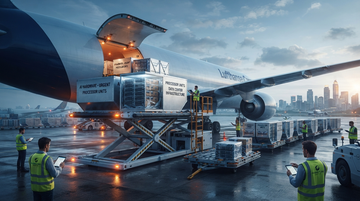
The traditional story for air cargo has been e-commerce: more parcels, more frequency, more incremental tonnage. But the supply-chain reality is changing: the highest urgency part of the AI value chain is physical hardware (chips, memory, servers, networking gear) that must hit commissioning windows. That changes who values capacity and how pricing power is exercised.
The key question for investors is not “is AI increasing air demand?” It’s who benefits when air capacity turns into a scarce, time-slot allocation problem—and which public companies actually sit at the chokepoints between chip/server exporters and U.S. and allied distribution.
Verified market signal
Air cargo is already central to AI goods—so capacity scarcity has moved from parcels to platforms
IATA reports that air cargo transported more than two-thirds of global AI-related goods in 2025. That statistic matters because it directly links AI hardware (not just digital services) to air freight as the physical transport mode.
If AI-related goods are largely airlifted, then the relevant supply-chain question becomes: where is capacity constrained (aircraft/crew/airspace/ground-handling/slot availability), and who can contract for it in advance.
Share of AI-related goods moved by air (2025)
> 2/3
Per IATA press release covering air cargo’s role in AI-related goods
What changed versus the e-commerce air-cargo playbook?
E-commerce parcel demand
Dispersed, forecastable by SKU
Valuation tends to be volume-led.
AI hardware demand
Dense, schedule-constrained by commissioning
Valuation tends to be capacity and timing-led.
Investor implication
Capacity control can matter more than total tonnage
Contracts, network flexibility, and slot/route economics matter.
Causal chain: chips -> servers -> air lanes -> airlines/forwarders
Dense AI hardware compresses tolerance for delays, so shippers pay for “reachable capacity”
- AI infrastructure procurement creates “build/commission windows,” so shippers prefer reliability and lead-time certainty over pure rate shopping.
- That shifts bargaining power toward carriers/forwarders that can secure capacity on constrained lanes before peak demand crystallizes.
- Freighter utilization and airport/handling throughput become the functional bottleneck, turning air cargo into a yield-management exercise rather than a logistics flow.
- Upstream components (memory and networking) can further concentrate demand in specific manufacturing-to-assembly corridors, reinforcing lane-level scarcity.
Where the supply chain turns into identifiable public-company exposures
Mapping the air-cargo chain to public tickers: semis (manufacturing pull), logistics (execution pull), aircraft (capacity supply)
To keep this grounded and investable, we connect the air-cargo mode shift to three publicly observable layers:
1) Upstream semiconductor manufacturing that supplies the physical AI bill of materials. 2) Logistics operators that monetize speed/reliability with premium services. 3) Aircraft OEMs / capacity supply where longer-cycle constraints can tighten the medium-term air capacity backdrop.
We do not claim any single company “controls” air cargo; instead, we show which listed names are plausible beneficiaries of a world where AI hardware demand is carried disproportionately by air.
| Layer | Why it matters for AI air-cargo scarcity | Public market proxy used here |
|---|---|---|
| Semiconductor exporters | AI hardware bill-of-materials (chips/memory) must physically move to server supply chains; air is disproportionately used for AI-related goods | SK Hynix, NVIDIA, Micron Technology |
| Express/air logistics execution | Premium services monetize the willingness-to-pay for reliability when air capacity is tight | FedEx |
| Aircraft capacity supply (long-cycle) | Freighter/commercial aircraft availability is a medium-term constraint backdrop for capacity economics | Boeing |
Data center build is physical—and the financials reflect demand concentration in semis and execution in logistics
Semiconductors and logistics operators show margin and cash-generation profiles consistent with “premium inputs” demand
Because we don’t have lane-level pricing data in the provided sources, we use listed-company fundamentals as a consistency check for the direction of travel.
For example, NVIDIA shows a high operating margin profile in the latest-taken financial snapshots (operating profit margin given by the data tools), consistent with AI platform demand being valuable enough to support premium supply chains. SK Hynix is highly profitable in its latest-taken snapshot as well, consistent with AI memory demand translating into financial strength. For logistics, FedEx has lower margins than semis, but it is a relevant proxy for capturing service revenue when air/express segments are in favor.
What could be captured as “scarcity premium” in practice
The scarcity premium likely shows up as contracted capacity + service mix, not just higher volumes
- Contracting shifts from ad-hoc e-commerce shipment patterns toward capacity reservation for dense AI hardware lanes, which supports better utilization discipline for logistics networks.
- Service mix changes: more shipments that require air speed/reliability likely move into premium tiers even if total air tonnage growth is modest.
- Ground-handling and customs workflows can become gating steps; operators who reduce “time exposed” for high-value hardware can earn a larger share of logistics revenue.
- If aircraft delivery cycles don’t keep pace, longer replacement/expansion timing makes near-term capacity economics more convex—so winners are those with network flexibility and pricing power.
In the air-cargo economy, the scarcity premium is typically captured by entities that can do two things well: (1) secure capacity before it is tight, and (2) convert that capacity into billable reliability and lead-time.
That’s why the investable set is less about “who ships the most” and more about who can keep shipments on schedule when capacity is constrained.
Horizons: what moves first vs. what compounds
Short-term (quarters): lane tightness and premium service mix; long-term (1–3 years): capacity cycles and AI procurement concentration
Short-term, the first observable effects are usually operational: more premium bookings, stronger yield management behavior, and tighter scheduling in the corridors feeding data-center buildouts.
Long-term, the compounding effect comes from procurement concentration: as AI build cycles repeat and as server rack footprints scale, airlift dependence for AI-related goods persists—so the system stays structurally capacity-sensitive.
Related listed stocks (verified) and how AI-driven air-cargo scarcity can hit them
- AI hardware demand keeps memory-intensive systems shipping by air; supports the revenue/margin base reflected in SK Hynix latest snapshot profitability.
- If capacity constraints persist, chip export cycles can stay schedule-critical; tends to reward suppliers with operational scale over smaller competitors.
- In 1–3 years, continued AI server build plans can sustain premium logistics throughput; reduces cyclicality risk versus “just e-commerce” demand.
- Air cargo is the mode for >2/3 of AI-related goods (IATA); aligns AI platform physical distribution with tight air capacity that favors high-value shipments.
- The latest-taken snapshot shows 64% operating margin, implying strong economics that can absorb logistics cost inflation.
- In days–quarters, premium air service mix can protect delivery SLAs for customers; reduces risk of delayed deployments relative to lower-margin competitors.
- AI server demand relies on memory supply chains that are air-shipped disproportionately for AI-related goods; supports steady high-speed component demand.
- In the latest snapshot, operating margin is 65.8%, consistent with premium input pricing that can tolerate higher transport costs.
- Over 1–3 years, sustained AI infrastructure build cycles can keep “time sensitive” logistics relevant; supports share gains for suppliers able to ship at scale.
- As air cargo capacity tightens for AI hardware, shippers shift to reliability-led services; can lift express/air-related service mix for FedEx.
- Latest snapshot shows 11.1% operating margin; that limits upside from logistics scarcity if costs rise faster than pricing.
- In days–quarters, premium pricing may be partially offset by network congestion and fuel/handling costs; creates a narrower spread than in semis.
- Air capacity scarcity has a medium-term supply side; if delivery/availability of aircraft remains constrained, supports higher value of capacity across the cycle.
- Latest-taken snapshot shows negative operating profit margin, so near-term financial capture is uncertain.
- In 1–3 years, freighter/commercial build and conversion timelines could affect capacity economics; depends on execution progress more than demand.