Latest
The day's market news, with the argument attached
New notes every trading day on earnings, policy and market structure. Each one opens with the conclusion, then the evidence, then the companies it hits.
2026-08-21
%22%2F%3E%0A%20%20%3Ccircle%20cx%3D%22220%22%20cy%3D%22150%22%20r%3D%22180%22%20fill%3D%22%2322d3ee%22%20fill-opacity%3D%220.12%22%2F%3E%0A%20%20%3Ccircle%20cx%3D%221010%22%20cy%3D%22130%22%20r%3D%22220%22%20fill%3D%22%2338bdf8%22%20fill-opacity%3D%220.08%22%2F%3E%0A%20%20%3Ccircle%20cx%3D%22920%22%20cy%3D%22520%22%20r%3D%22170%22%20fill%3D%22%2322d3ee%22%20fill-opacity%3D%220.06%22%2F%3E%0A%20%20%3Cpath%20d%3D%22M140%20430h920%22%20stroke%3D%22url(%23line)%22%20stroke-width%3D%2212%22%20stroke-linecap%3D%22round%22%2F%3E%0A%20%20%3Cpath%20d%3D%22M220%20360c120-150%20260-220%20380-220s260%2070%20380%20220%22%20fill%3D%22none%22%20stroke%3D%22%2367e8f9%22%20stroke-opacity%3D%220.5%22%20stroke-width%3D%2216%22%20stroke-linecap%3D%22round%22%20stroke-linejoin%3D%22round%22%2F%3E%0A%20%20%3Cpath%20d%3D%22M300%20398h600%22%20stroke%3D%22%2394a3b8%22%20stroke-opacity%3D%220.24%22%20stroke-width%3D%228%22%20stroke-linecap%3D%22round%22%2F%3E%0A%20%20%3Ctext%20x%3D%22220%22%20y%3D%22510%22%20fill%3D%22%23e2e8f0%22%20fill-opacity%3D%220.7%22%20font-family%3D%22Arial%2C%20Helvetica%2C%20sans-serif%22%20font-size%3D%2238%22%20letter-spacing%3D%228%22%3EINSIGHTS%3C%2Ftext%3E%0A%3C%2Fsvg%3E)

Ross Stores' full-year raise arrives as U.S. retail sales dip—off-price trade-down is holding better than headline demand
Ross Stores lifted FY2026 earnings and same-store sales guidance after reporting strong Q1 results, pointing to demand that’s more “traffic-led” than recession-led. With U.S. retail sales falling in July for the first time in nine months, the raise is a real-time read-through that consumers aren’t stopping shopping—they’re trading into off-price assortments and Ross’s inventory turn discipline.

Starcloud’s $170M orbital data-center raise reframes the AI “power wall” as a launch-supply problem
Starcloud’s $170M Series A to build data centers in low Earth orbit leans on a simple thesis: the bottleneck is getting power and heat out—not buying more GPUs. The funding also spotlights a second constraint: as AI shifts to space-based capacity, near-term deployment speed hinges on launch availability and satellite production throughput.

Uber’s €825M Dutch fine turns “algorithmic suspensions” into a balance-sheet liability
The Netherlands’ data regulator (AP) fined Uber €825 million for suspending drivers through automated decisions without adequate driver information and safeguards. With Uber’s 2025 revenue at $52.0B, the fine sizes up to ~1.6% of annual revenue—an order of magnitude large enough to change how platform labor-risk is budgeted across Europe and beyond.

US services flashed back to acceleration—turning the September Fed-cut bet into a growth-versus-inflation tug-of-war
S&P Global’s August flash PMI shows US services business activity re-accelerating to a 20-month high, while manufacturing stays in “soft” territory. That mix matters for Fed timing: it supports growth momentum, but it also raises the odds that services inflation stays sticky enough to delay rate-cut confidence even if the headline inflation trend continues to cool.

YMTC’s $4.9B Shanghai IPO turns into a NAND capacity lever — and it puts SanDisk’s “floor pricing” thesis on trial
YMTC’s parent is progressing toward a Shanghai STAR Market IPO, targeting roughly $4.9B, to fund a NAND buildout that—by company-reported planning—could reach ~300,000 wafers/month across three lines by 2026. That matters for the pricing-battle thesis because SanDisk’s reported backlog strategy is built around sustaining floor-like economics through the cycle; any step-change in supply intensity raises the probability that those floors get tested in negotiations, even if demand remains strong.
2026-08-20

Amazon gives Alexa+ away on Fire TV—an AI pricing pivot from subscriptions to device-and-ads monetization
Amazon is rolling out its AI-powered Alexa+ for free on compatible Fire TV devices in the U.S., without Prime and without any app or subscription activation. The move reframes the AI assistant debate: winning the user funnel can matter more than charging for the model access up front—especially when monetization shifts to shopping and advertising in Amazon’s retail media ecosystem.

Citi, HSBC and Standard Chartered plug Ant International’s FX-AI into liquidity risk—turning “forecasting” into market plumbing
Three global banks agreed to deploy Ant International’s upgraded FalconTST 2.0 model to manage foreign-exchange liquidity risk, signaling AI is moving from FX desk “assist” tools into the treasury systems that decide how much risk banks can safely carry. The investment implication is less about AI hype and more about who controls the forecasting layer—because that layer directly influences hedging and liquidity cost, and it raises real questions about model governance, data provenance, and regulatory comfort in Western bank workflows.

Australia just turned “pay for news” into a levy that prices Meta/Google ad economics—and may become the playbook for the U.S. Journalism Competition fight
Australia’s “News Bargaining Incentive” statutory levy turns news licensing from a negotiated transfer into a recurring cost line for large online platforms—creating an explicit pricing benchmark. The same mechanics explain why the U.S. Journalism Competition & Preservation Act is increasingly viewed as an international “template,” because it could operationalize a comparable bargaining-and-compensation regime.

Binance’s AI-agent trading is here—and the hard part is compliance, not code
Binance has expanded its Binance AI Agent Skills so agents can place, modify, and cancel orders, including in derivatives and margin contexts. The company describes “risk-aware” protections, but the key compliance principle is still user-driven permissions and approvals—turning today’s functionality into tomorrow’s liability question for exchanges, broker-dealers, and regulators.

Brent clearing $94 snaps the “oil fade” setup—and makes September rate math run through the P&L, not the dot plot
Brent pushed above $94 on Aug. 20, ending a multi-session run that had kept traders leaning on the idea of an $85 “fade.” The oil regime break matters for Fed odds because it quickly tightens near-term inflation and risk-premium assumptions, while also feeding directly into fuel-sensitive earnings.

The CFTC’s Compute-Derivatives Opening Turns GPU Capacity Into a Hedgeable “Pricing Primitive”
The CFTC’s Aug. 19, 2026 request for comment is the first real regulatory nudge toward compute futures—contracts whose value tracks AI computing capacity costs. If compute pricing becomes tradable, it can let hyperscalers, data-center operators, and market makers shift utilization risk from long-dated capex into hedgeable cash flows—changing how investors price the AI buildout.

China’s Bond Market Is Refusing to Diversify—Until It Might Suddenly Do the Job for Global Investors
When global yields rise on inflation and fiscal pressure, China’s bond market has been moving in the opposite direction, widening the China–U.S. 10-year yield gap again. That divergence matters because it determines whether foreign allocators keep treating long-duration U.S. Treasuries as the default “safety” trade—or start paying for China duration as the actual diversifier.
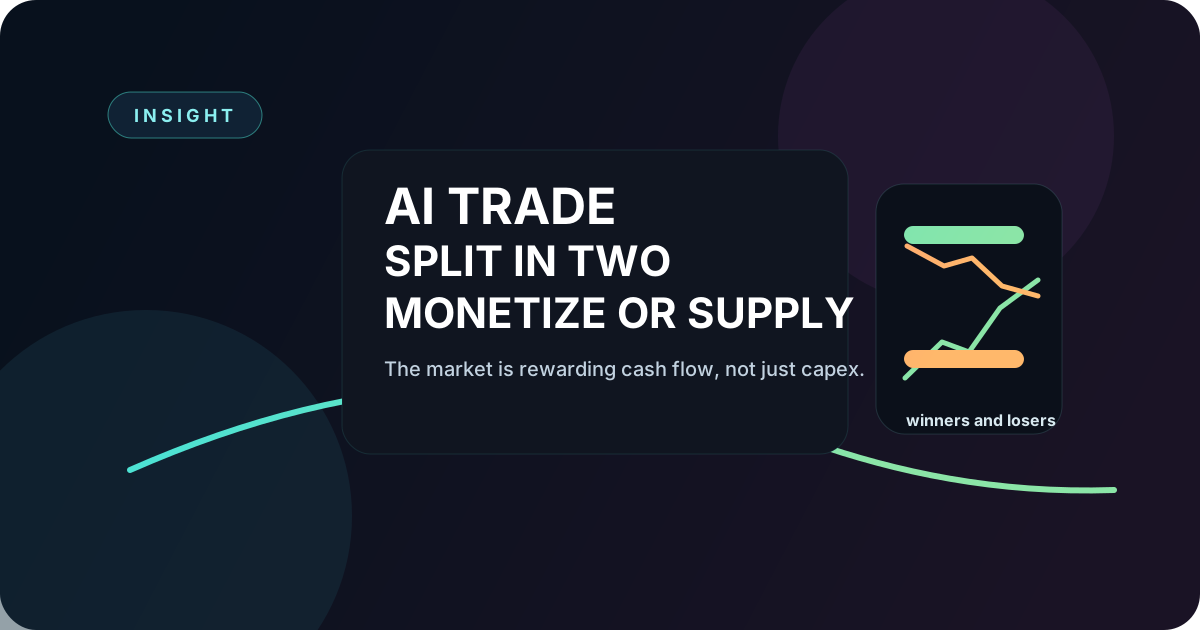
Citi’s dollar call is really an equity-flow warning: buyback policy can switch off USD demand
Citi’s Aug. 20 structural downgrade to the dollar ties the next leg of FX risk to a policy-controlled US buyback channel rather than a pure Fed timing story. If Washington tightens or constrains corporate buybacks, the biggest immediate transmission line runs through US equities—changing how global investors fund USD exposure and hedging demand.

After the $1T crypto flush, ETH leads a “melt-up”—and the real test is whether regulation headlines now beat ETF flows
The rebound day shows ETH outgaining BTC and majors, a pattern that only looks like “flow regime” improvement if shorts are repairing faster than ETFs are withdrawing. On Aug. 18, 2026 the SEC proposed “Regulation Crypto Assets,” proposing fit-for-purpose offering exemptions and an investment-contract safe harbor—setting the stage for a catalyst that can trigger positioning and short-covering beyond spot ETF flows.

Deere’s Construction Profit Turn Signals an “AI Earthmoving” Switch—And the Next Bottleneck Won’t Be Chips, It’ll Be Jobsite Capacity
Deere reported its first Construction & Forestry profit expansion in years and raised FY2026 net income guidance to $4.5B–$5.0B. The implication is simple: data-center capex is migrating from steel-and-glass planning into real earthmoving, turning heavy equipment into a jobsite throughput constraint rather than a software bottleneck.
Trump’s FDA pick Overton turns therapy-class FDA odds into a portfolio bet: psychedelics & non-opioid pain up, vaccines down
Heidi Overton’s nomination is being read by sell-side analysts as a cross-therapeutic shift in how FDA leadership signals risk tolerance—supportive for psychedelic and non-opioid pain programs, but less friendly for vaccines. The investors’ problem is that this “repricing by class” can move approval timelines without yet proving which platform companies actually monetize first.
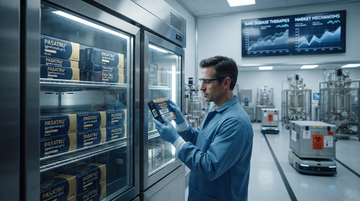
Regeneron's Pasatru turns an ultra-rare bone disease into an FDA pricing stress test—proof that sub-10,000-patient markets can still clear and fund premium drug economics
Regeneron won FDA approval for Pasatru (garetosmab-grts) in adults with fibrodysplasia ossificans progressiva (FOP) on Aug. 19, 2026, backed by OPTIMA results showing large lesion reductions at 56 weeks. The approval matters to investors because it spotlights whether ultra-orphan demand signals and list-price frameworks can support high-cost biologic commercialization even when the eligible population is extremely small.

Franklin Templeton builds a custody/transfer bridge that turns RWA tokens into 40-Act fund shares
Franklin Templeton’s Aug. 12, 2026 SEC no-action path for its [Franklin OnChain U.S. Government Money Fund] hinges less on tokenization optics and more on custody-grade transfer-agent recordkeeping. The practical result: tokenized ownership can be routed through the same “official shareholder record” logic used in traditional mutual-fund servicing—shifting value capture toward transfer agents, custody controls, and fund administrators that run the new on-chain workflow.

FTC’s personalized-pricing disclosure push would turn “price-discrimination math” into customer-facing notices—raising compliance costs across the consumer stack
The FTC is seeking public comment on an enforcement-policy approach that would require clearer disclosure when businesses use personalized, data-driven methods to set prices. For investors, the key risk is not just reputational: disclosure can weaken willingness-to-pay extraction, expose discounting logic, and force product, data, and checkout redesign across retail, travel, subscriptions, and consumer fintech.

Goodyear is trying to defend US tire profitability by moving upmarket—yet its own Q2 shows premium mix can’t fully offset volume and price/product mix pressure
Goodyear is positioning premium EV and luxury-SUV tires as a higher-ASP line of defense against Chinese import share. In its latest filings, however, Americas replacement volume fell 13% in Q2 2026 and price/product mix subtracted $26M of operating income—meaning tariff and mix dynamics still have the power to overwhelm the strategy.
What to expect
Evidence-first notes with a visible point of view.
This section collects sharp takes on earnings, shareholder meetings, and market structure. Each new piece should make the thesis, the facts, and the implications obvious within the first few screens.
Expect direct analysis, not generic commentary.
Expect the data to be explicit and the argument to be easy to follow.
Plutux is not an investment adviser. Market data and AI-generated analysis are for information and education only, not investment advice. Disclaimer