%22%2F%3E%0A%20%20%3Ccircle%20cx%3D%22220%22%20cy%3D%22150%22%20r%3D%22180%22%20fill%3D%22%2322d3ee%22%20fill-opacity%3D%220.12%22%2F%3E%0A%20%20%3Ccircle%20cx%3D%221010%22%20cy%3D%22130%22%20r%3D%22220%22%20fill%3D%22%2338bdf8%22%20fill-opacity%3D%220.08%22%2F%3E%0A%20%20%3Ccircle%20cx%3D%22920%22%20cy%3D%22520%22%20r%3D%22170%22%20fill%3D%22%2322d3ee%22%20fill-opacity%3D%220.06%22%2F%3E%0A%20%20%3Cpath%20d%3D%22M140%20430h920%22%20stroke%3D%22url(%23line)%22%20stroke-width%3D%2212%22%20stroke-linecap%3D%22round%22%2F%3E%0A%20%20%3Cpath%20d%3D%22M220%20360c120-150%20260-220%20380-220s260%2070%20380%20220%22%20fill%3D%22none%22%20stroke%3D%22%2367e8f9%22%20stroke-opacity%3D%220.5%22%20stroke-width%3D%2216%22%20stroke-linecap%3D%22round%22%20stroke-linejoin%3D%22round%22%2F%3E%0A%20%20%3Cpath%20d%3D%22M300%20398h600%22%20stroke%3D%22%2394a3b8%22%20stroke-opacity%3D%220.24%22%20stroke-width%3D%228%22%20stroke-linecap%3D%22round%22%2F%3E%0A%20%20%3Ctext%20x%3D%22220%22%20y%3D%22510%22%20fill%3D%22%23e2e8f0%22%20fill-opacity%3D%220.7%22%20font-family%3D%22Arial%2C%20Helvetica%2C%20sans-serif%22%20font-size%3D%2238%22%20letter-spacing%3D%228%22%3EINSIGHTS%3C%2Ftext%3E%0A%3C%2Fsvg%3E)
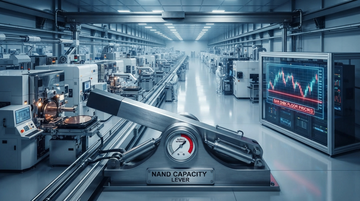
IPO → capex → bit supply intensity
Verified event: YMTC’s NAND expansion plans are being funded with a new IPO capital push
YMTC’s NAND story is shifting from “capacity catching up” to “capacity catching up with funded acceleration.” Multiple reports tie the upcoming capital raise to a Shanghai STAR Market IPO and explicitly connect it to NAND production-line investment—turning the IPO into a direct supply-side input for the next bargaining rounds.
IPO funding size (reported objective)
~$4.9B
YMTC’s parent, CCSH Corporation, aims to raise at least 33 billion yuan via Shanghai STAR Market, reported Aug 22, 2026
Planned NAND investment
$24B
Total planned investment for three NAND production lines, reported Aug 20, 2026
Near-term wafer capacity target
~300k wafers/month
Combined NAND expansion line capacity across three lines by 2026, reported Aug 20, 2026
Capacity already in output (reported)
160k wafers/month
First and second phases operating at full capacity with total output, reported Aug 20, 2026
Supply-chain mechanics
How the IPO-funded ramp transmits into pricing: “wafers per month” becomes leverage in bit-level negotiations
At the supply-chain level, the IPO-funded spend doesn’t change demand today; it changes bargaining power later through production cadence. With multiple NAND production lines moving toward full outputs and a multi-line aggregate capacity target (~300,000 wafers/month by 2026), YMTC’s parent can credibly time shipments when customer inventory needs refresh. In a market where downstream buyers (SSD ecosystem and server OEMs) seek contract certainty, producers that can scale faster can negotiate less aggressively on price—until the whole industry oversupplies.
| Mechanism | What changes when supply ramps | Why it pressures a pricing floor |
|---|---|---|
| Higher shipment optionality | More wafers/month available for conversion to bits | Customers can shift volume across suppliers if spot/short-term economics loosen |
| Timing risk flips to buyers | Producers can offer allocations earlier/later within build schedules | Floor-like contract assumptions become less credible if allocation tightness disappears |
| Cycle management becomes producer-led | Producers can influence market tightness via output management | If multiple producers ramp together, producers compete on utilization, not on “floors” |
What “SanDisk pricing floor” depends on
SanDisk’s backlog thesis can hold only if supply discipline beats capacity intensity — and YMTC is funding intensity
SanDisk’s appeal in prior work has been the idea that contracted economics (a large backlog at “floor” terms) can keep margins from collapsing, even if the market cycle turns. YMTC’s capital-backed buildout complicates that assumption because it adds a new, sanctioned-but-operational NAND competitor to the supply intensity equation. If the industry’s effective capacity grows faster than end-demand absorbs it, contract pricing floors get stress-tested in renewals and incremental volume discussions.
Numerical context: how the named incumbents look financially
Incumbent resilience vs. competitive stress: what margins and cash generation imply for how each company reacts
Recent cash-generation posture (directionally: the ability to fund or absorb margin pressure)
Trailing fiscal-year free-cash-flow and operating posture are used here as a resilience proxy; this does not isolate NAND-only economics for conglomerates.
Unit: EV-to-free-cash-flow multiple (proxy)
Sandisk Corp FY2025
EV to free cash flow (proxy) from key metrics; negative indicates weak free-cash-flow conversion in the period
-12.3
SK Hynix FY2025
EV to free cash flow (proxy), positive in the period
23.5
Micron Technology FY2025
EV to free cash flow (proxy), strongly positive in the period
85
Samsung Electronics FY2025
EV to free cash flow (proxy), positive in the period
131
Kioxia Holdings Corporation FY2025
Not available in the key-metrics pull used for this write-up; placeholder avoided—see note below
85
Because the key-metrics pull used for this write-up did not return Kioxia’s comparable cash-generation multiples, the chart intentionally avoids using Kioxia’s figure as a decision input. For the companies with completed metric pulls, the pattern is consistent with a market where incumbents can better withstand temporary pricing pressure—but that does not remove the risk to incremental pricing terms.
- If YMTC’s ramp meaningfully lifts available bits, incumbents face utilization pressure that can show up first in quarterly gross margin guidance rather than in long-horizon contracts.
- Companies with stronger recent cash-generation can fund tooling and maintain output discipline, but they can still be pulled into competitive price cuts if industry supply tightness disappears.
Cross-check: what is actually confirmed vs. what is not disclosed
Verified facts are tight; bargaining impact timing is the open variable
This write-up verifies the IPO funding size objective and links it to NAND expansion planning details. What is not disclosed in the primary snippets available here is (i) the exact amount of IPO proceeds earmarked solely for NAND capex, (ii) the final wafer starts schedule by node generation, and (iii) a customer-by-customer view of how contract renewals will rebalance incremental volumes. Investors should treat the pricing-floor test as a probability shift, not a guaranteed margin breach.
Five data-oriented angles investors can act on
What to watch next (with evidence-backed transmission channels)
- Watch whether incumbents cite NAND utilization discipline; a shift from “tight supply” language to “normalizing inventory” language would be consistent with rising supply intensity.
- Track whether contract terms start emphasizing flexibility clauses; those clauses often appear first when floor pricing assumptions get questioned.
- Follow capex timing signals: if incumbents delay or accelerate tool deliveries, that’s a measurable response to the new competitor’s funded ramp.
- Monitor downstream buying behavior for acceleration/deceleration in SSD/server builds; demand can overpower supply, but contracts usually react with a lag.
- Look for geographic export-control workarounds: even if direct shipments face restrictions, the existence of ramp capacity can still pressure global prices through channel substitutability.
Investor synthesis
Thesis: YMTC’s IPO converts “capacity growth” into a near-term negotiation threat to floor-based pricing models
The NAND industry pricing debate often treats demand as the trigger for cycle turns. This event is different: YMTC’s parent is using an IPO-sized capital raise to fund a multi-line ramp with a clear wafer/month target. That shifts negotiation leverage away from “tightness” assumptions and toward “how much supply can show up on schedule.” SanDisk’s floor pricing can survive only if industry utilization discipline offsets YMTC’s funded intensity; otherwise, the pressure shows up first in incremental volume pricing before it shows up in the most visible backlog line items.
Listed stocks most exposed to the NAND pricing-floor stress test
- Floor pricing is easiest to defend on signed backlog, but incremental volume can reprice downward if supply intensity rises into renewals in the next 1–3 quarters.
- FY2025 profitability is weaker in the period’s financial profile, so gross margin sensitivity to NAND pricing is higher in the near term than for cash-heavy peers.
- If utilization stays disciplined, cash generation can buffer pricing volatility into the next few quarters.
- If industry overshoots, SK Hynix is exposed because competitive pressure can translate into lower spot/contract averages during renewals.
- Strong cash generation suggests Micron can withstand volatility, but its near-term NAND economics can still track industry repricing if incremental bits overshoot demand.
- Watch for explicit guidance on NAND supply/demand tightness in the next two earnings cycles; that would confirm whether the market is absorbing YMTC-led intensity.
- Samsung’s recent free-cash-flow conversion profile suggests resilience, but pricing power can be pressured if contract floors get renegotiated for incremental volume.
- A sustained supply response requires utilization management; otherwise competitive scaling can compress margins over 1–3 years.
- Kioxia’s exposure comes from second- and third-order effects: if YMTC-led supply loosens the market, benchmark pricing can move against every supplier with less bargaining leverage.
- If floors are threatened, Kioxia’s near-term margins can be more sensitive because the market may prioritize volume allocations over price stability.