%22%2F%3E%0A%20%20%3Ccircle%20cx%3D%22220%22%20cy%3D%22150%22%20r%3D%22180%22%20fill%3D%22%2322d3ee%22%20fill-opacity%3D%220.12%22%2F%3E%0A%20%20%3Ccircle%20cx%3D%221010%22%20cy%3D%22130%22%20r%3D%22220%22%20fill%3D%22%2338bdf8%22%20fill-opacity%3D%220.08%22%2F%3E%0A%20%20%3Ccircle%20cx%3D%22920%22%20cy%3D%22520%22%20r%3D%22170%22%20fill%3D%22%2322d3ee%22%20fill-opacity%3D%220.06%22%2F%3E%0A%20%20%3Cpath%20d%3D%22M140%20430h920%22%20stroke%3D%22url(%23line)%22%20stroke-width%3D%2212%22%20stroke-linecap%3D%22round%22%2F%3E%0A%20%20%3Cpath%20d%3D%22M220%20360c120-150%20260-220%20380-220s260%2070%20380%20220%22%20fill%3D%22none%22%20stroke%3D%22%2367e8f9%22%20stroke-opacity%3D%220.5%22%20stroke-width%3D%2216%22%20stroke-linecap%3D%22round%22%20stroke-linejoin%3D%22round%22%2F%3E%0A%20%20%3Cpath%20d%3D%22M300%20398h600%22%20stroke%3D%22%2394a3b8%22%20stroke-opacity%3D%220.24%22%20stroke-width%3D%228%22%20stroke-linecap%3D%22round%22%2F%3E%0A%20%20%3Ctext%20x%3D%22220%22%20y%3D%22510%22%20fill%3D%22%23e2e8f0%22%20fill-opacity%3D%220.7%22%20font-family%3D%22Arial%2C%20Helvetica%2C%20sans-serif%22%20font-size%3D%2238%22%20letter-spacing%3D%228%22%3EINSIGHTS%3C%2Ftext%3E%0A%3C%2Fsvg%3E)
Industry News • Consumer Tech
Amazon makes Alexa+ a free Fire TV upgrade—no Prime required, no activation step
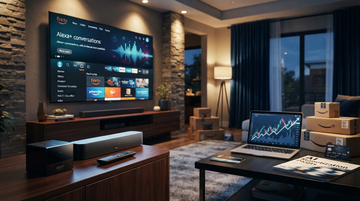
Amazon says it is rolling out Alexa+ on compatible Fire TV devices in the U.S. “to all customers” for no additional cost, with no app download and no subscription activation. The upgrade is designed to be automatic for eligible Fire TV customers, and Amazon positions it as “Alexa+” working directly on Fire TV (including smart home and conversational search).
What Amazon says is changing
Eligibility scope
Compatible [Fire TV](amzn) devices in the U.S. (automatic rollout)
Amazon describes the rollout as “to all customers in the U.S.” with compatible devices.
Paywall removal
No Prime required for Alexa+ on Fire TV
Amazon explicitly frames the offer as not needing Prime or separate activation.
Friction level
No action required—no app download, no subscription activation
Amazon states users can simply use Fire TV as normal.
Where Alexa+ shows up
Amazon Fire TV Stick(s), Fire TV Cube, Ember smart TVs, and select Alexa-built-in TVs
Amazon lists several categories and brand examples such as Hisense and Panasonic.
Pricing & Product Strategy
This inverts the subscription AI assistant model—Amazon monetizes where it already wins
Before this change, Alexa+ access carried a $19.99/month “Standard” price for non-Prime users on the Alexa+ product listing. Amazon’s Fire TV free rollout removes that up-front willingness-to-pay constraint at the exact point where consumers already experience Amazon’s TV interface—turning voice/intent into additional shopping and content discovery opportunities.
| Plan | Price framing | What Amazon says you get |
|---|---|---|
| Alexa+ Standard (non-Prime) | $19.99/month | “An advanced Alexa AI experience without Prime.” |
| Alexa+ with Prime | Included “for free” | “Full access to Alexa for free with a Prime membership … for free” on compatible devices. |
| Alexa+ on compatible Fire TV (U.S.) | No additional cost, no Prime required | Alexa+ included on Fire TV devices with “no action required, no app to download, and no subscription to activate.” |
Amazon also claims the engagement effect: Alexa customers “have nearly twice as many conversations on Fire TV as they did with the original Alexa.” If true, then the economics of the “assistant” shift from subscription revenue to conversion and retention inside Amazon’s device-to-commerce funnel.
Evidence-based engagement signal
Amazon is using Fire TV usage lift as the proof point—engagement first, monetization later
Engagement KPI Amazon cites
Nearly 2x
Amazon says Alexa customers have “nearly twice” as many conversations on Fire TV vs. original Alexa
The important investor takeaway is not the engagement metric itself—it’s how Amazon implies causality: widen access (remove the paywall), then expand conversational interactions on the Fire TV surface where Amazon can route answers into content, smart-home actions, and retail discovery. In an assistant market where competitors monetize access to the AI layer, Amazon is monetizing the downstream actions and outcomes.
Supply-chain-aware view (compute, devices, and interfaces)
The move changes who captures value across the stack: models → devices → retail media outcomes
- Amazon shifts the capture point from “assistant access price” to conversion on the Amazon TV interface by removing Prime/Standard gating on Fire TV.
- By making Alexa+ a device feature, Amazon increases the installed-base relevance of its AI stack and reduces churn risk tied to monthly fees.
- The broader implication for the hardware layer: TV and stick OEM ecosystems can benefit because Alexa+ is included by default, raising demand for compatible Fire TV inventories.
- For cloud/AI infrastructure providers, the business model is less about assistant subscriptions and more about usage-driven workloads—so inference demand can grow even without new user fees.
This is also why the strategy is consistent with “ad- and ecosystem-funded AI” logic: the assistant is the front-end to intent, while monetization is downstream in Amazon’s commerce and advertising engine. In that model, the subscription is not the product—retail outcomes are.
Amazon fundamentals context
Amazon can fund the switch: its scale supports large AI spend while sustaining cash generation
Amazon’s scale: revenue and operating profitability (trend anchor)
Trailing and fiscal-year anchor figures to contextualize the ability to absorb AI product pricing shifts
Unit: USD
FY2024 revenue
FY2024 revenue
637,959,000,000
FY2025 revenue
FY2025 revenue
716,924,000,000
TTM through Jun 30, 2026 revenue (reported as TTM)
TTM revenue
775,680,000,000
Amazon’s financial scale provides the runway for making Alexa+ broadly available on Fire TV without immediately requiring direct assistant subscription revenue. For investors, that matters because it reduces the risk that this is a temporary promotion; it fits a long-cycle distribution strategy where near-term monetization may be lower than subscription-only approaches.
What to watch next (short-term and long-term)
Expect “usage first” metrics first; then see whether retail media and device stickiness follow
- Short-term (days–quarters): watch for Amazon to quantify Fire TV conversation growth and any internal KPI changes tied to shopping and ad impressions after the rollout.
- Short-term (days–quarters): monitor whether compatible TV and stick partners see higher sell-through because Alexa+ is now included without Prime gating.
- Long-term (1–3 years): the bet is that assistant usage becomes a persistent “habit layer” that strengthens Amazon retail media engagement and recommendation loops.
- Long-term (1–3 years): risk shifts from “can Amazon sell subscriptions?” to “can Amazon keep engagement high while maintaining answer quality and brand trust?”
In practical terms: subscription-led AI assistants can grow by adding paying users; Amazon is trying to grow by adding reachable users and expanding the set of actions that Amazon can monetize. If it works, Amazon’s device funnel becomes the assistant market’s distribution moat.
Investor Synthesis
The clearest signal in AI pricing isn’t “who has the best model”—it’s who can monetize intent without charging for access
Amazon’s decision to make Alexa+ free on compatible Fire TV devices in the U.S. signals a durable pricing theory: assistants win when they sit in the moment of decision, not when users pay to “try” them. For Amazon, Fire TV is the surface; conversational intent is the input; retail media and commerce outcomes are the payoff.
Related listed exposures (where the strategy can transmit)
- Amazon can raise assistant engagement without Prime friction, supporting downstream retail media monetization tied to Fire TV usage
- Amazon’s scale means it can fund free assistant distribution while maintaining operating profitability across FY2024–FY2025 and TTM
- If Alexa+ conversations lift persists, it can increase ad and recommendation inventory inside Fire TV journeys over 1–3 years