%22%2F%3E%0A%20%20%3Ccircle%20cx%3D%22220%22%20cy%3D%22150%22%20r%3D%22180%22%20fill%3D%22%2322d3ee%22%20fill-opacity%3D%220.12%22%2F%3E%0A%20%20%3Ccircle%20cx%3D%221010%22%20cy%3D%22130%22%20r%3D%22220%22%20fill%3D%22%2338bdf8%22%20fill-opacity%3D%220.08%22%2F%3E%0A%20%20%3Ccircle%20cx%3D%22920%22%20cy%3D%22520%22%20r%3D%22170%22%20fill%3D%22%2322d3ee%22%20fill-opacity%3D%220.06%22%2F%3E%0A%20%20%3Cpath%20d%3D%22M140%20430h920%22%20stroke%3D%22url(%23line)%22%20stroke-width%3D%2212%22%20stroke-linecap%3D%22round%22%2F%3E%0A%20%20%3Cpath%20d%3D%22M220%20360c120-150%20260-220%20380-220s260%2070%20380%20220%22%20fill%3D%22none%22%20stroke%3D%22%2367e8f9%22%20stroke-opacity%3D%220.5%22%20stroke-width%3D%2216%22%20stroke-linecap%3D%22round%22%20stroke-linejoin%3D%22round%22%2F%3E%0A%20%20%3Cpath%20d%3D%22M300%20398h600%22%20stroke%3D%22%2394a3b8%22%20stroke-opacity%3D%220.24%22%20stroke-width%3D%228%22%20stroke-linecap%3D%22round%22%2F%3E%0A%20%20%3Ctext%20x%3D%22220%22%20y%3D%22510%22%20fill%3D%22%23e2e8f0%22%20fill-opacity%3D%220.7%22%20font-family%3D%22Arial%2C%20Helvetica%2C%20sans-serif%22%20font-size%3D%2238%22%20letter-spacing%3D%228%22%3EINSIGHTS%3C%2Ftext%3E%0A%3C%2Fsvg%3E)
Verified premise: what’s actually on the record
OpenAI’s first hardware is reported as a premium, screenless smart speaker priced at $300–$400
The load-bearing claim here is simple: reporting states OpenAI is working on its first consumer device as a premium, screenless smart speaker and that it could retail at $300–$400.
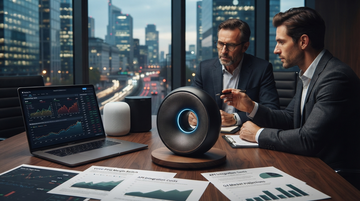
Tech press reporting specifically describes the device as “perhaps 300 to 400 per unit,” and frames it as a donut-shaped, portable, moving-parts smart speaker designed to be a physical manifestation of an AI assistant experience, with a reported development link to LoveFrom.
Reported unit price range
$300–$400
From market reporting describing the target retail price band
Reported first launch window
2027
From the same reporting set (no specific month disclosed)
Why this matters economically
This is less a device bet and more an API-to-voice margin-switch—sold through whoever controls the home surface
Smart speakers are already “voice surfaces,” but most monetization is either (a) retail hardware plus platform lock-in or (b) subscription tie-ins. The strategic twist with an AI-native speaker is that it can reprice the value chain: OpenAI’s usage (via API-style economics) becomes the economic center of gravity, while the hardware becomes the low-friction meter that drives repeated voice interactions.
At a margin level, the pitch investors should look for is whether the device is engineered so that each voice query has a clean path back to OpenAI’s model access economics, rather than getting monetized mostly as speaker hardware or as a generic assistant wrapper.
- OpenAI increases monetization per household by shifting from “chat access” to “always-on voice initiation.”
- A premium $300–$400 price point suggests OpenAI is willing to trade adoption volume for higher ARPU and higher willingness-to-pay for better interaction quality.
- A screenless form factor implies the voice UI must do more work per query (and likely more frequent querying).
- Retail distribution can become the growth lever: the winner is the ecosystem that can quickly ship devices into households without degrading the OpenAI usage loop.
Supply-chain + margin structure (full stack, not just the headline)
The margin bridge runs through design, components, and contract manufacturing—and then through retail logistics
Even with limited disclosed manufacturing specifics in the reporting we opened, the economics of a first consumer device typically break into (1) design/IP (industrial design + acoustics + camera/mic/compute packaging), (2) components (audio, mic array, connectivity, compute/edge AI, power management), (3) assembly (contract manufacturing), and (4) distribution (retail channel, fulfillment, and returns).
For an AI speaker built to drive repeated AI interactions, “downstream retail” matters because it determines how fast the installed base builds—and installed base is what converts usage from “occasional experimentation” into recurring querying.
| Layer | What changes if OpenAI wins | Investor signal | What would falsify the thesis |
|---|---|---|---|
| Industrial design / hardware enclosure | Higher willingness-to-pay supports price > commoditized smart speakers | Reported premium price aligns with material/assembly complexity | Pricing collapses toward commodity ranges without quality differentiation |
| Compute + voice capture chain | Voice capture reliability improves query success rate (more “successful” voice-to-AI sessions) | Rumors/specs indicate strong mic array + processing + offline wake reliability | If voice performance degrades, usage loops stall and subscription-like economics never form |
| Contract manufacturing and yield | Premium device still targets a sellable gross margin after yields | Any later disclosure of cost structure or manufacturing partner confidence | Sustained margin compression due to yield/cost overruns |
| Retail / logistics execution | Distribution speed accelerates installed base, compounding usage monetization | Retail relationships indicate fast global fulfillment readiness | Device availability remains limited/late vs. major smart speaker competitors |
Who gets squeezed (and who can fund the squeeze)
The competitive impact is a control-plane fight: voice edge vs. app/store edge vs. showroom edge
The strategic tension is that “AI UI” historically competed in chat apps and developer integrations, but a smart speaker relocates the UI into the home’s always-on voice entry point.
That creates three simultaneously pressured competitive positions:
1) Apple competes from an ecosystem/app-store control plane. A voice assistant surface that depends on external AI access risks forcing an accommodation on-device.
2) Amazon competes from distribution and devices already in millions of homes. If an OpenAI-branded device ships via Amazon channels, Amazon can monetize via fulfillment/logistics while OpenAI monetizes via usage.
3) Sonos competes from premium audio brand and connected home relevance. An AI-native assistant that feels “more like a companion” can shift mindshare and reframe Sonos’ role.
Context: these incumbents already have very different revenue scale and margin profiles in the smart-home/consumer stack
Using available financial-tool snapshots: AMZN and AAPL show high scale and profitability; SONO shows lower scale and narrower profitability. This affects each firm’s ability to fund platform concessions vs. defend hardware-only economics.
Unit: USD
Amazon revenue (TTM)
Used to compare scale; not a smart-speaker-specific line item.
775,680,000,000
Apple revenue (TTM)
Used to compare scale; not a HomePod-specific line item.
466,822,988,000
Sonos revenue (TTM)
Used to compare scale; not only smart-speaker revenue.
1,490,349,000
Fundamentals check for listed “touch points”
What the fundamentals say about who can absorb concessions if the voice edge gets reallocated
Even though the smart speaker is a private-company device rumor, public-company financials matter for how each incumbent would respond.
- Amazon can “fund distribution” due to massive operating scale and a wide margin base across retail, ads, and AWS.
- Apple has high profitability and a strong ecosystem rent engine, so it can afford to concede at the hardware layer only if it protects services economics.
- Sonos has a smaller revenue base and historically thinner margins, which makes differentiation and partnership leverage more important than price cuts.
Amazon operating profit margin (TTM)
13.7%
From company financial metrics snapshot; directionally supports ability to absorb strategic hardware/platform concessions
Apple net profit margin (TTM)
27.6%
From company financial metrics snapshot; supports ability to protect ecosystem economics if voice access requires compromise
Sonos operating margin (TTM)
10.6%
From company metrics snapshot; narrower margin cushion vs. Apple/AMZN
Investor angles that actually cash out
5–8 data-first angles to monitor before treating this as a “hype” story
- reprices the home voice funnel by shifting the primary interaction path from screens and apps into microphones at the edge, increasing query frequency per household
- Gross margin sensitivity: a premium $300–$400 positioning implies the device must clear manufacturing + logistics economics; watch for later disclosures or channel pricing behavior after launch.
- Ecosystem bargaining: if OpenAI’s voice access becomes default, Apple’s assistant stack may need concessions—watch services disclosures for any AI access pricing shifts (not guaranteed).
- Retail/logistics leverage: the distribution winner monetizes shipment and placement while the AI access provider monetizes usage; watch for reported retail partner terms if any are disclosed.
- Connected-audio competitive response: if voice companion value rises, audio brands may change roadmap emphasis; watch for Sonos product narrative changes and gross margin trajectory.
- Partner concentration risk: if one manufacturing partner dominates, delivery and yield risk can become the gating factor on adoption and therefore usage revenue.
What is not answerable from the primary sources we opened: exact manufacturing partners for the speaker, OpenAI’s unit economics/BOM, and explicit revenue-sharing with retailers. Those items require either OpenAI disclosure, credible multi-source confirmation, or SEC-style filings (unlikely for a private company).
Short-term vs long-term horizons
The catalyst path likely runs: retail availability → installed base → usage economics → ecosystem concessions
- Days–quarters: expect volatility in related device and audio peers if OpenAI’s entry is treated as a meaningful “voice UI” change rather than a niche product.
- 1–3 years: the winners should show strategy alignment—either protecting services economics (Apple) or defending device ecosystems while monetizing distribution (Amazon).
- 1–3 years: for Sonos, watch whether voice companion positioning becomes a competitive disadvantage for purely audio-first differentiation.
Listed stocks most tied to the competitive transmission (voice surface + device distribution + connected audio)
- Amazon can monetize distribution and placement into the home base even if OpenAI captures AI usage economics.
- Amazon’s scale supports a faster hardware retail response without margin stress given its large revenue base (TTM revenue $775.68B).
- In 1–3 years, Amazon could face voice-edge displacement pressure if customers treat OpenAI’s speaker as the default assistant surface.
- Apple can buffer ecosystem concessions with high profitability (TTM net margin 27.6%).
- In the short term, Apple may face assistant default pressure if OpenAI’s voice device is perceived as “ChatGPT in your home.”
- Over 1–3 years, Apple likely must protect services economics or risk share shift toward external AI access layers.
- Sonos has less margin cushion, so it can struggle to match voice-companion value with thinner profitability (TTM operating margin 10.6%).
- If OpenAI’s speaker becomes a premium companion alternative, Sonos could see demand reallocation toward assistant-first devices rather than audio-first positioning.
- In 1–3 years, Sonos’ direction hinges on whether it converts voice surfaces into platform advantages instead of losing mindshare.