%22%2F%3E%0A%20%20%3Ccircle%20cx%3D%22220%22%20cy%3D%22150%22%20r%3D%22180%22%20fill%3D%22%2322d3ee%22%20fill-opacity%3D%220.12%22%2F%3E%0A%20%20%3Ccircle%20cx%3D%221010%22%20cy%3D%22130%22%20r%3D%22220%22%20fill%3D%22%2338bdf8%22%20fill-opacity%3D%220.08%22%2F%3E%0A%20%20%3Ccircle%20cx%3D%22920%22%20cy%3D%22520%22%20r%3D%22170%22%20fill%3D%22%2322d3ee%22%20fill-opacity%3D%220.06%22%2F%3E%0A%20%20%3Cpath%20d%3D%22M140%20430h920%22%20stroke%3D%22url(%23line)%22%20stroke-width%3D%2212%22%20stroke-linecap%3D%22round%22%2F%3E%0A%20%20%3Cpath%20d%3D%22M220%20360c120-150%20260-220%20380-220s260%2070%20380%20220%22%20fill%3D%22none%22%20stroke%3D%22%2367e8f9%22%20stroke-opacity%3D%220.5%22%20stroke-width%3D%2216%22%20stroke-linecap%3D%22round%22%20stroke-linejoin%3D%22round%22%2F%3E%0A%20%20%3Cpath%20d%3D%22M300%20398h600%22%20stroke%3D%22%2394a3b8%22%20stroke-opacity%3D%220.24%22%20stroke-width%3D%228%22%20stroke-linecap%3D%22round%22%2F%3E%0A%20%20%3Ctext%20x%3D%22220%22%20y%3D%22510%22%20fill%3D%22%23e2e8f0%22%20fill-opacity%3D%220.7%22%20font-family%3D%22Arial%2C%20Helvetica%2C%20sans-serif%22%20font-size%3D%2238%22%20letter-spacing%3D%228%22%3EINSIGHTS%3C%2Ftext%3E%0A%3C%2Fsvg%3E)
Verified event (primary source): Aug 6 OpenAI blog
OpenAI made GPT‑5.6 Luna the default for Free—then scheduled unlimited text chats for next week
OpenAI used its Aug 6 product blog to change the economics of ChatGPT at the entry point: GPT‑5.6 Luna becomes the default for Free and Go users this week. In the same post, OpenAI said that “starting next week” Free (and Go) users will also get “unlimited text chats” on that model, plus a “Think” button for harder questions.
| User tier | This week | Starting next week | Model mentioned |
|---|---|---|---|
| Free | GPT‑5.6 Luna becomes default | Unlimited text chats; “Think” button | GPT‑5.6 Luna |
| Go | GPT‑5.6 Luna becomes default | Unlimited text chats; “Think” button | GPT‑5.6 Luna |
| Plus/Pro | Updated GPT‑5.6 Sol (with a reasoning slider) | — | GPT‑5.6 Sol |
The monetization mechanism (primary source): OpenAI’s ad policy blog
OpenAI also confirmed it will test ads on Free/Go in the U.S.—with “bottom of answers” placement
The “free pivot” becomes investable only when paired with monetization. In OpenAI’s separate post laying out its approach to advertising and expanding access, OpenAI said it plans to test ads in the U.S. for the free and Go tiers in the coming weeks. It further specified that ads would initially appear “at the bottom of answers” when there is a relevant sponsored product or service based on the conversation, and that ads are separate and clearly labeled.
- OpenAI states ads will be optimized for helpfulness, not for “time spent”
- OpenAI says conversations are private from advertisers and it does not sell user data to advertisers
- OpenAI says Pro/Business/Enterprise are ad-free, and users can turn off personalization and clear ad data
- OpenAI frames the business goal as a “diverse revenue model” where ads can increase access
Cost per task and token economics (primary source: GPT‑5.6 pricing page)
Luna’s position in the GPT‑5.6 cost stack makes “free” feasible as a scalable funnel
If OpenAI were simply giving away its most expensive frontier model, the economics wouldn’t work. But OpenAI’s GPT‑5.6 pricing/family page positions GPT‑5.6 Luna as the low-cost lane: GPT‑5.6 Luna is priced at $0.20 per million input tokens and $1.20 per million output tokens. That creates room to run higher chat volume on Free/Go without requiring paid conversions immediately.
GPT‑5.6 API token pricing: Luna vs Sol vs Terra (input/output per 1M tokens)
Numbers as stated on OpenAI’s GPT‑5.6 page (API rate card figures).
Unit: USD
Luna input
$ per 1M tokens (input)
0.2
Luna output
$ per 1M tokens (output)
1.2
Terra input
$ per 1M tokens (input)
2
Terra output
$ per 1M tokens (output)
12
Sol input
$ per 1M tokens (input)
5
Sol output
$ per 1M tokens (output)
30
Supply-chain aware impact (upstream + downstream)
Why this changes the “ad stack” forecast: the chat UI shifts demand from search queries to sponsored answers
Traditional ad markets (search and social) monetize attention at the moment of intent: query entry for search; feed/story placement for social. OpenAI’s change shifts intent formation earlier—into a conversational loop—while also stating it will test sponsored placements “based on the current conversation.” That means the monetization event is less “type a query” and more “receive an answer with a relevant sponsored product/service.”
- More Free-tier “unlimited text chats” increases ad inventory opportunities per user-session
- “Bottom of answers” placement uses conversational context to qualify sponsorship demand
- Cost headroom from Luna pricing reduces the penalty of higher free usage before monetization fully ramps
| Layer | What changes | Why it matters for ads | Evidence type (in this article) |
|---|---|---|---|
| Frontier access | Luna default for Free/Go; unlimited text chats next week | Higher volume + lower friction means more moments to show sponsored offers | OpenAI product blog (access changes) |
| Monetization | Planned ad testing for Free/Go in the U.S.; ads at the bottom of answers | Sponsored offers can attach to conversational context instead of only query strings | OpenAI advertising policy blog |
| Unit economics | Luna’s low $/token pricing vs Sol | OpenAI can scale free usage without paying frontier-level inference cost per task | OpenAI GPT‑5.6 pricing page |
Listed-company fundamentals to anchor the monetization narrative
Investor relevance: Microsoft search ads and Meta ad delivery already show AI- and format-driven spend cycles
If the chat UI becomes a conversion funnel, investors need to reassess how much ad revenue resilience depends on “traditional search query volumes” versus the ability to serve sponsored products in new answer surfaces. Two public indicators already point to AI-driven delivery and measurement being a live lever rather than a future aspiration.
Microsoft search advertising trend (illustrative signpost)
Search ad rev +$1.3B (+9%)
From Microsoft’s SEC filing: “Search advertising revenue increased $1.3B (9%).”
Alphabet search monetization mechanics
TAC rate ~19.8%
Traffic acquisition costs decreased to 19.8% (three & six months ended Jun 30, 2026 vs 2025).
Meta ad demand + pricing
Ad revenue +$12.8B (Q2 YoY)
Q2 2026 advertising revenue: $59,363M vs $46,563M in Q2 2025; price and impressions both up.
Meta ad pricing
+12% average price per ad
Meta’s SEC filing: average price per ad up 12% YoY (Q2 2026).
Horizons
What moves first (days–quarters) vs what takes 1–3 years to reprice (ad stack winners/losers)
- Free-tier access expansion can show up in weeks as sponsored-eligible answer volume (OpenAI said unlimited text chats next week and ad testing is “coming weeks”).
- Search and feed ad pricing may reprice in quarters if AI answer surfaces reduce query-to-click conversion—but platforms can offset via better formats and measurement (Meta already cites AI investments for delivery/targeting).
- Over 1–3 years, the market may shift from “AI as engagement” to “AI as monetized intent routing”—favoring players that can appear as the sponsored offer at the moment of decision.
Conclusion synthesis
The thesis: OpenAI’s free unlimited Luna rollouts convert “model usage” into a measurable sponsored-answers funnel
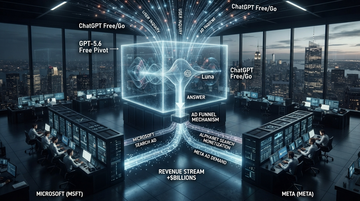
OpenAI’s Aug 6 move is best understood as a monetization architecture update. By pairing Luna-based unlimited free chat with an announced plan to test ads on Free/Go, OpenAI is effectively making ChatGPT’s conversational interface behave like an ad conversion layer—similar in function to a search results page, but with the “query” implicit in the conversation context.
For investors, that implies two portfolio questions. First: can a platform keep monetization per user session if some intent shifts from query entry to conversational answers? Second: can it win the sponsored-placement auction at the bottom of answers, where relevance is derived from the conversation? The near-term edge belongs to those with (1) proven ad delivery/measuring capacity and (2) operating leverage to incremental ad inventory.
Listed names most exposed to sponsored-answers monetization shifts
- Microsoft’s recent filing shows search advertising revenue increased $1.3B (+9%), supporting resilience of sponsored discovery even as AI changes query behavior.
- In the next few quarters, OpenAI’s free unlimited chats can increase sponsored-answer inventory; Microsoft is positioned to compete via Bing/Microsoft advertising stack.
- Over 1–3 years, if conversational surfaces absorb a portion of query volume, Microsoft’s ad monetization quality becomes a relative share question, not a volume question.
- Alphabet’s SEC filing shows TAC rates easing to ~19.8%, which can partially offset revenue volatility from AI-driven intent shifts.
- In the near term, sponsored-answer displacement could pressure query-dependent conversion, so the net effect depends on ad format improvements vs query shrink.
- Over 1–3 years, Alphabet’s upside is that conversation-context sponsored offers can preserve monetization if formats keep improving; downside is reduced search entry.
- Meta’s SEC filing shows Q2 2026 advertising revenue rose to $59,363M vs $46,563M a year earlier, indicating strong monetization per impression.
- In the next quarters, if OpenAI’s answer UIs push more commerce intent into app-like experiences, Meta’s Reels and messaging ad products are built to monetize that intent.
- Over 1–3 years, Meta’s AI investments in delivery/targeting can help defend average price per ad when sponsored placement moves across new surfaces.
- OpenAI’s free unlimited text chats imply higher inference volume; GPU/compute demand sensitivity can rise even if Luna is cheaper per token.
- In the next quarter(s), any additional usage uplift could show up in broader AI infrastructure spend signals, but timing is uncertain.
- Over 1–3 years, the monetized funnel thesis can accelerate frontier deployment, supporting sustained data-center AI capex if demand follows.