%22%2F%3E%0A%20%20%3Ccircle%20cx%3D%22220%22%20cy%3D%22150%22%20r%3D%22180%22%20fill%3D%22%2322d3ee%22%20fill-opacity%3D%220.12%22%2F%3E%0A%20%20%3Ccircle%20cx%3D%221010%22%20cy%3D%22130%22%20r%3D%22220%22%20fill%3D%22%2338bdf8%22%20fill-opacity%3D%220.08%22%2F%3E%0A%20%20%3Ccircle%20cx%3D%22920%22%20cy%3D%22520%22%20r%3D%22170%22%20fill%3D%22%2322d3ee%22%20fill-opacity%3D%220.06%22%2F%3E%0A%20%20%3Cpath%20d%3D%22M140%20430h920%22%20stroke%3D%22url(%23line)%22%20stroke-width%3D%2212%22%20stroke-linecap%3D%22round%22%2F%3E%0A%20%20%3Cpath%20d%3D%22M220%20360c120-150%20260-220%20380-220s260%2070%20380%20220%22%20fill%3D%22none%22%20stroke%3D%22%2367e8f9%22%20stroke-opacity%3D%220.5%22%20stroke-width%3D%2216%22%20stroke-linecap%3D%22round%22%20stroke-linejoin%3D%22round%22%2F%3E%0A%20%20%3Cpath%20d%3D%22M300%20398h600%22%20stroke%3D%22%2394a3b8%22%20stroke-opacity%3D%220.24%22%20stroke-width%3D%228%22%20stroke-linecap%3D%22round%22%2F%3E%0A%20%20%3Ctext%20x%3D%22220%22%20y%3D%22510%22%20fill%3D%22%23e2e8f0%22%20fill-opacity%3D%220.7%22%20font-family%3D%22Arial%2C%20Helvetica%2C%20sans-serif%22%20font-size%3D%2238%22%20letter-spacing%3D%228%22%3EINSIGHTS%3C%2Ftext%3E%0A%3C%2Fsvg%3E)
What happened (and why it matters beyond the gadget)
OpenAI launched a “screen-free” keypad to control Codex agents—positioned as workflow hardware, not a computer accessory
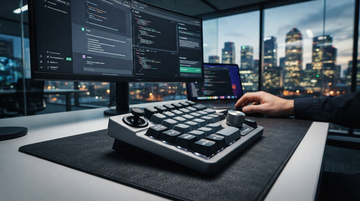
OpenAI’s first named hardware product is Codex Micro—a dedicated desktop keypad marketed to work with its AI coding agent workflow. In practice, it treats “agent control” as an input problem: the device adds physical controls (status + shortcuts + navigational controls) that map onto repeated agent tasks.
Launch date
Jul 15, 2026
Product launch reported as July 15, 2026 on TechCrunch
Price
$230
Confirmed by both TechCrunch and Croma Unboxed
Key count & type
13-key
Mechanical keypad with dedicated agent/status keys
Connectivity & OS
BT + USB-C
Compatible with Windows and macOS (per Croma Unboxed)
First batch shipping
From Jul 24
Croma Unboxed notes first batch shipping begins July 24
Load-bearing details the market will watch
The keypad’s control surface targets three friction points: agent state visibility, repeated commands, and workflow navigation
The “niche hardware” angle fades if you view the keypad as a physical UX layer for agent operations. OpenAI’s described control surface is specifically structured to make agent workflows less error-prone and less dependent on deep UI navigation.
- embeds agent status into dedicated keys so users can monitor what the coding agent is doing without burying state in menus, reducing context-switching time.
- compresses frequent actions into customizable command keys so repetitive steps become muscle memory rather than search-and-click operations.
- adds physical workflow navigation via joystick and dial so the user can traverse agent-driven code tasks and adjust “reasoning”/compute intensity without going through layered UI controls.
Full supply-chain lens: where value can move if users standardize on this input style
If Codex Micro creates a peripheral category, value can shift from app UX to platform-linked input hardware and its manufacturing + distribution stack
A specialized keypad is only economically meaningful if it becomes a repeatable standard. That standard would not just create one-time device sales—it can reshape bargaining power across (1) device makers that can build platform-authentic controls, (2) component suppliers that benefit from volume ramps, and (3) application ecosystems that integrate tightly with the new input surface.
| Layer | What would change | Codex Micro mechanism | Observable next signals |
|---|---|---|---|
| Device makers | More margin and differentiation via platform-linked control surfaces | Physical keys map to agent state/actions (status + shortcuts + navigation) | More OEMs/partners offering “agent control” keypads tied to the same app ecosystem |
| Component suppliers | Potential volume growth in input/lighting + control components | RGB-lit agent keys, rotary controls, joystick | BOM-cost and volume disclosures in supplier earnings; partner expansion announcements |
| Assembly & distribution | Retail/distribution leverage moves toward brands that can bundle with software workflows | Paired usage with the ChatGPT desktop experience | Bundling deals, larger market coverage, and repeat purchase cycles (upgrades) |
| Application ecosystem | Software integration shifts from “hotkeys in UI” to “hardware-triggered workflows” | Customizable shortcuts imply a stable mapping layer | Developer docs referencing device control surfaces; third-party plugins supporting the hardware triggers |
Investor-relevant logic: why this can be bigger than $230 hardware
The wedge is ownership of input distribution—hardware becomes a licensing/attachment point to agent workflows
The product itself is priced like a premium niche accessory, but the strategic bet is different: control surface ownership. If users treat the keypad as the “default remote control” for agent sessions, then the platform (OpenAI + its desktop app) effectively controls the interaction channel.
A key test is whether friction reduction compounds over time. Mechanical keypads excel when a user repeats the same workflow patterns. If Codex Micro’s joystick/dial mapping encourages frequent agent iteration, you should expect a strong “repeat session” loop—exactly where a specialized hardware remote can beat general-purpose input.
Financial data availability (what we can and can’t verify)
Because Codex Micro is a private-company product, the financial impact must be inferred via listed peripheral/platform comps—without assuming unit sales
OpenAI is private, and the specific unit economics of Codex Micro are not disclosed in the sources opened this session. Therefore, the article focuses on measurable, externally verifiable specs and supply-chain pathways, and it treats downstream stock impacts as directional scenarios rather than claiming specific incremental revenue for any vendor.
Causal chain: event → mechanism → structural driver
Codex Micro can become a wedge only if agent workflows become repetitive enough to justify new “input muscle memory”
- The event establishes a physical control surface for agent state and actions rather than relying only on GUI hotkeys or voice—an ownership shift in the interaction layer.
- The mechanism should reduce time spent searching and verifying UI state because dedicated keys mirror agent workflow steps (status, shortcuts, navigation).
- The structural driver is repeat usage during iterative coding sessions, which is when specialized input has the highest likelihood of outperforming general input.
What to watch next (short-term vs. long-term)
Near-term: distribution expansion and developer mapping. Long-term: whether “agent control peripherals” become a platform-wide standard
In the next days-to-quarters, the market should look for signals that Codex Micro is more than a limited run. The most decision-relevant indicators are: expanded availability, evidence of repeat workflows (not just novelty reviews), and whether third parties build around the same control concepts.
- Expanding shipping geography would indicate OpenAI expects at least modest demand beyond early adopters.
- Integrations that expose hardware-like triggers in the desktop app would indicate the interaction layer is becoming developer-facing, not a one-off accessory feature.
- New partner announcements around “agent control” devices would indicate category momentum rather than a single bespoke collaboration.
Listed stocks with plausible linkage to AI-native input adoption
- Logitech could win share in professional productivity peripherals if users standardize on specialized, workflow-first input devices; downside is commoditization if OpenAI’s device remains niche.
- Over 1–3 years, Logitech’s brand strength in keyboards/mice could translate into bundling leverage with software ecosystems if the keypad model expands.
- HP could benefit from attachment-driven PC accessory demand if AI workflows increase on desktops/laptops, but face risk that AI control shifts into software-only hotkeys.
- In the near term, expanded peripheral category adoption would improve “station” build-to-purpose bundling; failure would limit incremental upside.
- Dell should watch whether agent workflow hardware increases desktop usage among developers; if it does, Dell could add differentiated accessory bundles for creator/dev PCs.
- The catalyst is measurable if OpenAI-style input devices spread beyond early adopters; without that, impact remains uncertain and likely limited.
- Corsair’s gaming/peripheral customer base could adopt AI workflow keypads faster if specialized mechanical controls become mainstream for agent iteration.
- Over quarters, if category adoption happens, Corsair could see demand pull forward through higher keyboard accessory sell-through; downside is limited total addressable market.