%22%2F%3E%0A%20%20%3Ccircle%20cx%3D%22220%22%20cy%3D%22150%22%20r%3D%22180%22%20fill%3D%22%2322d3ee%22%20fill-opacity%3D%220.12%22%2F%3E%0A%20%20%3Ccircle%20cx%3D%221010%22%20cy%3D%22130%22%20r%3D%22220%22%20fill%3D%22%2338bdf8%22%20fill-opacity%3D%220.08%22%2F%3E%0A%20%20%3Ccircle%20cx%3D%22920%22%20cy%3D%22520%22%20r%3D%22170%22%20fill%3D%22%2322d3ee%22%20fill-opacity%3D%220.06%22%2F%3E%0A%20%20%3Cpath%20d%3D%22M140%20430h920%22%20stroke%3D%22url(%23line)%22%20stroke-width%3D%2212%22%20stroke-linecap%3D%22round%22%2F%3E%0A%20%20%3Cpath%20d%3D%22M220%20360c120-150%20260-220%20380-220s260%2070%20380%20220%22%20fill%3D%22none%22%20stroke%3D%22%2367e8f9%22%20stroke-opacity%3D%220.5%22%20stroke-width%3D%2216%22%20stroke-linecap%3D%22round%22%20stroke-linejoin%3D%22round%22%2F%3E%0A%20%20%3Cpath%20d%3D%22M300%20398h600%22%20stroke%3D%22%2394a3b8%22%20stroke-opacity%3D%220.24%22%20stroke-width%3D%228%22%20stroke-linecap%3D%22round%22%2F%3E%0A%20%20%3Ctext%20x%3D%22220%22%20y%3D%22510%22%20fill%3D%22%23e2e8f0%22%20fill-opacity%3D%220.7%22%20font-family%3D%22Arial%2C%20Helvetica%2C%20sans-serif%22%20font-size%3D%2238%22%20letter-spacing%3D%228%22%3EINSIGHTS%3C%2Ftext%3E%0A%3C%2Fsvg%3E)
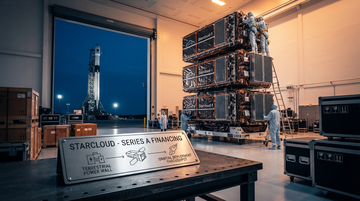
Orbital data centers are pitching themselves as a workaround for Earth’s growing AI infrastructure friction: permitting delays, grid congestion, and community pushback around power demand and cooling water. Starcloud’s latest financing makes that bet concrete by funding a path that starts with spacecraft power and thermal systems, then adds compute payloads.
Crucially, the investment story is less about GPUs and more about what lets GPUs stay on—consistent power generation, radiators sized for sustained thermal load, and the communications plumbing needed to run customer workloads from orbit. This reframing matters because it changes which parts of the AI value chain can scale first.
Verified event: Starcloud’s orbital data-center funding
Starcloud raised $170M to scale compute satellites that target terrestrial energy constraints—not GPU scarcity
Capital raised
$170M
Series A announced Mar 30, 2026
Post-money valuation referenced
$1.1B
Series A valuation referenced in the announcement dated Mar 30, 2026
Total capital raised mentioned
$200M
Company totals referenced across coverage on Mar 30, 2026
Energy thesis window
3–5 years
Management view stated in coverage dated Mar 30, 2026
What Starcloud says it is funding
What the raise accelerates
Next-generation spacecraft + scaled production
Focus described in the Business Wire announcement and echoed in coverage
What the first demo proved
AI compute operation in orbit
Coverage describes using an NVIDIA H100 in orbit and running AI workloads
What the next milestone targets
Starcloud-2 to run customer workloads
Coverage frames “later this year” as the next deployment step
What investors should watch next
Launch cadence + power/thermal capacity per satellite
The scaling logic depends on power generation and heat rejection
Mechanism: power + thermal + comms define “uptime”
Why the power and land story becomes a communications and launch story
- Starcloud’s pitch starts on Earth: AI buildouts face permitting friction and community resistance tied to electricity demand and cooling water needs.
- Orbital sidesteps “land” by moving the infrastructure into low Earth orbit, where heat rejection is designed around radiators instead of data-center HVAC footprints.
- Once power and thermal design constrain uptime, “capacity per launch” becomes the binding variable: each launch has a finite payload envelope, so Starcloud’s roadmap maps satellite mass and power upward with intended launch vehicles.
- Even with power in orbit, workloads require reliable data links; Starcloud’s architecture therefore links compute capability to intersatellite communications and third-party broadband systems.
- That creates a two-part dependency: spacecraft production throughput plus launch availability, which can slow deployments even when capital is available.
This is why the headline tension in the topic brief (funded orbital capacity vs. tightening launch options) is actually structural. AI demand growth can fund compute in advance; but orbital deployments can only scale when you can deliver satellites and their power/thermal capacity into the right orbit and then connect them to customer workload flows.
Supply chain: who wins along the orbital compute stack
The orbital AI value chain shifts dollars toward launch capacity, satellite power buses, and edge workload orchestration
| Value-chain layer | What Starcloud emphasizes | Why it matters economically | Who is positioned to benefit |
|---|---|---|---|
| Launch & integration | Planned scaling requires successive Starcloud spacecraft deliveries | If launches slip, funded capacity cannot turn into revenue | Space launch providers with the highest cadence and payload reliability |
| Satellite power & thermal | Largest deployable radiator and higher power generation across Starcloud-2/3 | Power/heat determine how long GPUs can run at full load | Satellite component ecosystems (power generation, radiators, thermal subsystems) |
| Compute payload ecosystem | Use of NVIDIA H100 and next-gen references in coverage | Compute availability still matters, but it is no longer the only constraint | GPU and accelerated compute suppliers used for the payloads |
| Cloud workload + customer access | Partnerships with cloud providers and an early customer framed in coverage | Revenue depends on customers actually placing workloads onto orbit capacity | Major cloud platforms and AI infrastructure integrators |
Timing: what moves first vs. what takes years
Near term: watch deployments that prove sustained workloads; long term: watch launch-enabled “capacity per month”
- Next 0–2 quarters: the market will likely trade whether Starcloud can deliver Starcloud-2 into orbit and start running customer workloads on schedule.
- Next 2–8 quarters: investors should watch whether spacecraft scale-ups (power generation and radiator capability) translate into repeatable capacity units per satellite.
- Next 1–3 years: Starcloud’s framing implies the economics can improve as more compute shifts into orbit; the key test is whether new orbital capacity becomes competitively deployable without launch bottlenecks as the constellation grows.
- Key downside: even strong spacecraft engineering cannot overcome launch delays; if launch cadence compresses, capital-funded capacity can sit idle.
A subtle but important point: Earth’s “power wall” makes orbital attractive as a narrative, but orbital’s revenue flywheel depends on execution across engineering (power/thermal), procurement (compute payloads), and logistics (launch and integration). When the three don’t align, the bottleneck moves from power to throughput.
Investor lens: what to extract from a private raise when the thesis is operational
Why this raise may be an early signal for a broader reallocation of AI infrastructure capex
Big AI capex cycles historically went into data centers, transformers, fiber, and cooling. Starcloud’s story tries to redirect a portion of that capex into space systems—where the “greenfield” constraint is less about permitting and more about orbital delivery and scalable spacecraft power/thermal design.
If Starcloud can demonstrate commercially useful sustained workloads from orbit, the demand signal would propagate downstream to the companies that supply the enabling layers: launch, satellite power/thermal subsystems, and cloud workload integration. The market will then reassess which portions of AI infrastructure are most constrained and which are most scalable.
Public-market linkages to the orbital AI execution stack
- Starcloud’s scaling plan depends on frequent satellite deliveries; faster launch cadence can turn funded orbital capacity into deployable capacity on earlier timelines.
- If Starcloud (and peers) increase demand for heavy-lift or high-throughput rideshare, space launch utilization can rise over the next 12–36 months.
- Orbital systems still require accelerators; Starcloud’s use of an H100 in orbit supports that GPU demand can follow into space workloads in 1–3 years.
- But if orbital adoption stays low until launch throughput improves, incremental GPU revenue may lag near-term expectations.
- Starcloud’s partnership with AWS implies potential cloud demand for workload orchestration; if orbit capacity scales, cloud services usage could increase over 1–3 years.
- If launches lag, AWS workload migration remains limited and near-term demand uplift may underwhelm versus the narrative.
- Starcloud’s Google Cloud partnership suggests a pathway for orbit-to-cloud service integration; successful deployments could widen addressable AI edge workloads in 1–3 years.
- Execution risk remains high because capacity availability is bounded by launch delivery rather than software alone.