%22%2F%3E%0A%20%20%3Ccircle%20cx%3D%22220%22%20cy%3D%22150%22%20r%3D%22180%22%20fill%3D%22%2322d3ee%22%20fill-opacity%3D%220.12%22%2F%3E%0A%20%20%3Ccircle%20cx%3D%221010%22%20cy%3D%22130%22%20r%3D%22220%22%20fill%3D%22%2338bdf8%22%20fill-opacity%3D%220.08%22%2F%3E%0A%20%20%3Ccircle%20cx%3D%22920%22%20cy%3D%22520%22%20r%3D%22170%22%20fill%3D%22%2322d3ee%22%20fill-opacity%3D%220.06%22%2F%3E%0A%20%20%3Cpath%20d%3D%22M140%20430h920%22%20stroke%3D%22url(%23line)%22%20stroke-width%3D%2212%22%20stroke-linecap%3D%22round%22%2F%3E%0A%20%20%3Cpath%20d%3D%22M220%20360c120-150%20260-220%20380-220s260%2070%20380%20220%22%20fill%3D%22none%22%20stroke%3D%22%2367e8f9%22%20stroke-opacity%3D%220.5%22%20stroke-width%3D%2216%22%20stroke-linecap%3D%22round%22%20stroke-linejoin%3D%22round%22%2F%3E%0A%20%20%3Cpath%20d%3D%22M300%20398h600%22%20stroke%3D%22%2394a3b8%22%20stroke-opacity%3D%220.24%22%20stroke-width%3D%228%22%20stroke-linecap%3D%22round%22%2F%3E%0A%20%20%3Ctext%20x%3D%22220%22%20y%3D%22510%22%20fill%3D%22%23e2e8f0%22%20fill-opacity%3D%220.7%22%20font-family%3D%22Arial%2C%20Helvetica%2C%20sans-serif%22%20font-size%3D%2238%22%20letter-spacing%3D%228%22%3EINSIGHTS%3C%2Ftext%3E%0A%3C%2Fsvg%3E)
Capital markets × aerospace-defense
This isn’t a “curiosity position”—it’s a concentrated, strategic equity bet
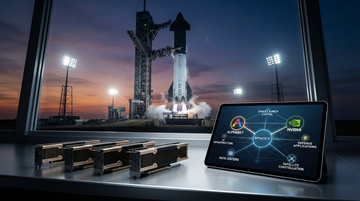
The headline shift is ownership concentration. In Nvidia’s NVDA most recent Form 13F-HR for the quarter ended June 30, 2026, the company reported a SpaceX position valued at about $21B, disclosed as a top-tier holding in the 13F schedule.
That value matters because 13F-HR filings are not deal announcements—they’re a quarterly snapshot of public-market investors’ equity exposure. When a mega-cap that sits at the center of AI compute also shows up as a very large holder of a critical launch-and-infrastructure equity vehicle, it creates a new transmission channel: AI cash flow can increasingly follow the next bottleneck in space-enabled compute and defense capacity.
Verified filing-based facts
What the filings actually show (and what they don’t)
Nvidia’s reported SpaceX stake
~$21B
Form 13F-HR for the quarter ended June 30, 2026
Alphabet’s reported SpaceX stake
~$94B
Alphabet’s 13F disclosure cited in Reuters coverage (period end: June 30, 2026)
Tiger Global’s reported SpaceX stake
~$64M
Tiger Global’s 13F disclosure cited in Reuters coverage (period end: June 30, 2026)
A second, equally important constraint: 13F-HR does not disclose voting arrangements, board rights, or whether any specific side letters exist with SpaceX. So the investor takeaway is not “Nvidia controls SpaceX.” The cleaner conclusion is narrower and more investable: Nvidia is financially exposed at a scale where governance outcomes and strategic cash-use inside SpaceX can feed back into Nvidia’s balance sheet risk profile.
Supply-chain mapping
The supply chain is wider than rockets: it’s GPUs → launch cadence → defense procurement → follow-on compute
SpaceX sits at the intersection of three capital-intensive pipelines:
1) Upstream capital allocation into manufacturing and launch systems (vehicles, engines, avionics, supply tooling). 2) Execution cadence (launch frequency, reliability, and turnaround time), which determines how fast capacity becomes usable. 3) Downstream demand from defense and communications customers, where contract timing and contract terms can effectively re-price the “required equity float” for the next phase of fleet growth.
When ownership concentrates among AI cash generators like NVIDIA and mega-cap tech holders like Alphabet, it increases the probability that capital availability for upstream manufacturing and launch capacity is influenced by AI-adjacent investment theses—not just aerospace-only investment theses.
Non-obvious causal mechanism
A circular-demand risk emerges when the same balance sheets fund both the compute boom and the launch boom
- Nvidia’s scale links its AI investment cycle to SpaceX equity risk, so any slowdown in AI infrastructure spending can indirectly tighten appetite for space-capital allocations.
- Alphabet’s much larger reported position raises the probability of correlated tradeoffs between communications/space ambitions and other capital-hungry projects within the same tech conglomerate.
- Tiger Global’s entry adds a “public-market timing” layer, since hedge-fund style rebalancing can amplify volatility around future SpaceX liquidity events even if fundamentals remain unchanged.
This is the core shift versus “normal” strategic partnerships. Strategic holders can still be value-seeking—but concentration increases the chance that the same macro driver (liquidity for risk assets, cost of capital, or a compute demand correction) hits both sides of the chain at once.
For investors, the question becomes: does SpaceX’s next capital requirement behave more like a long-duration aerospace project, or more like a liquid-tech equity story? The ownership footprint suggests it can behave like both.
Fundamentals cross-check for listed beneficiaries
What to watch inside Nvidia after the disclosure: equity risk budgeting vs. AI margin resilience
NVIDIA is still primarily an AI semiconductor cash machine. The new element is how equity-risk budgeting changes when a top-tier 13F holding is outside the semiconductor value chain.
If Nvidia’s AI demand stays robust, the firm can plausibly treat the SpaceX exposure as a high-return strategic asset. If AI demand compresses or capital markets tighten, Nvidia’s willingness to keep—and possibly expand—concentrated non-semiconductor exposures becomes part of the equity story, not a footnote.
Even without new guidance, the filing-driven implication is straightforward: SpaceX becomes a second lever on Nvidia’s investor narrative—alongside AI earnings power.
Horizons
Short-term catalyst: sentiment and liquidity optics. Long-term catalyst: how defense/communications capacity turns into recurring capital needs
| Horizon | What moves first | Why it matters | What would falsify the thesis |
|---|---|---|---|
| Days–weeks | Risk sentiment around SpaceX ownership concentration | Media and investor attention can re-price the probability of governance/cash-use outcomes | A rapid, broad-based rotation away from long-duration private-equity exposure across major public holders |
| 1–2 quarters | How Nvidia frames capital allocation (buybacks vs. expansion vs. continued strategic stakes) | The market will interpret whether SpaceX is a “core holding” or a “one-cycle exposure” | Evidence of reduced strategic equity footprint or a shift to less concentrated space-related exposures |
| 1–3 years | SpaceX capacity build and defense/communications contract execution cadence | If execution de-risks future funding needs, the equity risk premium should compress | If contract timing slips materially or costs rise without corresponding demand, the funding and governance narrative weakens |
Listed names with the most credible linkage to this ownership-shift
- Nvidia’s reported SpaceX exposure raises non-core equity risk next to core AI earnings, so any AI demand dip can spill into SpaceX sentiment.
- If AI margins hold, Nvidia can finance strategic stakes without stressing operating cash (watch quarterly cash generation).
- Governance outcomes at SpaceX can re-rate Nvidia’s “strategic upside” narrative even without new AI guidance.
- Alphabet’s reported SpaceX stake anchors a long-duration upside path tied to communications/defense capacity and eventual liquidity.
- Because Alphabet’s holding is far larger, it likely increases capital-commitment durability through risk cycles.
- If SpaceX execution de-risks funding, Alphabet’s stake can act as a valuation ballast versus headline tech volatility.
- Nvidia becoming a top-tier holder can improve institutional confidence, but it also concentrates “public investor” narrative risk.
- If future funding needs arise, concentrated strategic ownership can tighten negotiating leverage around valuation and capital terms.
- Near-term volatility is likely when liquidity expectations or contract timing changes (watch post-quarter updates).