%22%2F%3E%0A%20%20%3Ccircle%20cx%3D%22220%22%20cy%3D%22150%22%20r%3D%22180%22%20fill%3D%22%2322d3ee%22%20fill-opacity%3D%220.12%22%2F%3E%0A%20%20%3Ccircle%20cx%3D%221010%22%20cy%3D%22130%22%20r%3D%22220%22%20fill%3D%22%2338bdf8%22%20fill-opacity%3D%220.08%22%2F%3E%0A%20%20%3Ccircle%20cx%3D%22920%22%20cy%3D%22520%22%20r%3D%22170%22%20fill%3D%22%2322d3ee%22%20fill-opacity%3D%220.06%22%2F%3E%0A%20%20%3Cpath%20d%3D%22M140%20430h920%22%20stroke%3D%22url(%23line)%22%20stroke-width%3D%2212%22%20stroke-linecap%3D%22round%22%2F%3E%0A%20%20%3Cpath%20d%3D%22M220%20360c120-150%20260-220%20380-220s260%2070%20380%20220%22%20fill%3D%22none%22%20stroke%3D%22%2367e8f9%22%20stroke-opacity%3D%220.5%22%20stroke-width%3D%2216%22%20stroke-linecap%3D%22round%22%20stroke-linejoin%3D%22round%22%2F%3E%0A%20%20%3Cpath%20d%3D%22M300%20398h600%22%20stroke%3D%22%2394a3b8%22%20stroke-opacity%3D%220.24%22%20stroke-width%3D%228%22%20stroke-linecap%3D%22round%22%2F%3E%0A%20%20%3Ctext%20x%3D%22220%22%20y%3D%22510%22%20fill%3D%22%23e2e8f0%22%20fill-opacity%3D%220.7%22%20font-family%3D%22Arial%2C%20Helvetica%2C%20sans-serif%22%20font-size%3D%2238%22%20letter-spacing%3D%228%22%3EINSIGHTS%3C%2Ftext%3E%0A%3C%2Fsvg%3E)
What happened (verified) & why it matters
The headline isn’t “AI partnerships”—it’s equity financing tied to an AI factory buildout
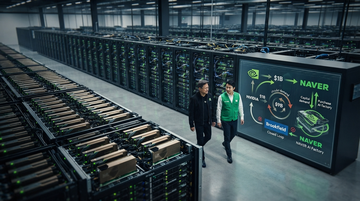
Multiple outlets attribute a new Nvidia investment to NAVER in the form of newly issued Naver shares, framed as financing for an AI data-center/factory under construction in South Korea. The core investor implication is transmission-risk: when a chip vendor funds a prospective infrastructure customer, the next stage is not just “more GPUs sold,” but also “more governance and cashflow interdependence” between the two companies.
Nvidia investment into NAVER
$1 billion
Nvidia plans to invest $1B into NAVER (reported as share investment) for AI infrastructure expansion (press coverage attributed to Nvidia disclosure).
Brookfield component
Up to $9 billion
Brookfield entered a nonbinding term sheet to fund up to $9B for the broader project (reported alongside Nvidia’s $1B component).
Combined reported package
$10 billion
NAVER coverage describes a combined $10B investment from Nvidia and Brookfield to expand AI infrastructure.
Verified anchors used for the article’s fact base
Partnership + amounts
Naver secured combined $10B from Nvidia + Brookfield
Used to ground the scale and identify Brookfield as the downstream financing entity.
Equity-linked angle
Nvidia plans $1B investment into NAVER
Used as the load-bearing “equity financing” premise; governance specifics are not disclosed in the NAVER-facing coverage we could open.
Mechanism (supply chain, not just PR)
Equity financing converts a procurement relationship into an “ecosystem contract”
In a normal supplier-customer setup, Nvidia’s role is mostly throughput monetization (accelerators + networking + software attach). When Nvidia finances NAVER directly, the relationship can behave more like an ecosystem contract: Nvidia has stronger incentives for NAVER’s AI capacity ramp, while NAVER has a clearer path to procure compute at scale.
- Step 1: NVIDIA pairs $1B financing with an AI factory buildout, reducing NAVER’s funding uncertainty during the construction phase.
- Step 2: The project’s “capacity ramp” then drives upstream demand for accelerators and supporting infrastructure (GPUs, networking, and data-center systems), not just short-term GPU shipments.
- Step 3: If the buildout is delayed or utilization underperforms, the counterparty link can amplify downside because the supplier already took equity exposure into the customer’s capital plan.
Data-backed fundamentals backdrop
Why this matters financially: Nvidia has scale liquidity; NAVER has to fund capex leverage
To evaluate “circular capex risk,” you need two baselines: (1) Nvidia’s financial capacity to fund/anchor long-dated relationships, and (2) NAVER’s capital intensity and funding capacity. Even without project-specific capex disclosure in the opened sources, the companies’ recent balance sheet and cash flow profiles show they can participate in large buildouts—but that doesn’t eliminate execution and utilization risk.
| Company | Cash & ST investments (latest FY) | Free cash flow (latest FY) | Capex (latest FY) |
|---|---|---|---|
| NVIDIA | $43.21B (cash + short-term investments) | $60.85B (FCF) | $3.24B (capex) |
| NAVER | ₩8.95T (cash + short-term investments) | ₩1.86T (FCF) | ₩1.23T (capex) |
Full supply-chain view
Upstream and downstream: who benefits if utilization rises—and who bears risk if it doesn’t
This deal’s supply-chain effect isn’t only about Nvidia GPUs. An AI factory expansion is a systems build: compute, networking, and the data-center stack must be matched with power and operational readiness. That means the “winner set” includes multiple categories—accelerator suppliers, data-center infrastructure financiers/operator partners, and memory/compute supply chains. The “loser set” is concentrated where utilization misses expectations and fixed costs cannot be recovered.
- Upstream compute: a utilization-driven ramp increases demand for accelerated compute systems that Nvidia supplies or enables.
- Supporting stack: data-center buildout typically increases demand for networking/interconnect and supporting enterprise AI software deployment (not quantified in the opened sources).
- Financing/downstream infrastructure: Brookfield’s role (financing/infrastructure investment) suggests the buildout has a capital-market and energy-asset dimension.
What an investor should look for next (governance + utilization)
Two questions decide whether this is strategic AI alliance or circular capex risk
- Governance: does Nvidia’s $1B come with any meaningful rights (board seat, veto on major capex, supply terms)? Without disclosure, treat governance effect as unconfirmed.
- Utilization: will NAVER deploy enough workload to keep the new capacity economically rational (not just “build capacity”)? Look for forward guidance or segment/capex commentary tied to AI compute demand.
- Concentration: does NAVER become overly dependent on one chip vendor’s roadmap, reducing bargaining power over time?
My base-case interpretation is “strategic alignment with financing,” because equity financing usually reduces execution risk for the customer and helps the supplier secure future demand. The counterweight is circular capex risk: when the same relationship both funds buildout and becomes the expected output channel, underutilization can feed back into shareholder value through both capital charges and the supplier’s own perceived exposure.
Horizons (short-term catalysts vs 1–3 year reality check)
Near-term: sentiment and supply assurance; 1–3 years: cash economics and counterparty risk
Nvidia free cash flow scale suggests financing flexibility (baseline, not incremental)
Latest annual FCF available from the data tools. The chart is used only to show Nvidia’s ability to fund an equity anchor without straining liquidity.
Unit: USD
Free cash flow (latest annual)
60,853,000,000
- Short-term (days–quarters): NAVER equity-linked financing can support market sentiment and reduce uncertainty around AI infrastructure timing; but it won’t prove utilization economics.
- Short-term: Nvidia’s narrative strengthens “end-to-end AI factory” credibility, potentially supporting customer lock-in via deployment momentum.
- 1–3 years: investors should verify whether the capacity expansion shows up in higher-margin cloud/AI revenue streams and whether capex intensity stabilizes rather than escalating.
Listed-stock exposure: where the market transmission is most direct
- Nvidia funds $1B into NAVER’s AI factory, which can support more predictable demand for accelerators and platform deployments over 1–3 years (counterparty execution still matters).
- Nvidia generated ~$60.9B of free cash flow in its latest annual period, suggesting the $1B financing is strategically targeted rather than liquidity-stressing in the short term.
- NAVER receives combined $10B investment capacity from Nvidia + Brookfield, improving funding headroom for AI infrastructure (but without disclosed utilization targets, economics are not guaranteed).
- NAVER spent ~₩1.23T on capex in its latest annual period, so additional AI capacity execution can pressure cash generation if utilization lags.
- If the AI factory buildout ramps, incremental memory demand should rise through HBM/DRAM supply needs typical of AI training/inference clusters (project capacity not disclosed in opened sources).
- Brookfield enters a term sheet up to $9B for infrastructure financing, so incremental project approvals could support its deal pipeline (nonbinding terms mean timing risk).