%22%2F%3E%0A%20%20%3Ccircle%20cx%3D%22220%22%20cy%3D%22150%22%20r%3D%22180%22%20fill%3D%22%2322d3ee%22%20fill-opacity%3D%220.12%22%2F%3E%0A%20%20%3Ccircle%20cx%3D%221010%22%20cy%3D%22130%22%20r%3D%22220%22%20fill%3D%22%2338bdf8%22%20fill-opacity%3D%220.08%22%2F%3E%0A%20%20%3Ccircle%20cx%3D%22920%22%20cy%3D%22520%22%20r%3D%22170%22%20fill%3D%22%2322d3ee%22%20fill-opacity%3D%220.06%22%2F%3E%0A%20%20%3Cpath%20d%3D%22M140%20430h920%22%20stroke%3D%22url(%23line)%22%20stroke-width%3D%2212%22%20stroke-linecap%3D%22round%22%2F%3E%0A%20%20%3Cpath%20d%3D%22M220%20360c120-150%20260-220%20380-220s260%2070%20380%20220%22%20fill%3D%22none%22%20stroke%3D%22%2367e8f9%22%20stroke-opacity%3D%220.5%22%20stroke-width%3D%2216%22%20stroke-linecap%3D%22round%22%20stroke-linejoin%3D%22round%22%2F%3E%0A%20%20%3Cpath%20d%3D%22M300%20398h600%22%20stroke%3D%22%2394a3b8%22%20stroke-opacity%3D%220.24%22%20stroke-width%3D%228%22%20stroke-linecap%3D%22round%22%2F%3E%0A%20%20%3Ctext%20x%3D%22220%22%20y%3D%22510%22%20fill%3D%22%23e2e8f0%22%20fill-opacity%3D%220.7%22%20font-family%3D%22Arial%2C%20Helvetica%2C%20sans-serif%22%20font-size%3D%2238%22%20letter-spacing%3D%228%22%3EINSIGHTS%3C%2Ftext%3E%0A%3C%2Fsvg%3E)
Capital markets • IPO mechanics • Liquidity microstructure
The first real test isn’t whether the IPO was priced right—it’s whether liquidity can absorb a sudden supply step
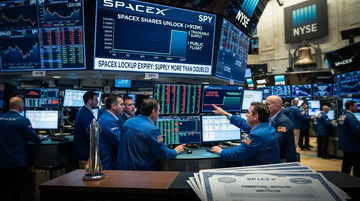
A SpaceX IPO can be “successful” on day one and still fail the only test that matters for ongoing pricing: can public-market buyers absorb the inventory the market has unlocked?
On the first post-IPO lockup expiry, reporting indicates up to ~911.5–912 million shares became eligible for trading, and that this more than doubled the then-current public float. That is a clean, mechanical supply shock that occurs even if fundamentals (reliability, capacity, contract wins) are unchanged.
First unlock eligible shares
≈911.5–912M
First post-IPO lockup expiry; multiple outlets cite “up to 911.5 million” shares.
Outstanding shares referenced
≈13.6B
Shares unlocking as a portion of roughly 13.6B outstanding shares.
Float step-change
More than double
Coverage describes public-tradable supply more than doubling after expiry.
Next large supply wave (mid-2027)
+12.9B
Staggered schedule reportedly frees additional 12.9B shares by mid-2027.
What happened (verified)
On the first lockup expiry, SpaceX’s tradeable float jumped—on a calendar, not on earnings
- First lockup expiry occurred on Thursday, with up to 911.5–912 million shares becoming eligible for trading.
- Reporting frames the event as an eligibility-driven supply step—not a new issuance and not a company fundamentals update.
- The same coverage also notes a much larger staggered unlocking footprint, including 12.9B additional shares freed by mid-2027.
- Because this wave is time-bound, it gives the market a forced re-pricing catalyst even if demand remains stable.
In other words, the “post-IPO trade” isn’t just about valuation multiples. It’s about the market suddenly learning what public buyers will pay when insiders and early holders are no longer capacity-constrained by lockups.
Mechanism
Why a float step-change can move the stock more than Starship reliability headlines
Liquidity shocks work through a simple chain: supply becomes tradeable → dealer inventories and short-covering demand change → order-book depth changes → realized price moves.
When the unlock share count is large enough to matter relative to the initial public float, the market can re-rate quickly even without new information. This is especially true right after an IPO when the float was intentionally small to support a clean debut. That intentional strategy reduces early liquidity stress; the tradeoff is that the first major unlock creates a more violent second act.
| Checkpoint | Reported eligible shares | Reported effect on float | Why it matters for price discovery |
|---|---|---|---|
| First post-IPO unlock | Up to 911.5–912M | More than doubled public float | Forces a new equilibrium between marginal buyers and marginal sellers |
| Staggered unlock by mid-2027 | Additional 12.9B freed | Ongoing float expansion | Extends liquidity repricing across multiple windows |
Supply chain view (investor framing)
Even though the catalyst is financial engineering, it ripples into aerospace execution via cost of capital
A float unlock is not a supply-chain event—yet it is a capital-cost event. If public-market liquidity becomes more volatile around unlock windows, the market often demands a higher risk premium for the issuer and for its closest listed “liquidity proxies.”
That can show up downstream as tougher financing conditions for adjacent programs (ground systems, propulsion components, satellites, launch-support services) and upstream as more cautious investor behavior toward high-burn capex narratives. In short: when the market struggles to absorb post-IPO supply, capital allocation becomes more conservative.
Short-term vs long-term horizons (what to watch next)
Short-term: liquidity absorption and selling behavior will lead. Long-term: precedent-setting for every mega-private IPO
- Short-term (days–weeks): the key signal is whether reported heavy unlock supply causes a sustained drawdown or gets absorbed quickly; watch for whether volatility clusters around the eligibility date.
- Short-term (days–weeks): if price holds while supply becomes tradable, that supports the bull case that demand is deep enough to offset incremental supply.
- Long-term (1–3 years): the staggered schedule—especially the mid-2027 wave—determines whether the issuer transitions into a more “mature float” regime or repeatedly revisits liquidity stress.
- Long-term (1–3 years): the precedent matters because every mega-private considering a public listing has to negotiate the same tradeoff: debut liquidity vs future unlock risk.
The underwriter challenge isn’t just pricing. It’s that the market eventually tests the boundary between “tradable demand” and “tradable supply.” SpaceX’s first unlock is that boundary being tested in public, in real time.
Fundamentals check (what we can and can’t quantify here)
This article isolates the liquidity event; fundamentals impact is plausible but not numerically supported in-session
This research session primarily verified the lockup/unlock supply numbers from opened primary reporting pages. The pipeline rules require that any additional financial-metric claims for SpaceX (or listed supply-chain proxies) come from data tools or SEC filings—here, SEC retrieval failed and no financial tool calls were made for SpaceX’s operating metrics.
So the central thesis is anchored to what the market mechanically must absorb: the documented unlock eligibility and float impact. Any statement about which downstream contractors benefit (or get pressured) is treated as an investor framing, not a quantified fundamental call.
Related listed proxies (liquidity/market-structure spillover, not supply-chain substitution)
- absorbs ~912M share supply on the first unlock, so short-term returns will hinge on seller-vs-buyer balance rather than fundamentals.
- If demand absorbs the step without a persistent drawdown, the stock can earn a lower liquidity-risk discount into later unlock windows.
- Unlock-driven volatility typically increases secondary-market activity, so Forge can see higher trading volumes during post-IPO windows.
- If Space Exploration Technologies Corp. (SpaceX) sells off on unlock supply, ARK-type funds can experience correlated drawdowns in days–weeks.
- If absorption is smooth, the same exposure can benefit from sentiment rebound into the next unlock tranche.