%22%2F%3E%0A%20%20%3Ccircle%20cx%3D%22220%22%20cy%3D%22150%22%20r%3D%22180%22%20fill%3D%22%2322d3ee%22%20fill-opacity%3D%220.12%22%2F%3E%0A%20%20%3Ccircle%20cx%3D%221010%22%20cy%3D%22130%22%20r%3D%22220%22%20fill%3D%22%2338bdf8%22%20fill-opacity%3D%220.08%22%2F%3E%0A%20%20%3Ccircle%20cx%3D%22920%22%20cy%3D%22520%22%20r%3D%22170%22%20fill%3D%22%2322d3ee%22%20fill-opacity%3D%220.06%22%2F%3E%0A%20%20%3Cpath%20d%3D%22M140%20430h920%22%20stroke%3D%22url(%23line)%22%20stroke-width%3D%2212%22%20stroke-linecap%3D%22round%22%2F%3E%0A%20%20%3Cpath%20d%3D%22M220%20360c120-150%20260-220%20380-220s260%2070%20380%20220%22%20fill%3D%22none%22%20stroke%3D%22%2367e8f9%22%20stroke-opacity%3D%220.5%22%20stroke-width%3D%2216%22%20stroke-linecap%3D%22round%22%20stroke-linejoin%3D%22round%22%2F%3E%0A%20%20%3Cpath%20d%3D%22M300%20398h600%22%20stroke%3D%22%2394a3b8%22%20stroke-opacity%3D%220.24%22%20stroke-width%3D%228%22%20stroke-linecap%3D%22round%22%2F%3E%0A%20%20%3Ctext%20x%3D%22220%22%20y%3D%22510%22%20fill%3D%22%23e2e8f0%22%20fill-opacity%3D%220.7%22%20font-family%3D%22Arial%2C%20Helvetica%2C%20sans-serif%22%20font-size%3D%2238%22%20letter-spacing%3D%228%22%3EINSIGHTS%3C%2Ftext%3E%0A%3C%2Fsvg%3E)
What changed
India is no longer only a government-space story. It now has a private orbital launch market.
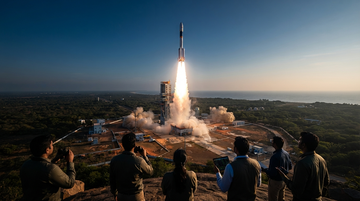
Skyroot's successful Vikram-1 launch matters because orbital access is the gating function for everything that follows in space: satellites, Earth observation, communications, and defense payloads.
Once a private company can reach orbit from India, the market can start to price launch schedules, launch reliability, and launch capacity as commercial inputs rather than as sovereign project milestones.
That is a bigger shift than the rocket itself. It means India has moved one step closer to a real launch-services industry.
Why it matters
Launch capacity is the rare space bottleneck that can still be sold as a product.
That makes the read-through broad. Rocket Lab gets a reminder that the global small-launch market is becoming more competitive. SpaceX gets a reminder that orbital launch leadership is increasingly regional, not absolute. Defense names like Boeing, Northrop Grumman, and Lockheed Martin have to think about how lower-cost launch options affect procurement economics over time.
For satellite operators, the significance is even bigger: more launch providers means more optionality, but it also means the launch market can begin to behave like an industry with price competition and capacity planning.
Skyroot's achievement therefore matters beyond India. It adds another node to the global orbital supply chain.
| Layer | What the launch changes | Why investors care |
|---|---|---|
| Launch providers | More competition | Pricing power may normalize |
| Satellite operators | More launch optionality | Mission timing gets easier to source |
| Defense procurement | More launch alternatives | Cost assumptions can shift |
| Private capital | Proven orbital capability | More willingness to fund the ecosystem |
Read-through
The space economy gets more interesting when access to orbit becomes commercially repeatable.
The market should not treat this as a one-off patriotic headline. The real implication is that India now has a credible private launch lane, which should deepen the ecosystem around components, services, payload integration, and downstream satellite applications.
That also means the market has one more launch geography to price. If launch becomes more available and more competitive, the winners may be the firms that control payload demand, satellite data, and mission integration rather than only the rocket builders.
In that sense, Skyroot is creating another version of the same commercial-space question that SpaceX and Rocket Lab already answer in the U.S.: who owns the right to lift hardware into orbit on schedule?
Skyroot turns Indian space into a commercial launch market
The launch milestone matters because it combines payload success, orbit access, and a large addressable market.
Unit: counts / kilometers / USD billions
Payloads
Mission success
6
Altitude (km)
LEO target
450
Valuation ($B)
Private-market support
1.1
Space economy ($B)
2033 estimate
40
Bottom line
Skyroot's launch is not just India's first private orbital success. It is the moment the market can start pricing launch as a business.
That is the investment implication. A launch provider becomes more interesting once the market believes the service can be repeated, bought, and scaled.
If Vikram-1 proves repeatable, India's private space stack gets a real commercial runway.
That is how a milestone becomes a market.