%22%2F%3E%0A%20%20%3Ccircle%20cx%3D%22220%22%20cy%3D%22150%22%20r%3D%22180%22%20fill%3D%22%2322d3ee%22%20fill-opacity%3D%220.12%22%2F%3E%0A%20%20%3Ccircle%20cx%3D%221010%22%20cy%3D%22130%22%20r%3D%22220%22%20fill%3D%22%2338bdf8%22%20fill-opacity%3D%220.08%22%2F%3E%0A%20%20%3Ccircle%20cx%3D%22920%22%20cy%3D%22520%22%20r%3D%22170%22%20fill%3D%22%2322d3ee%22%20fill-opacity%3D%220.06%22%2F%3E%0A%20%20%3Cpath%20d%3D%22M140%20430h920%22%20stroke%3D%22url(%23line)%22%20stroke-width%3D%2212%22%20stroke-linecap%3D%22round%22%2F%3E%0A%20%20%3Cpath%20d%3D%22M220%20360c120-150%20260-220%20380-220s260%2070%20380%20220%22%20fill%3D%22none%22%20stroke%3D%22%2367e8f9%22%20stroke-opacity%3D%220.5%22%20stroke-width%3D%2216%22%20stroke-linecap%3D%22round%22%20stroke-linejoin%3D%22round%22%2F%3E%0A%20%20%3Cpath%20d%3D%22M300%20398h600%22%20stroke%3D%22%2394a3b8%22%20stroke-opacity%3D%220.24%22%20stroke-width%3D%228%22%20stroke-linecap%3D%22round%22%2F%3E%0A%20%20%3Ctext%20x%3D%22220%22%20y%3D%22510%22%20fill%3D%22%23e2e8f0%22%20fill-opacity%3D%220.7%22%20font-family%3D%22Arial%2C%20Helvetica%2C%20sans-serif%22%20font-size%3D%2238%22%20letter-spacing%3D%228%22%3EINSIGHTS%3C%2Ftext%3E%0A%3C%2Fsvg%3E)
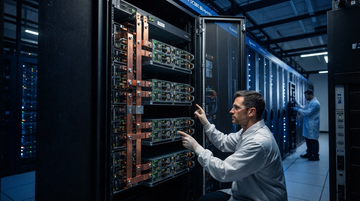
The verified bottleneck shift: from megawatts on the grid to watts inside the rack
Supermicro’s Vera Rubin rack design concentrates power conversion into repeatable, shelf-level modules
AI supply chains have spent the last year pricing grid upgrades and substation capacity. But rack-scale architectures are now forcing the next constraint: how efficiently and compactly you convert and regulate power once it’s inside the building.
Supermicro’s disclosed “DCBBS Blueprints” for the NVIDIA Vera Rubin NVL72 explicitly describe that each NVL72 rack includes four 110 kW power shelves with redundant 18.3 kW power supply units. That turns rack power into a modular, shelf-repeated design problem—where every percentage point of efficiency improvement and every watt saved becomes “real dollars per rack.”
Why 48V, SiC, and VRMs are converging into one stack
The grid-to-GPU chain is becoming multi-stage—and each stage favors different physics
The in-rack stack the market is underpricing usually looks like this:
- Rack entry conversion (often AC/DC with battery backup / ride-through features)
- Intermediate distribution bus (commonly moving to higher-voltage DC like 48V to cut current)
- Point-of-load regulation (VRMs and power-stage conversion)
- High-efficiency switching devices (SiC for higher-voltage/efficiency at high temperature; GaN in some high-frequency roles)
onsemi’s data-center positioning ties these changes to HVDC architecture choices and higher rack densities, noting the shift to 800V HVDC architecture for megawatt-scale AI infrastructure and the efficiency/power-density benefits of higher-voltage DC designs. In other words, the voltage level you choose upstream determines how many conversion losses you pay inside the rack—and what silicon types become viable at the power stage where VRMs and shelf electronics live.
This is also why the “dollars-per-watt war” starts looking less like a one-time design win (grid) and more like a compounding qualification treadmill (rack): higher-voltage architectures and denser shelves increase heat flux, which increases the value of switching devices that can maintain efficiency at higher operating temperatures and with tighter thermal constraints.
The investor-relevant proof points: backlog (grid) + architecture guidance (rack silicon)
Grid-side electrical OEMs are filling backlog, but rack-side power silicon is where the efficiency upgrades compound
Eaton’s disclosed demand signal supports the idea that grid-side electrical build-out is active: in its reporting for Q2 2026, Eaton states strong year-over-year total backlog growth of 43% in the Electrical sector.
That backdrop matters because it funds the availability of high-power electrical infrastructure. But it doesn’t automatically monetize the in-rack conversion efficiency per watt—because the value capture depends on who supplies the shelf/VRM conversion electronics that must run efficiently at very high rack power densities.
Vera Rubin NVL72 rack power shelves
4 × 110 kW
Per Supermicro DCBBS Blueprints for NVL72 racks (Jun 1, 2026), with redundant 18.3 kW power supply units
Eaton Electrical sector backlog growth
+43%
Year-over-year total backlog growth in Electrical sector (Eaton Q2 2026 results release, Jul 31, 2026)
onsemi data-center power architecture focus
800V HVDC
onsemi guidance/positioning on using 800V HVDC architecture for megawatt AI infrastructure (company solutions page)
Supply-chain map (full stack): who builds what, and where margin tends to concentrate
Who captures the upside when rack power scales: SiC/GaN supply devices vs. electrical OEMs vs. rack integrators
- At rack-scale, shelf-level conversion becomes repeatable: Supermicro’s NVL72 specifies multiple 110 kW shelves per rack, creating many “conversion opportunities” per server customer deployment.
- As intermediate distribution moves to higher-voltage DC (48V in many deployments; 400V/800V HVDC in building architectures), conversion losses shift stage-by-stage, increasing the value of efficient switching in VRM/power-stage electronics.
- onsemi emphasizes 800V HVDC architecture benefits for megawatt AI infrastructure; that aligns with demand for switching devices that can reduce conduction and switching losses while supporting higher power density.
- Eaton’s Electrical-sector backlog indicates procurement momentum for grid infrastructure, but the compounding per-watt efficiency wins inside racks are not the same revenue line as grid equipment.
Net takeaway: grid build-out enables deployments; rack conversion efficiency controls how much silicon you need to deliver a given compute-per-watt. That makes power silicon candidates—especially SiC and GaN—structurally better positioned to monetize the upgrade cycle than organizations whose product is primarily a one-time grid interface.
Fundamentals overlay: the sanity check on who is economically built for this cycle
onsemi’s current financial profile supports continued investment in power silicon while revenue swings with semiconductor demand cycles
onsemi has been profitable and generates operating cash flow, but its reported financials also show semiconductor-cycle volatility. For investors focusing on rack-power silicon as the monetization layer, the key isn’t “whether power demand exists”—it’s whether silicon vendors can fund capacity and R&D through cycle bottoms.
From reported annual results: revenue fell from $8.253B (FY2023) to $7.082B (FY2024) and then to $5.995B (FY2025), while operating income declined from $2.538B (FY2023) to $1.768B (FY2024) and further to $0.748B (FY2025). That pattern is consistent with a broader semiconductor downcycle, yet operating cash flow remained positive at $1.978B (FY2025) and free cash flow stayed positive at $1.419B (FY2025).
| Fiscal year | Revenue | Operating income | Operating cash flow | Free cash flow |
|---|---|---|---|---|
| FY2023 | $8.253B | $2.538B | $1.978B | $0.438B |
| FY2024 | $7.082B | $1.768B | $1.906B | $1.212B |
| FY2025 | $5.995B | $0.748B | $1.760B | $1.419B |
What to watch next (short-term vs. long-term)
The “dollars-per-watt” winners show up twice: first in shelf design, later in silicon share
- Near term (days to quarters): watch for more rack-scale blueprints specifying shelf counts and power-supply unit redundancy patterns; those are early indicators of how many power conversion modules a rack buyer will install.
- Near term: track whether HVDC-focused system designs (e.g., 48V/400V/800V architectures) increasingly push conversion into stages that favor SiC/GaN efficiency at high density.
- Long term (1–3 years): silicon share gains should follow if vendors can translate HVDC/megawatt architecture standards into lower wattage per rack for the same compute; that’s where cost-per-rack optimization becomes a buyer budget lever.
- Risk: if platform vendors standardize on a particular power-device ecosystem that is already locked in, new entrants may need longer qualification cycles than compute buyers expect.
Listed stocks most exposed to the rack-power bottleneck transmission channel
- HVDC and megawatt AI rack guidance aligns with higher-efficiency switching needs, supporting a shift in silicon mix toward SiC/GaN-enabled power stages.
- onsemi generated positive operating cash flow in FY2025 ($1.760B operating cash flow) supporting R&D and capacity through the cycle as AI infrastructure scales.
- As rack shelves repeat (e.g., 110 kW shelves per NVL72 rack), power-stage silicon content per rack scales with conversion opportunities, not just with grid MW.
- Eaton’s Q2 2026 disclosure of +43% Electrical-sector backlog growth supports continued grid-side infrastructure spend that enables deployments.
- Grid build-out doesn’t directly monetize in-rack conversion losses; that limits how much Eaton’s revenue can capture per-watt efficiency wars.
- Long-term upside is stronger if Eaton’s product lines increasingly include rack-level power distribution and data-center electrical architectures tied to high-density designs.
- GE Vernova is a known participant in large grid and electrification builds; if utility and data-center power projects accelerate, backlog visibility can expand.
- However, rack-level conversion economics are not disclosed in the sources used here, so the in-rack silicon transmission to earnings is uncertain.
- Watch for disclosures tying electrification projects more explicitly to megawatt AI facilities with standardized HVDC/data-center electrical architectures.
- Flex acts as an OEM/EMS-style integrator across power and computing; rack-power platform demand can increase content per AI deployment.
- But integrators often face pricing pressure when buyers push total cost-per-rack down, which can cap margin expansion even as volumes rise.
- A positive swing would require platform design wins where efficiency upgrades move beyond assembly into proprietary power distribution and shelf electronics.
- Wolfspeed is a pure-play SiC name; if SiC-enabled shelf/VRM designs are validated as the efficiency path, demand could accelerate.
- But FY financial resilience in the data used here shows negative profitability (e.g., negative gross/EBITDA), so execution and funding risk remains material.
- Watch for more megawatt AI power conversion announcements that explicitly connect device adoption to rack bus and power-stage efficiency gains.
- Infineon is positioned across power semiconductors; if HVDC/48V adoption expands, switching-device content per rack can rise.
- However, no primary source in this article ties Infineon to the NVL72 shelf/VRM BOM directly, so the linkage is pending evidence.
- Watch for explicit data-center HVDC and rack-power device supply announcements that specify silicon adoption stages.