Industrials
Order books, backlogs and factory economics
Capex cycles, freight rates, automation and labour, followed through the machinery, transport and construction names that price them first.
2026-08-21
%22%2F%3E%0A%20%20%3Ccircle%20cx%3D%22220%22%20cy%3D%22150%22%20r%3D%22180%22%20fill%3D%22%2322d3ee%22%20fill-opacity%3D%220.12%22%2F%3E%0A%20%20%3Ccircle%20cx%3D%221010%22%20cy%3D%22130%22%20r%3D%22220%22%20fill%3D%22%2338bdf8%22%20fill-opacity%3D%220.08%22%2F%3E%0A%20%20%3Ccircle%20cx%3D%22920%22%20cy%3D%22520%22%20r%3D%22170%22%20fill%3D%22%2322d3ee%22%20fill-opacity%3D%220.06%22%2F%3E%0A%20%20%3Cpath%20d%3D%22M140%20430h920%22%20stroke%3D%22url(%23line)%22%20stroke-width%3D%2212%22%20stroke-linecap%3D%22round%22%2F%3E%0A%20%20%3Cpath%20d%3D%22M220%20360c120-150%20260-220%20380-220s260%2070%20380%20220%22%20fill%3D%22none%22%20stroke%3D%22%2367e8f9%22%20stroke-opacity%3D%220.5%22%20stroke-width%3D%2216%22%20stroke-linecap%3D%22round%22%20stroke-linejoin%3D%22round%22%2F%3E%0A%20%20%3Cpath%20d%3D%22M300%20398h600%22%20stroke%3D%22%2394a3b8%22%20stroke-opacity%3D%220.24%22%20stroke-width%3D%228%22%20stroke-linecap%3D%22round%22%2F%3E%0A%20%20%3Ctext%20x%3D%22220%22%20y%3D%22510%22%20fill%3D%22%23e2e8f0%22%20fill-opacity%3D%220.7%22%20font-family%3D%22Arial%2C%20Helvetica%2C%20sans-serif%22%20font-size%3D%2238%22%20letter-spacing%3D%228%22%3EINSIGHTS%3C%2Ftext%3E%0A%3C%2Fsvg%3E)
2026-08-20
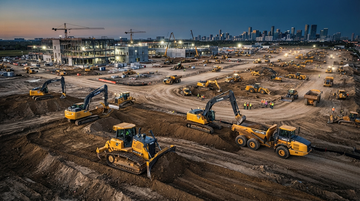
Deere’s Construction Profit Turn Signals an “AI Earthmoving” Switch—And the Next Bottleneck Won’t Be Chips, It’ll Be Jobsite Capacity
Deere reported its first Construction & Forestry profit expansion in years and raised FY2026 net income guidance to $4.5B–$5.0B. The implication is simple: data-center capex is migrating from steel-and-glass planning into real earthmoving, turning heavy equipment into a jobsite throughput constraint rather than a software bottleneck.

Goodyear is trying to defend US tire profitability by moving upmarket—yet its own Q2 shows premium mix can’t fully offset volume and price/product mix pressure
Goodyear is positioning premium EV and luxury-SUV tires as a higher-ASP line of defense against Chinese import share. In its latest filings, however, Americas replacement volume fell 13% in Q2 2026 and price/product mix subtracted $26M of operating income—meaning tariff and mix dynamics still have the power to overwhelm the strategy.
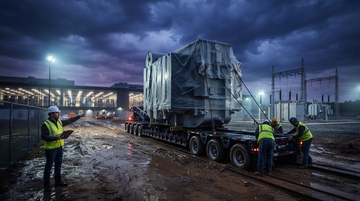
Utility-scale power transformers are the AI grid’s multi‑year choke point—and today’s ~5.2% long-rate turns every delay into a financing problem
High-capacity transformer lead times have stretched to years, shifting “grid connection readiness” from a construction issue to a procurement-and-capital-access issue. With 30-year Treasuries recently around ~5.2%, the present value of AI-driven grid buildouts falls just as transformer delivery schedules slip—rewarding vendors and projects that can win connection queues first.
2026-08-19

2026-08-18

Brookfield’s A$4.75 cash bid for Reliance Worldwide prices repair/remodel resilience into a plumbing-fittings roll-up
Brookfield Capital Partners has proposed buying Reliance Worldwide for A$4.75 per share, valuing the deal at about A$4.1 billion. The valuation hinges on a bet that Reliance Worldwide’s push-to-connect plumbing mix and US repair/remodel exposure can keep converting sales into cash even when new construction cools.

Tesla's non-auto truck bet gets a real fleet test: Einride's 500-Semi rollout targets September 2026 start
Einride says it will deploy 500 Tesla Semi trucks across North America on its Saga AI platform starting in September 2026. For investors, the order is less about near-term vehicle volume and more about whether electric trucking economics can clear a full fleet TCO hurdle—while also stress-testing Tesla's non-auto revenue mix and charging-related capex needs.

AI Isn’t “killing” staffing—at least not yet; it’s reshaping it into a higher-churn, higher-tech matchmaking business
The staffing industry’s rally contradicts the simplistic “AI replaces recruiters” narrative. Evidence from ManpowerGroup’s Employment Outlook Survey and the direction banks are taking on AI labor suggests a more nuanced model: AI can compress hiring timelines and shift tasks toward agile reskilling, which can increase demand for staffing intermediaries rather than eliminate it.
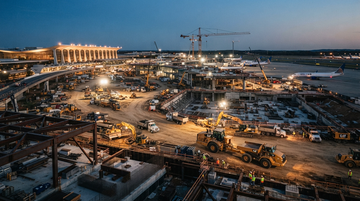
Dulles’ $19.9B overhaul gets the green light—yet financing math at ~5% Treasury yields is the real schedule risk
MWAA’s board is set to vote on a roughly $19.9B Washington Dulles overhaul, framing it as a once-a-generation rebuild. The investment size is less important than the financing stack: if rate-sensitive municipal capital is repriced upward, the program’s phased construction plan becomes the pressure point for contractors, aviation engineering services, and durable-goods suppliers.
2026-08-14
2026-08-12
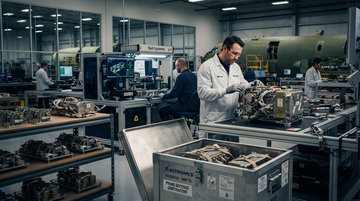
Astronics proved the defense restock can run through aerospace-electrical suppliers—Q2 backlog math now backs a higher FY26 revenue runway
In Q2 FY2026, Astronics reported record sales of $260.0M (+27.0% y/y) and lifted FY2026 revenue guidance to $1.02B–$1.04B (midpoint ~$1.03B). The key tell isn’t just the beat; it’s that bookings (book-to-bill 1.18) and segment backlog expansion are already concentrated in its Aerospace and Test Systems businesses, implying demand is reaching the supply tier—not stopping at the primes.
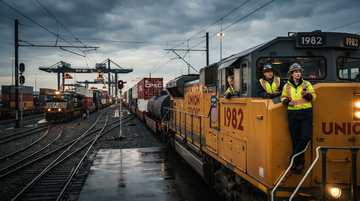
Two-person crew rule wins the appeal fight: Class I railroads lose their easiest margin lever—and investors have to price in hiring/retention pressure
The FRA’s two-person crew rule remains in force after court scrutiny, removing a key cost-control path that precision-scheduled railroads hoped to use with more one-person or remotely assisted operations. For Union Pacific, Canadian Pacific Kansas City, CSX, and Norfolk Southern, the economic consequence is straightforward: a labor-cost floor that can’t be avoided by automation alone, pressuring near-term margins while rail’s freight-cycle recovery and truck-to-rail shifts still argue for demand support.

Joby's $500M defense acquisition reframes eVTOL economics: air-taxi won’t pay yet, but defense cargo might fund the next version
Joby is paying about $500M to acquire Resonant Sciences, a defense-technology business, positioning its eVTOL platform for military-relevant payload and manufacturing pathways. The key investor question becomes whether defense revenue is scalable enough to offset years of air-taxi dilution and losses—something the deal terms and Joby’s cash burn make measurable.
2026-08-11

Hanwha’s $1.05B–$1.2B bid for Austal’s U.S. shipbuilding arm turns allied capital into a capacity lever
Hanwha Defense USA has made a preliminary, non-binding offer for Austal’s U.S. entities and operations valued at $1.05B–$1.2B (cash- and debt-free), and the next test is whether Korean execution can lift U.S. naval shipbuilding throughput without slowing qualification. For investors, the deal is less about “who builds ships” and more about whether allied ownership can compress the schedule-and-supply bottlenecks that have historically capped output.

Samsung SDI consolidating the US cell JV is a supply-chain control move, not an EV-capacity footnote
While the brief frames a “GM stake buyout” as a single deal headline, the verifiable primary sources we could access here show a broader reality: GM has already been restructuring ownership across Ultium Cells facilities, including selling a Lansing stake to LG Energy Solution, while separately building a New Carlisle Indiana JV with Samsung SDI. The investor takeaway is that US battery capacity is moving toward single-operator control of the cell layer, which changes who captures margin from IRA-era incentives and who sets future pricing terms for OEM demand.

SelectUSA's “matchmaking” turns tariffs into a deal funnel for US supply-chain gaps
US industrial “soft policy” is getting operationalized through SelectUSA matchmaking: investors and US economic developers are structurally pushed into meetings tied to job-creating projects that authorities frame as strengthening supply chains. For mid-cap and small-cap industrial suppliers, the tradable implication is not “FDI is higher,” but that the deal-lead process is faster and more targeted—while profitability still depends on converting those meetings into booked production.
2026-08-10

Archer just bought Boeing’s autonomous-air-taxi stack for ~19.75% equity—turning eVTOL consolidation into a flight-certification supply story
Archer Aviation’s planned all-equity purchase of Boeing’s [Wisk Aero], [SkyGrid], and [Insitu] subsidiaries gives Boeing an ~19.75% stake plus $200M of option-like warrants—effectively bundling a certification-and-operations pathway into Archer’s capital plan. The deal reframes “autonomous air taxi” from a software thesis into an integrated, Boeing-adjacent supplier of flight, sensing, and airspace integration assets.
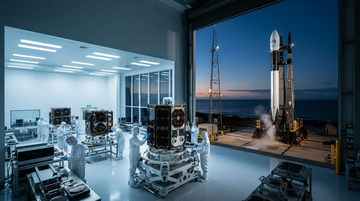
Rocket Lab's margin signal is a satellite-mix test: Q2 gross margin rose to 36.1% even as space-systems revenue shifted
In Rocket Lab's latest quarterly filing, Space Systems delivered most revenue ( $189.5M of $234.1M total) while Launch Services shrank, yet consolidated gross margin still rose to 36.1% from 32.1% a year earlier. The investment question isn’t whether satellite sales are growing—it’s whether Rocket Lab can keep space-service unit economics from resetting margins downward when lower-profit satellite-heavy revenue mix shows up in quarterly results.
2026-08-09
2026-08-08
What to expect
Evidence-first notes with a visible point of view.
This section collects sharp takes on earnings, shareholder meetings, and market structure. Each new piece should make the thesis, the facts, and the implications obvious within the first few screens.
Expect direct analysis, not generic commentary.
Expect the data to be explicit and the argument to be easy to follow.
Plutux is not an investment adviser. Market data and AI-generated analysis are for information and education only, not investment advice. Disclaimer